
Is Renting a Laminator a Better Deal?
Renting suits one-time projects; total fees and repeat use determine whether buying costs less overall.
Key Takeaways
- Rentals can suit a short event or a one-off project.
- Compare the full rental quote, including delivery, return, and protection fees.
- Repeated rentals can cost more than buying an entry-level model; check current prices.
- Consider storage, return steps, and how soon you need access to the machine.
Benefits of Renting a Laminator
Use a machine for a short-term event
Renting can reduce the upfront outlay for a trade show or temporary project. You use the machine for the agreed period without keeping it afterward.
Avoid long-term storage
When the job ends, return the machine instead of storing it. Some rental providers inspect and maintain equipment between rentals; confirm what service the provider includes.
What to Check Before Renting
Calculate the full rental cost
Check the rental fee, delivery and return charges, minimum term, and any optional protection or handling fees. Compare the total with a current purchase price for a similar model.
Read the damage and fault terms
Confirm what happens if the machine is damaged, malfunctions, or arrives with a problem. Check whether a protection plan applies and what costs remain your responsibility.
Allow time for return tasks
Check the return deadline, packaging requirements, and collection or drop-off process. Late returns may add charges under some rental agreements.
When Buying a New Laminator Makes Sense
Compare repeated rental fees with ownership
For recurring use, add the expected rental costs across all projects and compare them with the machine’s purchase price, pouches, and maintenance. A low-cost new model may be less expensive over time, depending on current prices and rental terms.
Keep the machine available
Ownership gives you access when a new job comes up, without arranging another booking. Check the model’s warranty and service terms before buying.
What to Check When Buying New
Match the machine to your document size
Choose an entry width that accommodates your largest planned item.
Check warm-up time
Compare the stated warm-up time with the way you schedule work.
Look for a release function
A release lever or reverse function can help clear a misfeed. Follow the manual’s instructions for the specific model.
Conclusion
Renting can suit a one-time job; buying can make sense when use recurs and the total costs compare favorably. For larger, ongoing production needs, explore our recommendations by production scale using the button below.
[Advertisement]
[By production scale]
Three Fully Automatic Laminators
[By production scale]
Three Fully Automatic Laminators
When choosing a fully automatic laminator, it is important to base your decision on the volume you process in a day rather than the size of the main unit or equipment scale.
This is an introduction to fully automatic laminators that match the workload and operational style of different production scales.
Advertiser Disclosure:
We receive compensation from some of the companies listed below.This compensation may affect which companies are included and the order in which they appear.
[About 100+ sheets per month]
Small-lot production
Small-lot production
GBC Foton 30
(ACCO Brands Corporation)
(ACCO Brands Corporation)
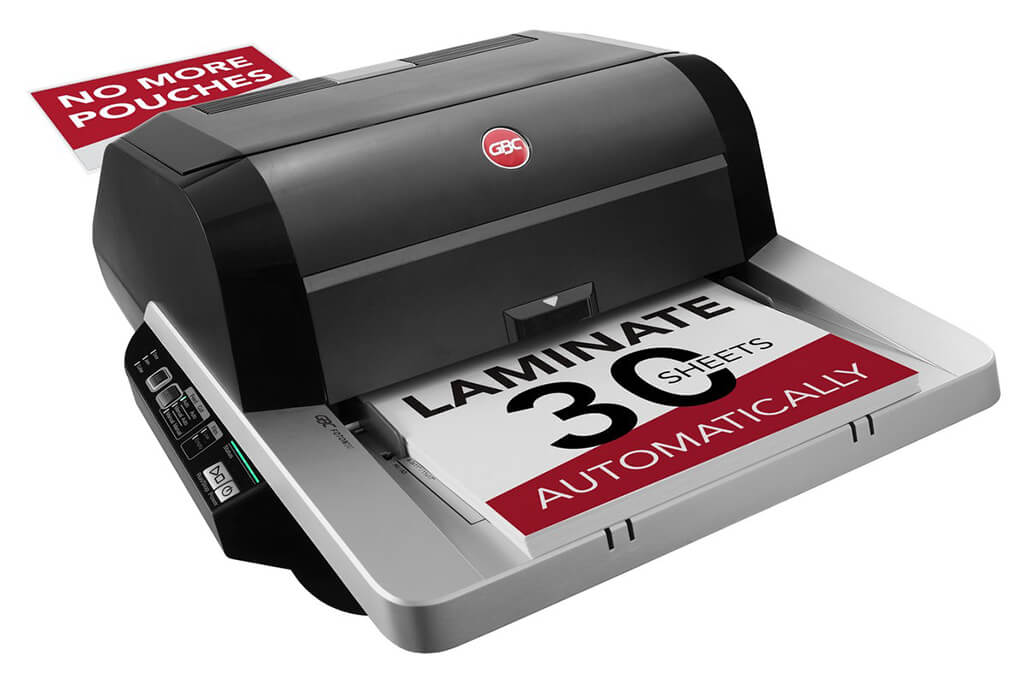
Image Source: ACCO Brands Corporation Official Site
(https://www.gbc-machines.com/products/gbc-foton-30-automatic-laminator)
(https://www.gbc-machines.com/products/gbc-foton-30-automatic-laminator)
Example facilities
Schools, hospitals, municipalities, etc.
Reasons for recommendation
Automates small-scale operations with fewer personnel
- With the push of a button, automatically laminates 30 sheets of A4 paper in 15 minutes. Its size allows it to be placed on a desk, making it easy to install.
- By fully automating the process from feeding to lamination, it enables the handling of jobs with low daily processing volumes in parallel with other operations.
The fact that it does not require dedicated operators or subsequent processes makes it suitable for small-scale sites.
| Maximum processing speed | 7.0 m/min |
|---|---|
| Maximum width | 297 mm (A3 compatible) |
| Warm-up | about 4 minutes |
| Processing type | roll type, double-sided (with borders) |
| Voltage (CE) | AC220 to 240V |
| Main unit dimensions | W 580 mm / D 440 mm / H 250 mm |
[About 1,000+ sheets per month]
Medium-lot production
Medium-lot production
Revo-Flex
(Lami Corporation)
(Lami Corporation)
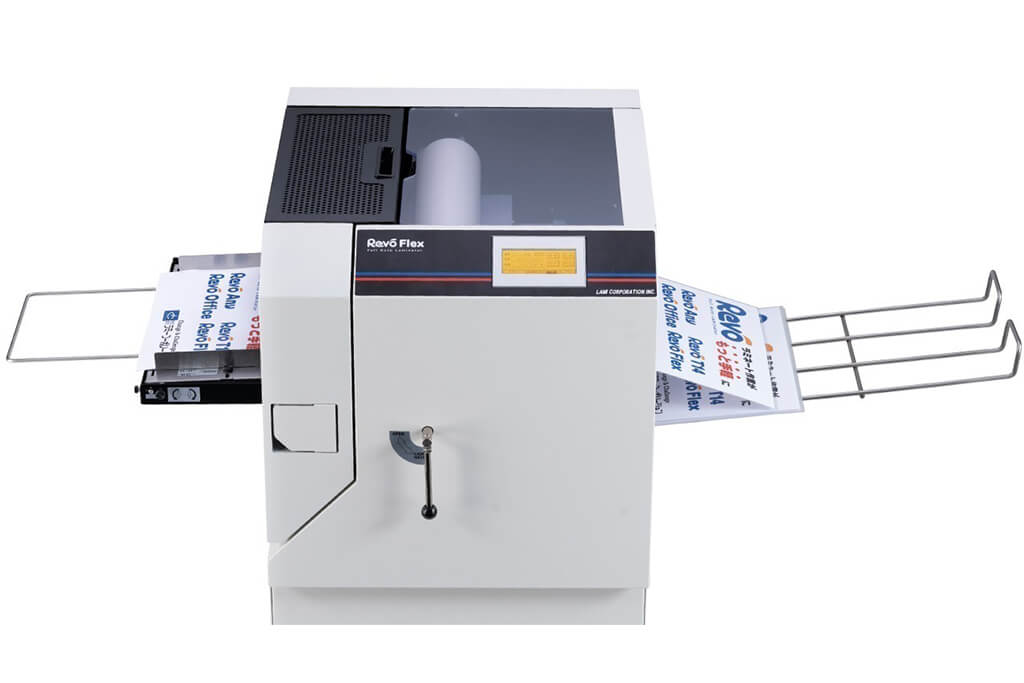
Image source: LAMI Corporation Official Website
(https://www.lami-corporation.co.jp/english/products/detail/51)
(https://www.lami-corporation.co.jp/english/products/detail/51)
Example facilities
Output centers, design offices, franchise headquarters, etc.
Reasons for recommendation
High-mix, fast-turnaround jobs are efficient through process reduction
- Completes trimming simultaneously with lamination, eliminating the need to move to subsequent processes or separate equipment.
Eliminates bottlenecks that tend to occur in on-demand printing and production sites. - High-precision automatic four-side trimming reduces trimming errors resulting from manual work, reducing film loss and the hassle of reprinting.
Even at sites with high-mix, small-lot production, it processes efficiently with consistent quality.
| Maximum processing speed | 2.0 m/min |
|---|---|
| Maximum width | 320 mm (SRA3 standard) |
| Warm-up | about 5 minutes *1 |
| Processing type | roll type, double-sided (border on/off selectable) |
| Voltage (CE) | AC230V |
| Main unit dimensions | W 1,300 mm / D 610 mm / H 1,080 mm *2 |
[10,000+ sheets per month]
High-lot production
High-lot production
Mini 76 TH
(Autobond Laminating)
(Autobond Laminating)
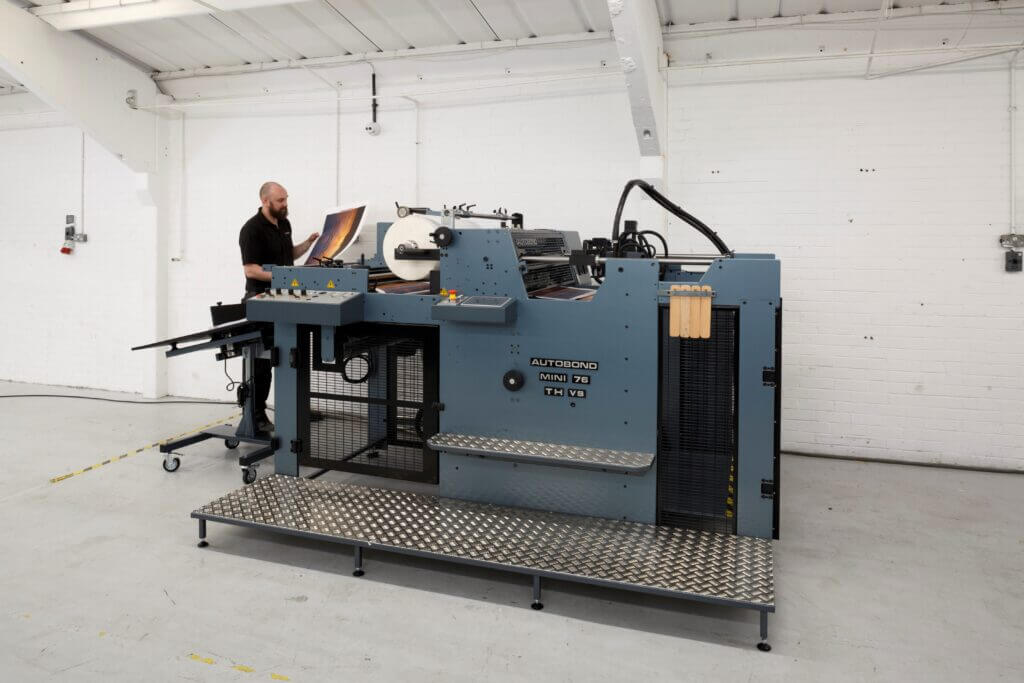
Image source: AUTOBOND Official Website
(https://www.autobondlaminating.com/machinery/thermal-lamination/mini/mini-76-th/)
(https://www.autobondlaminating.com/machinery/thermal-lamination/mini/mini-76-th/)
Example facilities
Printing factories, bookbinding lines, etc.
Reasons for recommendation
High-speed, continuous processing that can be integrated into mass-production lines
- Uses a steel side plate with a thickness of 20 mm described as sturdy like a tank. This rigid structure physically eliminates vibrations even at high-speed operations of 60 m per minute, maintaining stable processing accuracy.
- With a processing capacity of 60 m per minute, it can continuously handle large-format prints stably.
It demonstrates its true value when introduced as a part of a production line rather than as a standalone machine.
| Maximum processing speed | 60.0 m/min |
|---|---|
| Maximum width | 760 mm (B1+ compatible) |
| Warm-up | inquire for details |
| Processing type | roll type, single-sided or double-sided (borderless) |
| Voltage (CE) | inquire for details |
| Main unit dimensions | inquire for details |
*1. At 100°C (212°F) setting
*2. Dimensions when assembled, including the stand, tray, etc.