
Laminator Power and Space Requirements
Index
Three things stop a laminator on delivery day: the circuit trips during warm-up, the crate will not go through the door, or the working footprint turns out to be several hundred millimetres wider than the number on the brochure.
Each one can be a simple check before the order and an expensive problem afterwards.
Key Takeaways
- Warm-up, not running, is when the machine draws the most current. Size the circuit for that peak.
- Published dimensions often describe the machine fully rigged. The space you actually need adds operator access and film changing.
- Voltage and wattage differ between regional builds of the same model, so confirm the figures for the version sold in your market.
- Weight, doorway width and floor level decide whether the machine can be positioned at all. Check them before the order is placed.
The Power Numbers That Matter
Four figures determine the machine's power requirements: rated wattage, supply voltage, single or three phase, and whether the manufacturer requires a dedicated circuit.
Desktop and light production roll laminators generally run from a single-phase supply. Larger production machines, and anything with heated rollers across a wide web, may specify three phase or a higher-rated single-phase circuit. Treat phase as a question to ask rather than an assumption to carry over from an existing machine.
Regional variation is the detail that catches people out. Manufacturers build the same model for different supply voltages depending on the market, and the current draw moves with the voltage even when the wattage does not. A 1,000 W machine draws roughly 10 A on a 100 V supply, 8.3 A on 120 V and 4.3 A on 230 V. The same machine can therefore require a very different circuit arrangement.
Ask the distributor for the figures on the unit they will actually ship, in the voltage of your building, and ask whether that machine may share a circuit with other equipment.
Warm-Up Draws More Than Running Does
Heated rollers pull full load while they come up to temperature. Once they reach the set point the heaters cycle on and off, so steady-state consumption sits below the rated figure. The peak that trips a breaker can occur in the first few minutes after switch-on.
Warm-up on a thermal roll laminator is typically a matter of minutes rather than seconds, and it lengthens with thicker film and higher set temperatures. That is a short burst, but it is enough to trip a shared circuit if a kettle, a heater or another warm-up cycle starts at the same moment.
The practical check is simple: find out what else is on that circuit, and ask the supplier for peak draw rather than accepting the rated wattage as the whole answer. If the room already trips occasionally, treat that as evidence before the machine arrives, not after.
Footprint Is Not the Machine's Width
Published dimensions frequently describe the machine fully rigged — stand, feeder tray, extension tray and stacker all fitted. That is the working size, not the cabinet, and comparing a rigged figure on one machine against a cabinet figure on another produces a misleading shortlist.
Four things sit outside even the rigged dimensions:
- Standing space at the feeder so an operator can load and square a stack
- Clearance at the delivery end for output to stack without the pile fouling the machine
- Side or rear access for changing film rolls, which usually means opening a cover
- Room to open the machine for jam clearing and roller cleaning
Mark the full rigged dimensions on the floor with tape, then walk the loading and unloading positions before committing to a location. A machine that technically fits but cannot be loaded from the front may need to be repositioned.
Heat, Ventilation and What Sits Next to It
Thermal roll laminators run their rollers hot — commonly somewhere in the 80 to 140 °C range depending on film and speed — and that heat comes off the machine into the room. Enclosing one in a cupboard or pushing it against a wall traps it.
Two things should not be placed next to the machine. Paper stock stored beside a heat source picks up curl and loses moisture consistency, which shows up later as feed problems on both the press and the laminator. Equipment with its own thermal limits, including some digital presses and finishing electronics, should not sit in the exhaust path either.
Manufacturers publish minimum clearances for exactly this reason. Get them in writing for the model you are buying and treat them as part of the footprint rather than as a recommendation.
Getting It Through the Door
Desktop and light production laminators are commonly a two-person or trolley move. Production-class machines are a pallet delivery, and the crate is larger than the machine.
Confirm before the order:
- Crated width and height against the narrowest doorway on the route
- Lift dimensions and weight capacity, or whether the route involves stairs
- Floor loading where the machine will stand, particularly above ground level
- Whether the stand is assembled on site or arrives built
- Whether delivery is kerbside, inside the building, or positioned and commissioned
Kerbside delivery of a crated machine to a first-floor studio with no goods lift can create an installation problem that is only discovered on the delivery day.
Site Readiness Checklist
| Item | What to confirm | Ask |
|---|---|---|
| Supply voltage and phase | Matches the build shipped to your market | Distributor |
| Rated and peak current | Peak during warm-up, not just running load | Distributor |
| Dedicated circuit | Whether shared circuits are permitted | Distributor and electrician |
| Socket type and position | Within cable reach of the final machine position | Electrician |
| Rigged dimensions | With stand, trays and stacker fitted | Distributor |
| Minimum clearances | Front, rear and sides, in writing | Manufacturer |
| Crated dimensions and weight | Against doorways, lift and floor loading | Distributor |
| Delivery scope | Kerbside, inside, or positioned and commissioned | Distributor |
FAQs About Laminator Installation Requirements
Q. Can a production laminator run from a standard wall socket?
Some desktop and light production machines can, but it depends on the rated load and what else is on the circuit. Get the peak draw from the supplier and have an electrician confirm the circuit rather than assuming a standard socket is sufficient.
Q. Does a laminator need extraction or ventilation?
Thermal roll laminators do not normally need ducted extraction, but they do need room air movement and the manufacturer's stated clearances. Confirm the requirement for the specific model, since it varies with roller temperature and enclosure design.
Q. How much extra floor space should I allow beyond the published dimensions?
Plan for operator standing space at the feed end and output stacking at the delivery end on top of the rigged dimensions, and check the manufacturer's clearance figures for the sides and rear. Tape the outline on the floor before deciding.
Q. Our building is 230 V but the specification sheet shows a lower voltage. Is that a problem?
It usually means you are reading the specification for a different regional build. Ask the distributor for the sheet covering the unit sold in your market before drawing any conclusion about compatibility.
[Advertisement]
[By production scale]
Three Fully Automatic Laminators
[By production scale]
Three Fully Automatic Laminators
When choosing a fully automatic laminator, it is important to base your decision on the volume you process in a day rather than the size of the main unit or equipment scale.
This is an introduction to fully automatic laminators that match the workload and operational style of different production scales.
Advertiser Disclosure:
We receive compensation from some of the companies listed below.This compensation may affect which companies are included and the order in which they appear.
[About 100+ sheets per month]
Small-lot production
Small-lot production
GBC Foton 30
(ACCO Brands Corporation)
(ACCO Brands Corporation)
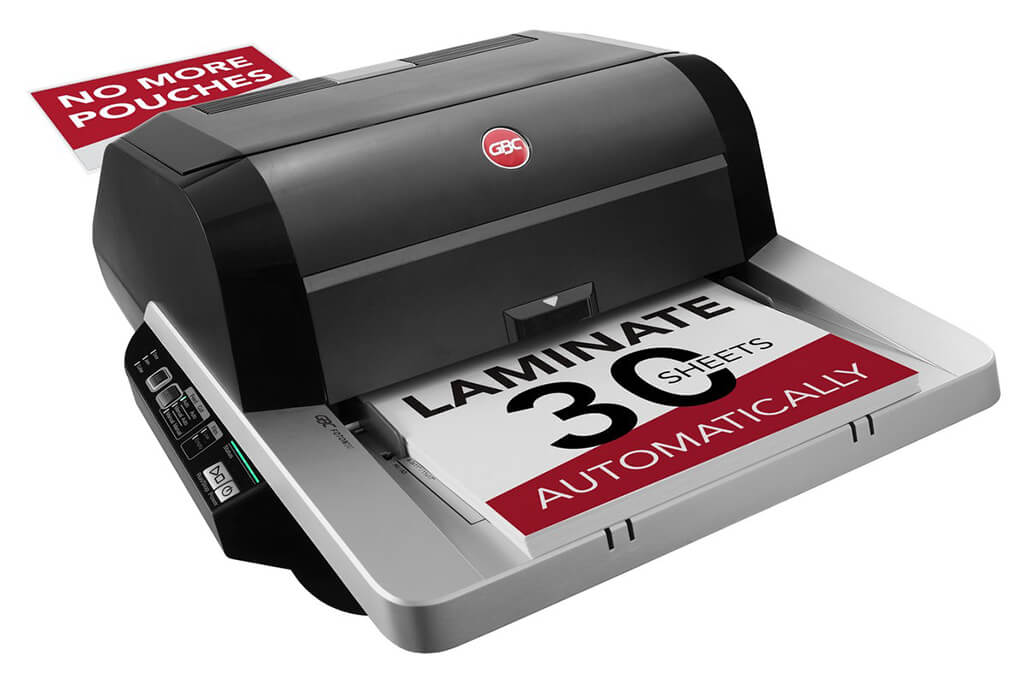
Image Source: ACCO Brands Corporation Official Site
(https://www.gbc-machines.com/products/gbc-foton-30-automatic-laminator)
(https://www.gbc-machines.com/products/gbc-foton-30-automatic-laminator)
Example facilities
Schools, hospitals, municipalities, etc.
Reasons for recommendation
Automates small-scale operations with fewer personnel
- With the push of a button, automatically laminates 30 sheets of A4 paper in 15 minutes. Its size allows it to be placed on a desk, making it easy to install.
- By fully automating the process from feeding to lamination, it enables the handling of jobs with low daily processing volumes in parallel with other operations.
The fact that it does not require dedicated operators or subsequent processes makes it suitable for small-scale sites.
| Maximum processing speed | 7.0 m/min |
|---|---|
| Maximum width | 297 mm (A3 compatible) |
| Warm-up | about 4 minutes |
| Processing type | roll type, double-sided (with borders) |
| Voltage (CE) | AC220 to 240V |
| Main unit dimensions | W 580 mm / D 440 mm / H 250 mm |
[About 1,000+ sheets per month]
Medium-lot production
Medium-lot production
Revo-Flex
(Lami Corporation)
(Lami Corporation)
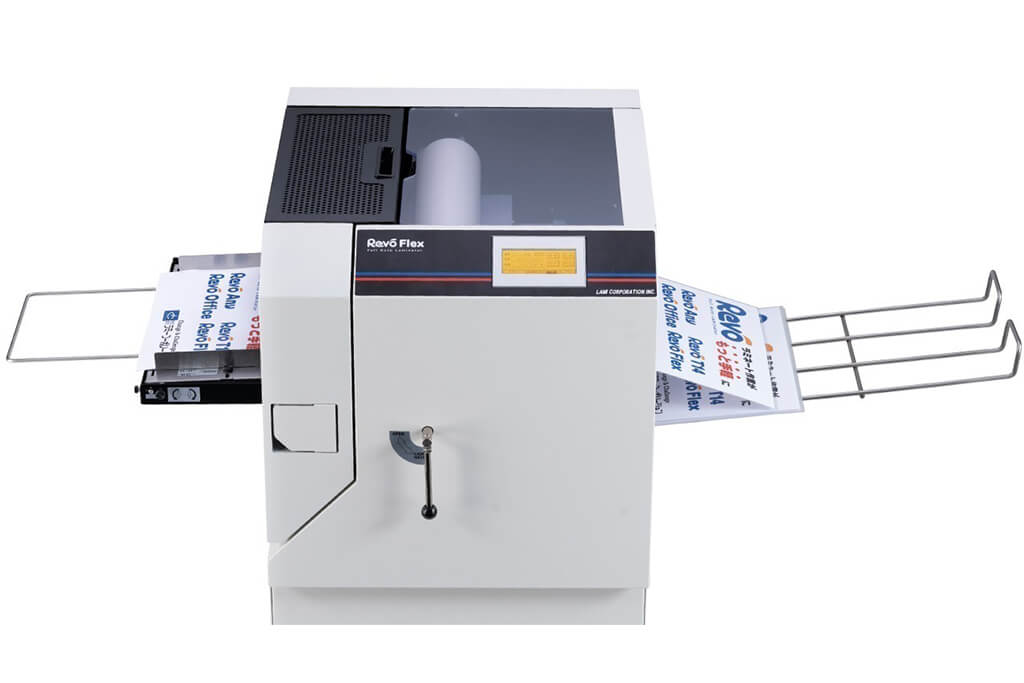
Image source: LAMI Corporation Official Website
(https://www.lami-corporation.co.jp/english/products/detail/51)
(https://www.lami-corporation.co.jp/english/products/detail/51)
Example facilities
Output centers, design offices, franchise headquarters, etc.
Reasons for recommendation
High-mix, fast-turnaround jobs are efficient through process reduction
- Completes trimming simultaneously with lamination, eliminating the need to move to subsequent processes or separate equipment.
Eliminates bottlenecks that tend to occur in on-demand printing and production sites. - High-precision automatic four-side trimming reduces trimming errors resulting from manual work, reducing film loss and the hassle of reprinting.
Even at sites with high-mix, small-lot production, it processes efficiently with consistent quality.
| Maximum processing speed | 2.0 m/min |
|---|---|
| Maximum width | 320 mm (SRA3 standard) |
| Warm-up | about 5 minutes *1 |
| Processing type | roll type, double-sided (border on/off selectable) |
| Voltage (CE) | AC230V |
| Main unit dimensions | W 1,300 mm / D 610 mm / H 1,080 mm *2 |
[10,000+ sheets per month]
High-lot production
High-lot production
Mini 76 TH
(Autobond Laminating)
(Autobond Laminating)
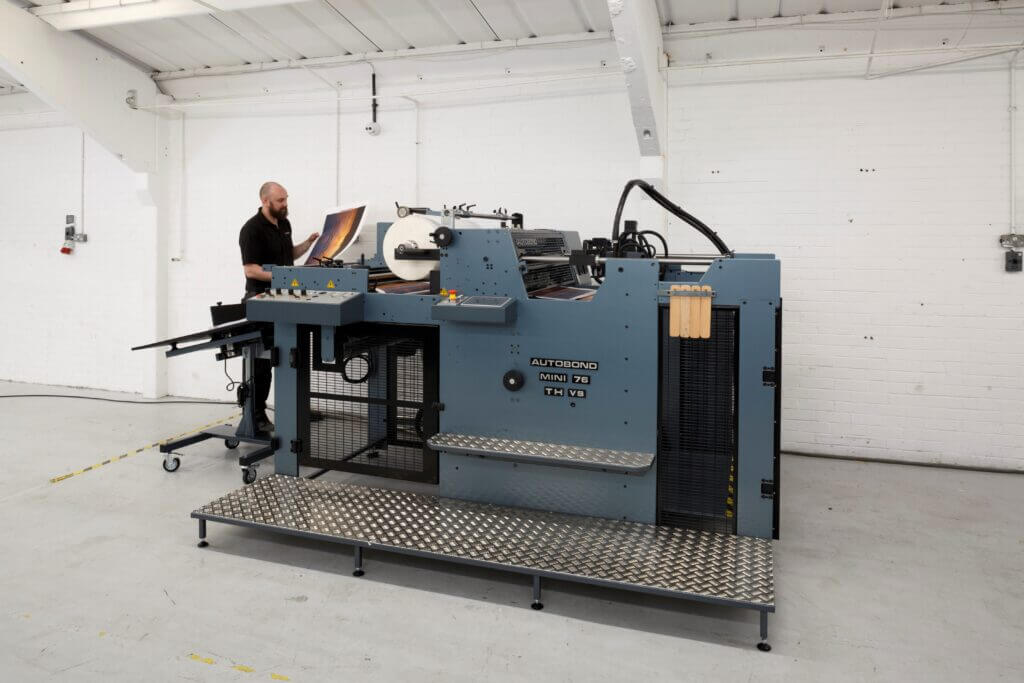
Image source: AUTOBOND Official Website
(https://www.autobondlaminating.com/machinery/thermal-lamination/mini/mini-76-th/)
(https://www.autobondlaminating.com/machinery/thermal-lamination/mini/mini-76-th/)
Example facilities
Printing factories, bookbinding lines, etc.
Reasons for recommendation
High-speed, continuous processing that can be integrated into mass-production lines
- Uses a steel side plate with a thickness of 20 mm described as sturdy like a tank. This rigid structure physically eliminates vibrations even at high-speed operations of 60 m per minute, maintaining stable processing accuracy.
- With a processing capacity of 60 m per minute, it can continuously handle large-format prints stably.
It demonstrates its true value when introduced as a part of a production line rather than as a standalone machine.
| Maximum processing speed | 60.0 m/min |
|---|---|
| Maximum width | 760 mm (B1+ compatible) |
| Warm-up | inquire for details |
| Processing type | roll type, single-sided or double-sided (borderless) |
| Voltage (CE) | inquire for details |
| Main unit dimensions | inquire for details |
*1. At 100°C (212°F) setting
*2. Dimensions when assembled, including the stand, tray, etc.