
Hot Roll Laminator
Index
This article is written for business and professional use.
It introduces the key features of hot-roll laminators and how to choose the right model for workplaces that need both high-quality finishing and high processing capacity.
How Hot-Roll Laminators Work and What They Offer
How they work
A hot-roll laminator heats the film’s heat-activated adhesive layer and uses roller pressure to bond it tightly to the item being laminated. The heat softens and helps the adhesive layer settle, then the rollers press it down evenly to minimise streaking and trapped air bubbles.
This method is well suited to continuous processing with roll film. Because the material can be fed from a roll and run through at a constant speed, it becomes easier to build up output efficiently as volumes increase.
Key features
Hot-roll lamination is known for delivering strong adhesion and high durability. With the surface firmly protected, it helps printed materials that are prone to scuffing, staining, or moisture stay easy to handle while supporting long-term protection.
It also tends to produce excellent clarity and a glossy finish. Colours can look richer and more defined, which is why it is often chosen for attractive finishes on promotional materials and cover applications.
Points to note
Hot-roll systems require warm-up time before operation. They may also be unsuitable for heat-sensitive materials or media that can warp or discolour when exposed to heat, so care is needed when selecting substrates.
Key Installation Environments and Uses for Hot Roll Laminators
Typical installation environments
- Print shops and on-demand printing services
- Copy centres
- Sign and display production sites
- Bookbinding lines and print shops
In environments like these, it is essential to deliver not only an attractive finish, but also consistent throughput to meet deadlines. Equipment that can run continuously with a roll-fed system tends to deliver clear value.
Hot roll lamination is well suited when durability is required, when you need to process large volumes with the same specification in a continuous run, and when you want to prioritise visual quality, such as clarity and gloss, as well as consistent, repeatable results.
Typical applications
- Book and magazine covers
- Menus, POPs, and promotional items
- Posters and display notices
- Finishing printed materials in large production runs
Differences from a Cold Roll Laminator
| Item | Hot Roll Laminator | Cold Roll Laminator |
|---|---|---|
| Bonding method | Heat | Pressure |
| Suitable media | Mainly heat-resistant paper and printed materials | Heat-sensitive materials and media that can warp under heat |
| Finish | Strong adhesion is easier to achieve, making it well suited to a stable, durable protective layer | A softer finish that avoids heat effects, but the surface appearance can sometimes be uneven |
| Suitability for continuous, high-volume work | Many models are designed for mass production | Generally less suited to high-volume processing, though some models support production use |
Neither is inherently “better”. If durability and high-throughput output are priorities, the hot method is a strong fit. If you handle heat-sensitive materials, cold lamination is more suitable.
Pre-purchase Checks
- Compatible media (whether they are heat-resistant)
- Laminating speed and continuous throughput
- Warm-up time
- Ease of operation (manual feed / auto-feeding / fully automatic)
- Installation requirements (power supply, ventilation, and installation space)
In high-volume environments, a fully automatic hot roll laminator is effective on both fronts: it can automate feeding and set-up tasks, improving workflow efficiency while keeping results consistent.
How to think about increased processing frequency
When choosing a laminator, the perspective of processing frequency is essential, alongside sheet size.
As volume increases, time lost to manual feeding and repeated setup accumulates. For business use, this is exactly why automation features become increasingly important.
On this site, we have carefully selected fully automatic laminator models by production scale across different facilities. Use this as a reference when considering your introduction.
FAQs About Hot Roll Laminators
Q. What types of materials are hot roll laminators best suited for?
A. They are ideal for heat-resistant media that is unlikely to deform under heat, such as paper-based items, printed materials, and card stock.
Q. Are they more expensive than cold roll laminators?
A. It depends on the situation.
In high-volume environments, continuous roll-to-roll processing can reduce labour time and rework. In those cases, the hot method may lower the total cost.
On the other hand, if you mainly handle heat-sensitive media and cold lamination is essential, choosing a hot roll laminator can mean more testing and additional countermeasures. This may increase running costs.
Q. What kind of workplaces are fully automatic laminators
best suited for?
A. They are well suited to operations that need labour savings, high-volume throughput, and consistent quality all at once. They are particularly effective for on-demand printing services and copy centres that handle large daily volumes and continuously finish output to the same specifications, as well as print shops that want to standardise finishing quality before and after the binding process.
[Advertisement]
[By production scale]
Three Fully Automatic Laminators
[By production scale]
Three Fully Automatic Laminators
When choosing a fully automatic laminator, it is important to base your decision on the volume you process in a day rather than the size of the main unit or equipment scale.
This is an introduction to fully automatic laminators that match the workload and operational style of different production scales.
Advertiser Disclosure:
We receive compensation from some of the companies listed below.This compensation may affect which companies are included and the order in which they appear.
[About 100+ sheets per month]
Small-lot production
Small-lot production
GBC Foton 30
(ACCO Brands Corporation)
(ACCO Brands Corporation)
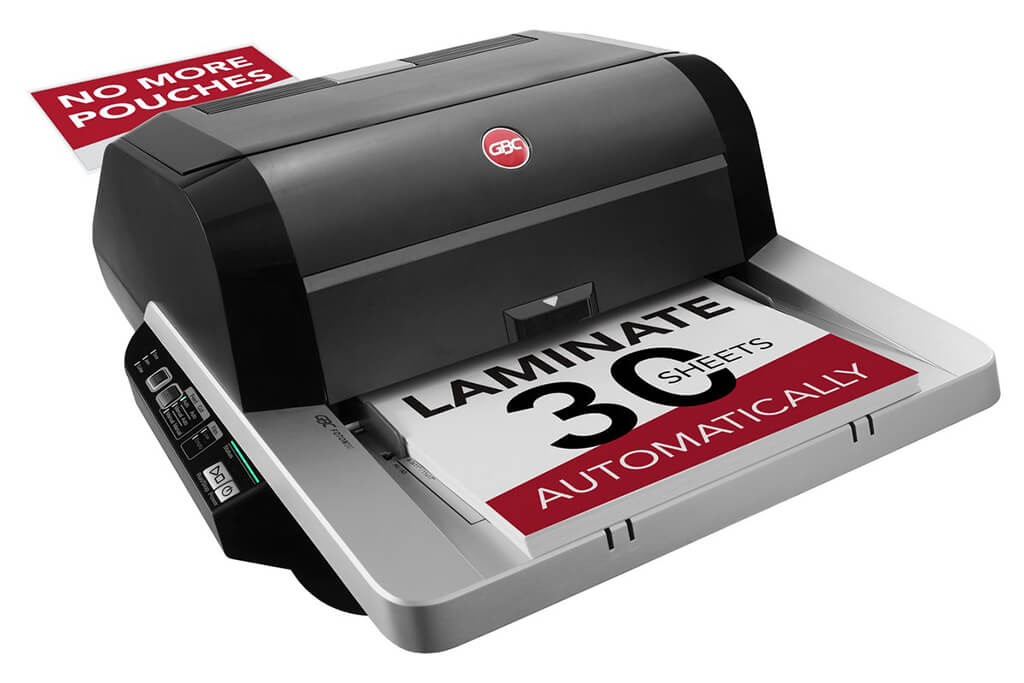
Image Source: ACCO Brands Corporation Official Site
(https://www.gbc-machines.com/products/gbc-foton-30-automatic-laminator)
(https://www.gbc-machines.com/products/gbc-foton-30-automatic-laminator)
Example facilities
Schools, hospitals, municipalities, etc.
Reasons for recommendation
Automates small-scale operations with fewer personnel
- With the push of a button, automatically laminates 30 sheets of A4 paper in 15 minutes. Its size allows it to be placed on a desk, making it easy to install.
- By fully automating the process from feeding to lamination, it enables the handling of jobs with low daily processing volumes in parallel with other operations.
The fact that it does not require dedicated operators or subsequent processes makes it suitable for small-scale sites.
| Maximum processing speed | 7.0 m/min |
|---|---|
| Maximum width | 297 mm (A3 compatible) |
| Warm-up | about 4 minutes |
| Processing type | roll type, double-sided (with borders) |
| Voltage (CE) | AC220 to 240V |
| Main unit dimensions | W 580 mm / D 440 mm / H 250 mm |
[About 1,000+ sheets per month]
Medium-lot production
Medium-lot production
Revo-Flex
(Lami Corporation)
(Lami Corporation)
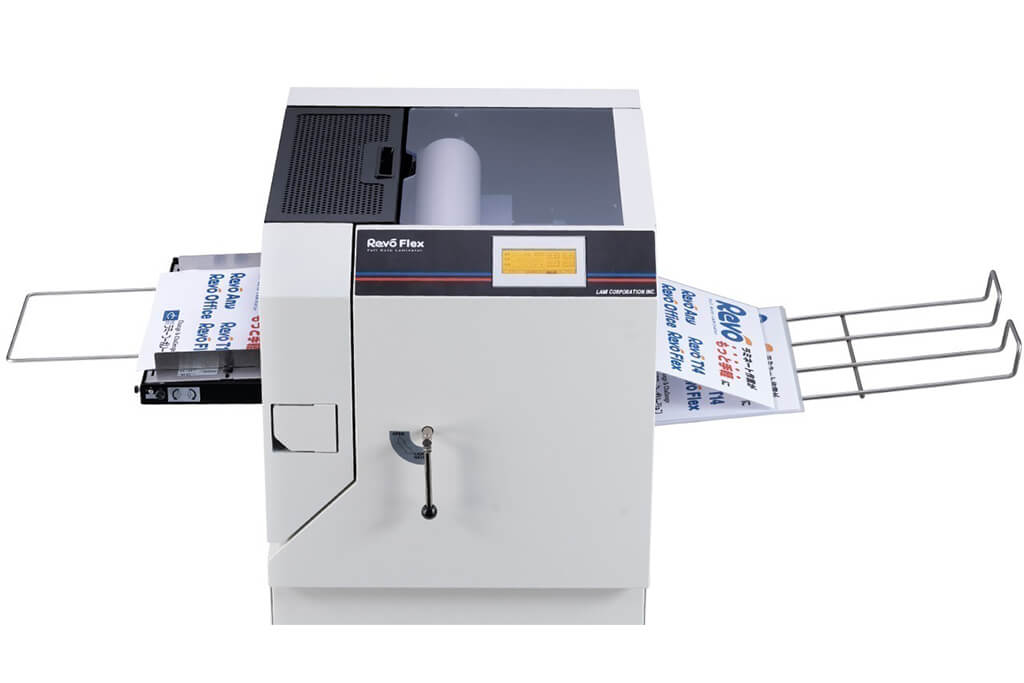
Image source: LAMI Corporation Official Website
(https://www.lami-corporation.co.jp/english/products/detail/51)
(https://www.lami-corporation.co.jp/english/products/detail/51)
Example facilities
Output centers, design offices, franchise headquarters, etc.
Reasons for recommendation
High-mix, fast-turnaround jobs are efficient through process reduction
- Completes trimming simultaneously with lamination, eliminating the need to move to subsequent processes or separate equipment.
Eliminates bottlenecks that tend to occur in on-demand printing and production sites. - High-precision automatic four-side trimming reduces trimming errors resulting from manual work, reducing film loss and the hassle of reprinting.
Even at sites with high-mix, small-lot production, it processes efficiently with consistent quality.
| Maximum processing speed | 2.0 m/min |
|---|---|
| Maximum width | 320 mm (SRA3 standard) |
| Warm-up | about 5 minutes *1 |
| Processing type | roll type, double-sided (border on/off selectable) |
| Voltage (CE) | AC230V |
| Main unit dimensions | W 1,300 mm / D 610 mm / H 1,080 mm *2 |
[10,000+ sheets per month]
High-lot production
High-lot production
Mini 76 TH
(Autobond Laminating)
(Autobond Laminating)
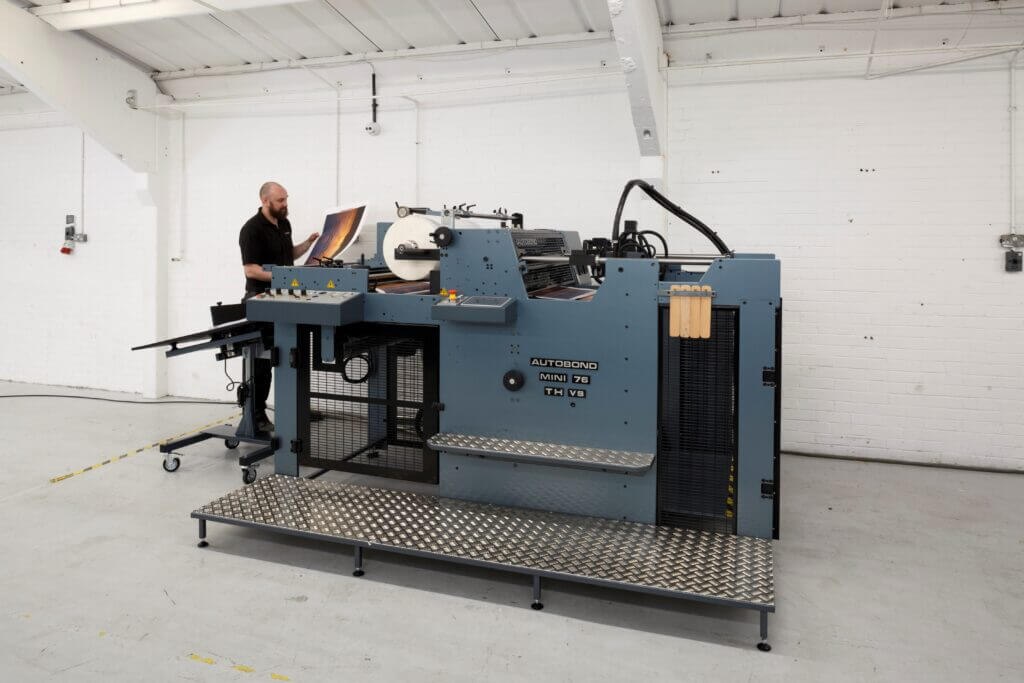
Image source: AUTOBOND Official Website
(https://www.autobondlaminating.com/machinery/thermal-lamination/mini/mini-76-th/)
(https://www.autobondlaminating.com/machinery/thermal-lamination/mini/mini-76-th/)
Example facilities
Printing factories, bookbinding lines, etc.
Reasons for recommendation
High-speed, continuous processing that can be integrated into mass-production lines
- Uses a steel side plate with a thickness of 20 mm described as sturdy like a tank. This rigid structure physically eliminates vibrations even at high-speed operations of 60 m per minute, maintaining stable processing accuracy.
- With a processing capacity of 60 m per minute, it can continuously handle large-format prints stably.
It demonstrates its true value when introduced as a part of a production line rather than as a standalone machine.
| Maximum processing speed | 60.0 m/min |
|---|---|
| Maximum width | 760 mm (B1+ compatible) |
| Warm-up | inquire for details |
| Processing type | roll type, single-sided or double-sided (borderless) |
| Voltage (CE) | inquire for details |
| Main unit dimensions | inquire for details |
*1. At 100°C (212°F) setting
*2. Dimensions when assembled, including the stand, tray, etc.