
Laminators for Offices
Index
We will walk you through how to choose a laminator that supports smoother, more efficient office operations. Because usage frequency and purposes vary from one workplace to another, it is important to identify the model that best fits your organisation.
Benefits of Using a Laminator in the Office
Lamination helps protect presentation materials, internal manuals, and office notices from dirt, creasing, and water damage. With a laminator on hand in the office, you can process documents whenever you need them without worrying about outsourcing costs or turnaround times.
Types of Laminators to Choose Based on Office Usage Frequency
The right type of laminator depends on the size and volume of the printed materials you want to laminate. Over-specifying can drive up costs, while insufficient performance can slow down your workflow. Use the usage frequency guidelines below as a reference to find the best option for your needs.
*The usage frequency examples below are not based on definitive statistics. Please treat them as general guidelines only.
Fewer than 10 sheets per week: Compact pouch laminators
This is a standard type of laminator, sealing printed materials by sandwiching them in a dedicated film and bonding it with heat and pressure. With a small desktop model, you can keep both the initial cost and the required installation space to a minimum. Many options support A4, making them a good fit for small offices that only need to protect a limited number of in-house notices and handouts.
Around 50 sheets per week: High-speed pouch laminators
If you laminate around 50 sheets a week and the time and labour involved are starting to add up, it’s better to invest a little more than you would in a compact unit. Choose a model with a short warm-up time and faster laminating speeds.
These laminators are well suited to departments and mid-sized offices where laminating tasks come up regularly, such as preparing meeting handouts, signage, and manuals.
100+ sheets per week: High-speed roll laminators
The upfront cost is higher than pouch laminators, but film is cheaper per unit, helping you keep running costs down when laminating in bulk. They are a strong fit for offices where printing is a core task, as well as in-house print rooms.
If your workplace is aiming for even greater labour savings and automation, a fully automatic laminator that handles everything from sheet feeding onwards is also worth considering.
What is a fully automatic laminator that automates everything from feeding to laminating?
With standard laminators, you need to feed each sheet manually. That means you cannot step away until the job is finished. If you want to streamline the process further, a fully automatic laminator, which automates everything from feeding to laminating at the press of the start button, is an excellent choice.
On this site, we carefully select and introduce recommended fully automatic laminators based on the production volume of different facilities.
Office Laminator Selection Checklist
Use the checklist below to compare models point by point. If you want an easy-to-use laminator that truly fits your organisation’s needs, review these items before you buy.
| Supported sizes and film thickness | Can it handle the print sizes you want to laminate? Does it support the film thickness you plan to use? |
|---|---|
| Warm-up time | Can you start laminating straight after switching it on, without waiting? |
| Ease of use and automatic settings | Can anyone operate it confidently without getting stuck? Does it offer automatic functions such as thickness detection? |
| Finish quality | Is it less likely to cause rippling or whitening? Does it seal cleanly and evenly? |
| Safety and jam clearance | Is it designed with safety in mind? Can you remove paper jams easily? |
| Installation space and power requirements | Will it fit on a desk? Is it suitable for your office power setup? |
| Cost | Is the purchase price reasonable? Are running costs (film, etc.) reasonable? |
| Maintenance and warranty | Is cleaning straightforward? Is support available if something goes wrong? |
List of Laminators for Office
We have compiled a directory of laminator models developed for office use (this list will be updated regularly).
GBC Foton 30
A fully automatic model built for efficiency
| Maximum width | 297mm (A3 compatible) |
|---|---|
| Maximum processing speed | 700 mm/min |
| Supported film thickness | 75 to 125 μm |
| Warm-up | About 4 minutes |
| Power supply | AC220 to 240 V / 1,084 W |
With a desk-friendly footprint of 577 mm (W) × 478 mm (D) × 245 mm (H), this fully automatic laminator fits comfortably in an office environment. Simply press the start button and it runs the entire process automatically, from sheet feeding through to lamination. It is well suited to offices that regularly produce meeting handouts and display materials.
Leitz iLAM Office A4 Laminator
A compact model that will not crowd your desk area
| Maximum width | 240 mm (A4 compatible) |
|---|---|
| Maximum processing speed | 500 mm/min |
| Supported film thickness | 75 to 125 μm |
| Warm-up | About 1 minute |
| Power supply | AC220 to 240 V / 1,400 W |
This is an A4-only model that laminates using a two-roller system. Its compact design is a key advantage, measuring 130 mm (W) × 75 mm (H) × 370 mm (D). It is well suited to installation in space-limited areas such as reception desks and general administration counters.
Fellowes Amaris A3 Office Laminator
A premium, high-end model for top-quality results
| Maximum width | 320 mm (A3 compatible) |
|---|---|
| Maximum processing speed | 800 mm/min |
| Supported film thickness | 80 to 175 μm |
| Warm-up | About 1 minute |
| Power supply | Not specified on the official website |
With six rollers designed to reduce bubbles and warping, this laminator delivers high-quality finishes for photos and important presentation materials. Alongside its rapid one-minute warm-up and high-speed performance, it also includes a function that alerts you when maintenance is due. It is ideal for offices that refuse to compromise on both speed and quality.
[Advertisement]
[By production scale]
Three Fully Automatic Laminators
[By production scale]
Three Fully Automatic Laminators
When choosing a fully automatic laminator, it is important to base your decision on the volume you process in a day rather than the size of the main unit or equipment scale.
This is an introduction to fully automatic laminators that match the workload and operational style of different production scales.
Advertiser Disclosure:
We receive compensation from some of the companies listed below.This compensation may affect which companies are included and the order in which they appear.
[About 100+ sheets per month]
Small-lot production
Small-lot production
GBC Foton 30
(ACCO Brands Corporation)
(ACCO Brands Corporation)
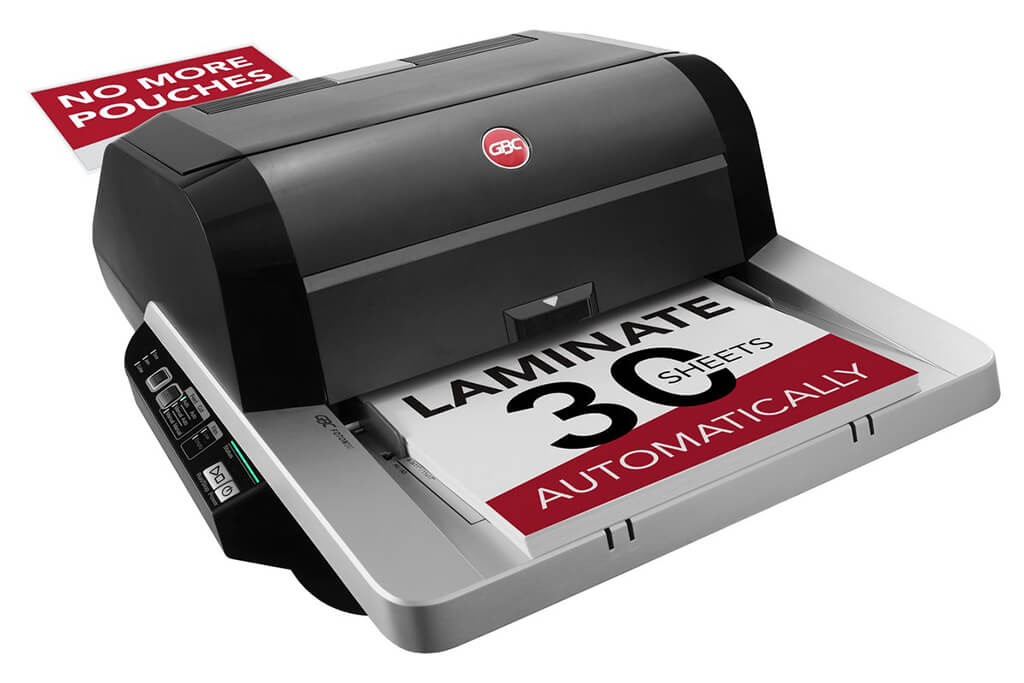
Image Source: ACCO Brands Corporation Official Site
(https://www.gbc-machines.com/products/gbc-foton-30-automatic-laminator)
(https://www.gbc-machines.com/products/gbc-foton-30-automatic-laminator)
Example facilities
Schools, hospitals, municipalities, etc.
Reasons for recommendation
Automates small-scale operations with fewer personnel
- With the push of a button, automatically laminates 30 sheets of A4 paper in 15 minutes. Its size allows it to be placed on a desk, making it easy to install.
- By fully automating the process from feeding to lamination, it enables the handling of jobs with low daily processing volumes in parallel with other operations.
The fact that it does not require dedicated operators or subsequent processes makes it suitable for small-scale sites.
| Maximum processing speed | 7.0 m/min |
|---|---|
| Maximum width | 297 mm (A3 compatible) |
| Warm-up | about 4 minutes |
| Processing type | roll type, double-sided (with borders) |
| Voltage (CE) | AC220 to 240V |
| Main unit dimensions | W 580 mm / D 440 mm / H 250 mm |
[About 1,000+ sheets per month]
Medium-lot production
Medium-lot production
Revo-Flex
(Lami Corporation)
(Lami Corporation)
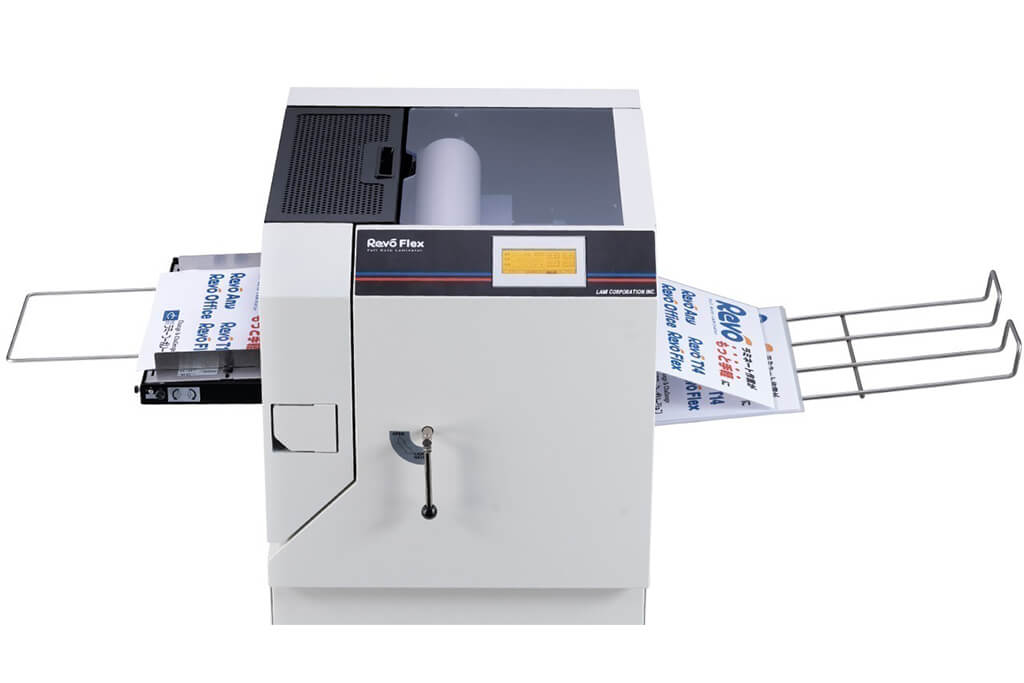
Image source: LAMI Corporation Official Website
(https://www.lami-corporation.co.jp/english/products/detail/51)
(https://www.lami-corporation.co.jp/english/products/detail/51)
Example facilities
Output centers, design offices, franchise headquarters, etc.
Reasons for recommendation
High-mix, fast-turnaround jobs are efficient through process reduction
- Completes trimming simultaneously with lamination, eliminating the need to move to subsequent processes or separate equipment.
Eliminates bottlenecks that tend to occur in on-demand printing and production sites. - High-precision automatic four-side trimming reduces trimming errors resulting from manual work, reducing film loss and the hassle of reprinting.
Even at sites with high-mix, small-lot production, it processes efficiently with consistent quality.
| Maximum processing speed | 2.0 m/min |
|---|---|
| Maximum width | 320 mm (SRA3 standard) |
| Warm-up | about 5 minutes *1 |
| Processing type | roll type, double-sided (border on/off selectable) |
| Voltage (CE) | AC230V |
| Main unit dimensions | W 1,300 mm / D 610 mm / H 1,080 mm *2 |
[10,000+ sheets per month]
High-lot production
High-lot production
Mini 76 TH
(Autobond Laminating)
(Autobond Laminating)
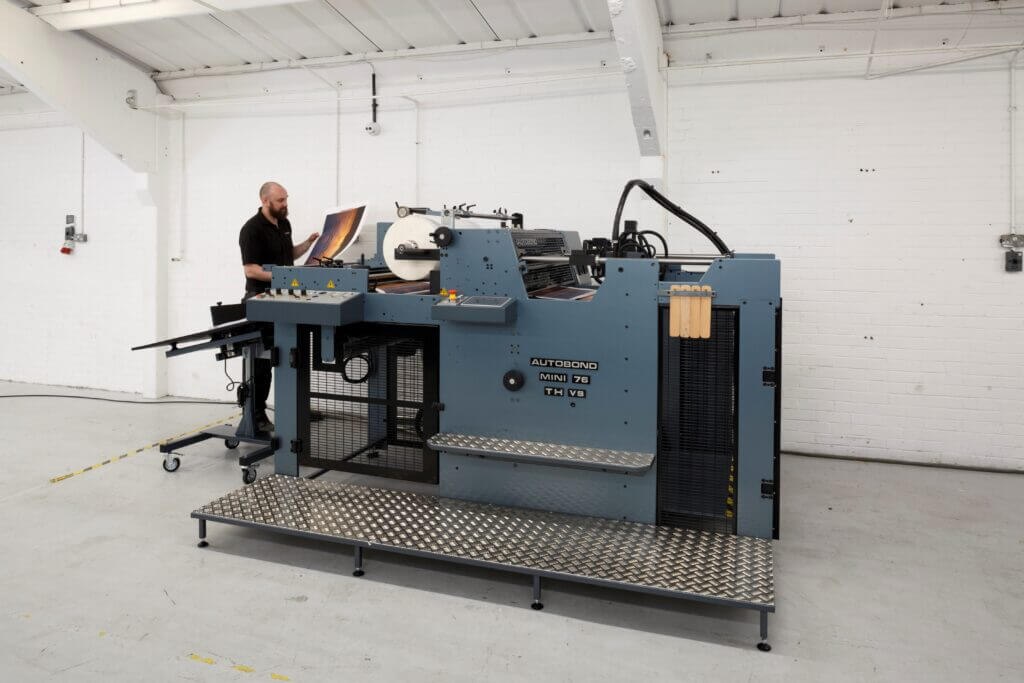
Image source: AUTOBOND Official Website
(https://www.autobondlaminating.com/machinery/thermal-lamination/mini/mini-76-th/)
(https://www.autobondlaminating.com/machinery/thermal-lamination/mini/mini-76-th/)
Example facilities
Printing factories, bookbinding lines, etc.
Reasons for recommendation
High-speed, continuous processing that can be integrated into mass-production lines
- Uses a steel side plate with a thickness of 20 mm described as sturdy like a tank. This rigid structure physically eliminates vibrations even at high-speed operations of 60 m per minute, maintaining stable processing accuracy.
- With a processing capacity of 60 m per minute, it can continuously handle large-format prints stably.
It demonstrates its true value when introduced as a part of a production line rather than as a standalone machine.
| Maximum processing speed | 60.0 m/min |
|---|---|
| Maximum width | 760 mm (B1+ compatible) |
| Warm-up | inquire for details |
| Processing type | roll type, single-sided or double-sided (borderless) |
| Voltage (CE) | inquire for details |
| Main unit dimensions | inquire for details |
*1. At 100°C (212°F) setting
*2. Dimensions when assembled, including the stand, tray, etc.