
Automatic Laminator Hub » Laminator Purchase Guide [by Facility Type] » Industrial Laminators
for Commercial Printing and Bookbinding
for Commercial Printing and Bookbinding
Industrial Laminators
for Commercial Printing and Bookbinding
Index
Industrial laminators are built for high-volume production in commercial print, bookbinding and other finishing environments. When comparing models, consider sheet size, production volume, processing speed, automation, run length and compatibility with your existing workflow. The right configuration can reduce manual handling, improve throughput and support consistent finishing across longer production runs.
What Is an Industrial Laminator?
An industrial laminator is designed for repeated or continuous processing where speed, consistency and automation are important. Depending on the model, it may combine automatic sheet feeding, film unwinding, heat and pressure control, sheet separation, delivery and stacking.
Industrial machines can also accommodate larger formats, including B1 on compatible models. The right machine should therefore be assessed not only by maximum width and speed, but by how well it fits the production process as a whole.
Industrial Laminator vs Heavy-Duty Laminator: What Is the Difference?
The terms “industrial laminator” and “heavy-duty laminator” are sometimes used interchangeably, but they do not always describe the same class of machine.
A heavy-duty laminator generally refers to a machine designed for frequent use and greater durability than a standard office model. This category can include relatively compact machines used in schools, offices, copy shops and print rooms. Industrial laminators, by contrast, are typically specified around production requirements such as larger sheet formats, extended runs, automated handling and higher throughput.
| Heavy-duty laminator | Industrial laminator | |
|---|---|---|
| Typical environment | Offices, schools, copy shops and print rooms | Commercial print, bookbinding and production facilities |
| Primary requirement | Frequent use and durability | Throughput, consistency and production efficiency |
| Sheet handling | Often manual or semi-automatic | Automatic or production-line feeding may be available |
| Format | Typically smaller standard formats | Can include B1 and other large formats |
| Extended runs | Depends on the model | Often designed for longer production runs |
| Line integration | Usually standalone | May be configured with feeders, stackers and other finishing equipment |
For commercial print and bookbinding applications, the key question is not simply whether a machine is described as “heavy duty”, but whether its specifications match the required volume, media, run length and workflow.
Benefits of an Industrial Laminator
Automating sheet feeding, lamination, separation and delivery can reduce manual handling and the scope for operator error. Stable feeding, temperature and pressure also help maintain consistent results during longer runs.
For higher-volume operations, automation can also reduce bottlenecks between printing and downstream finishing, improving productive running time while limiting unnecessary material handling and waste.
How to Choose an Industrial Laminator by Production Volume and Automation Level
Daily volume is a useful starting point, but it should not be considered in isolation. Sheet size, stock thickness, job length, changeover frequency, operating hours and manual handling requirements can all affect the level of capacity and automation required.
The volumes below are general guidelines rather than fixed thresholds. Actual requirements will depend on the jobs and production configuration at each site.
Moderate-volume production: Semi-automatic laminators
For operations processing around 500 sheets per day, a semi-automatic machine may provide sufficient capacity without requiring a fully automated workflow. These models can reduce manual handling while remaining suitable for sites introducing automation in stages.
High-volume production: Fully automatic laminators
At around 1,000 sheets per day or more, reducing manual feeding and delivery can become increasingly important. Fully automatic laminators are suited to operations processing substantial volumes of covers, posters and other printed work where consistent sheet handling is required.
Continuous and large-format production: Fully automatic production-line laminators
For operations processing 1,500 sheets per day or more, particularly where B1 formats, thicker stocks or extended runs are involved, a larger fully automatic system may be more appropriate. At this level, frame rigidity, stable sheet transport and automated feeding and delivery become increasingly important to throughput and production continuity.
What Makes an Industrial Laminator Heavy Duty?
In an industrial setting, “heavy duty” is not defined by a single specification. What matters is whether the machine can maintain stable performance under the required production conditions.
- Rigid construction: A stable frame helps limit vibration and maintain consistent sheet transport and roller pressure at higher speeds.
- Extended-run capability: Drive systems, rollers, heating components and feeding mechanisms need to perform consistently over the required run length.
- Stable temperature and pressure: Consistent operating conditions help maintain adhesion and finishing quality throughout longer jobs.
- Automated feeding and delivery: Pile feeders, sheet separation and stacking can reduce manual intervention as production volumes increase.
- Film capacity: Larger film rolls can reduce changeover frequency during longer jobs.
- Serviceability: Access to rollers, consumable components, spare parts and technical support becomes more important as utilisation increases.
Industrial Laminator Selection Checklist
Compare machines in the context of the complete production process rather than focusing on maximum speed alone.
| Factor | What to check | Why it matters |
|---|---|---|
| Supported sizes and media | Maximum sheet width, B1 compatibility, custom formats, thicker stocks and specialist papers | Determines whether jobs can be processed without additional cutting or handling |
| Processing speed | Rated speed and realistic output under expected production conditions | Shows whether lamination can keep pace with upstream and downstream processes |
| Run requirements | Suitability for the expected length and frequency of production runs | Helps prevent lamination from becoming a bottleneck on longer jobs |
| Film supply | Maximum roll capacity and compatibility with larger rolls | Higher capacity can reduce film changes and increase productive running time |
| Feeding system | Manual, stream, pile or pallet feeding and sheet registration performance | Directly affects throughput, operator workload and misfeeds |
| Delivery system | Jogger, stacker or other automated delivery options | Determines how much manual handling remains after lamination |
| Line integration | Compatibility with presses, cutting equipment and other finishing systems | Allows laminating capacity to be assessed as part of the overall workflow |
| Installation requirements | Footprint, delivery access, electrical supply and compressed-air requirements | Can affect installation planning and cost |
| Maintenance and support | Service access, consumable replacement, spare-parts availability and manufacturer support | Affects uptime and longer-term operating costs |
What Affects the Cost of an Industrial Laminator?
Industrial laminator prices vary considerably because width and processing speed are only part of the specification. Feeder configuration, automation, delivery equipment, installation requirements and after-sales support can all affect the initial investment.
When comparing machines, consider total operating cost as well as purchase price. Labour, changeover time, maintenance, downtime and achievable throughput all affect the cost per processed sheet over the life of the machine.
CHECK
Which Laminator Fits Your Production Requirements?
The right industrial laminator depends on more than processing speed. Sheet size, media compatibility, automation, run requirements, installation conditions and integration with existing equipment should all be considered.
For demanding production environments, compare feeder and delivery performance, film capacity, stability over longer runs and maintenance requirements alongside headline speed.
Industrial Laminator Comparison
The machines below represent different approaches to industrial lamination, from high-speed B1 production to compact multifunction finishing. Compare width and speed alongside feeder design, automation, expandability and intended application.
| Model | Maximum width | Maximum speed | Production feature | Best suited to |
|---|---|---|---|---|
| Autobond Mini 76 TH | 760 mm (B1+ compatible) | 60 m/min | Heidelberg feeder and expandable modular configuration | High-speed B1 production and sites planning future expansion |
| D&K Proteus B1 | 760 mm (B1 compatible) | 35 m/min | Pallet loading and fully automatic operation | High-volume production with large stacks and extended runs |
| IFS Foliant Vega 400A | B3+ compatible | 18 m/min | Compact footprint with optional foiling and varnishing | Operations combining lamination with specialist finishing |
Autobond Mini 76 TH
Expandable model with a Heidelberg feeder
| Maximum width | 760 mm (B1+ compatible) |
|---|---|
| Maximum processing speed | 60 m/min (variable) |
| Feeding | Heidelberg feeder |
| Production design | Expandable modular configuration |
Its 20 mm-thick steel side plates help limit vibration during operation at speeds of up to 60 m/min, supporting stable finishing accuracy.
The modular design also allows options such as a stacker or UV finishing to be added later. It is suited to B1+ production where high speed and scope for future expansion are priorities.
D&K Proteus B1
A fully automatic B1 laminator with pallet feeding
| Maximum width | 760 mm (B1 compatible) |
|---|---|
| Maximum processing speed | 35 m/min (variable) |
| Feeding | Pallet loading |
| Power supply | AC400 V / 10 kW (3-phase) |
The D&K Proteus B1 is designed for both digital and offset output. Pallet loading reduces repeated manual loading on longer production runs, while lateral film-position adjustment allows operators to fine-tune alignment during operation.
It is suited to high-volume sites that need to load large stacks and maintain automated production over extended runs.
IFS Foliant Vega 400A
A compact multifunction machine with foiling and varnishing options
| Supported format | B3+ compatible |
|---|---|
| Maximum processing speed | 18 m/min (variable) |
| Warm-up | About 10 minutes |
| Optional finishing | Hot foiling and spot varnishing |
The IFS Foliant Vega 400A combines an industrial specification with a compact footprint of 82 cm × 220 cm. Its pneumatic high-pressure system is designed to support consistent lamination of digital print.
Optional hot foiling and spot varnishing make it suitable for operations looking to combine lamination and specialist finishing within a compact production setup.
Frequently Asked Questions About Industrial Laminators
How should rated laminating speed be translated into realistic production throughput?
Rated speed should be considered alongside feeder capacity, sheet size, job length, changeover time and downstream handling. A machine may have a high maximum speed but deliver lower effective throughput if loading, alignment, film changes or unloading require frequent operator intervention.
For line planning, compare expected output across the complete process rather than using laminating speed alone.
When does full automation justify the additional investment?
Full automation is most valuable where manual feeding, separation or stacking already constrains output or ties up an operator for extended periods. The case is generally stronger for repeated and longer-run work, where automated handling can be used consistently.
For short jobs with frequent changes of format, stock or film, changeover efficiency may be as important as maximum automation.
What should be validated before specifying a laminator for B1 or heavier stocks?
Check the actual maximum sheet dimensions rather than relying on the format designation alone. Feeding, registration, roller pressure, frame stability and delivery handling should also be assessed under the sheet weights and sizes used in production.
Where possible, representative jobs should form part of the machine evaluation rather than relying solely on headline specifications.
What should be checked before integrating a laminator into an existing production line?
Review sheet flow, feeder and delivery heights, floor space, electrical supply, compressed-air requirements where applicable, and the interface with upstream and downstream equipment.
Also consider buffer space, operator access, film-changing procedures and maintenance access. These practical constraints can affect effective line performance even when individual machines are technically compatible.
How should competing industrial laminators be compared on total cost of ownership?
Compare purchase price with labour requirements, expected utilisation, changeover time, film capacity, utilities, maintenance, spare parts and the operational impact of downtime.
A higher-capacity or more automated machine may reduce cost per processed sheet when utilisation is high enough to make use of that capability. Where volumes are lower, additional speed or automation may provide less economic benefit.
[Advertisement]
[By production scale]
Three Fully Automatic Laminators
[By production scale]
Three Fully Automatic Laminators
When choosing a fully automatic laminator, it is important to base your decision on the volume you process in a day rather than the size of the main unit or equipment scale.
This is an introduction to fully automatic laminators that match the workload and operational style of different production scales.
Advertiser Disclosure:
We receive compensation from some of the companies listed below.This compensation may affect which companies are included and the order in which they appear.
[About 100+ sheets per month]
Small-lot production
Small-lot production
GBC Foton 30
(ACCO Brands Corporation)
(ACCO Brands Corporation)
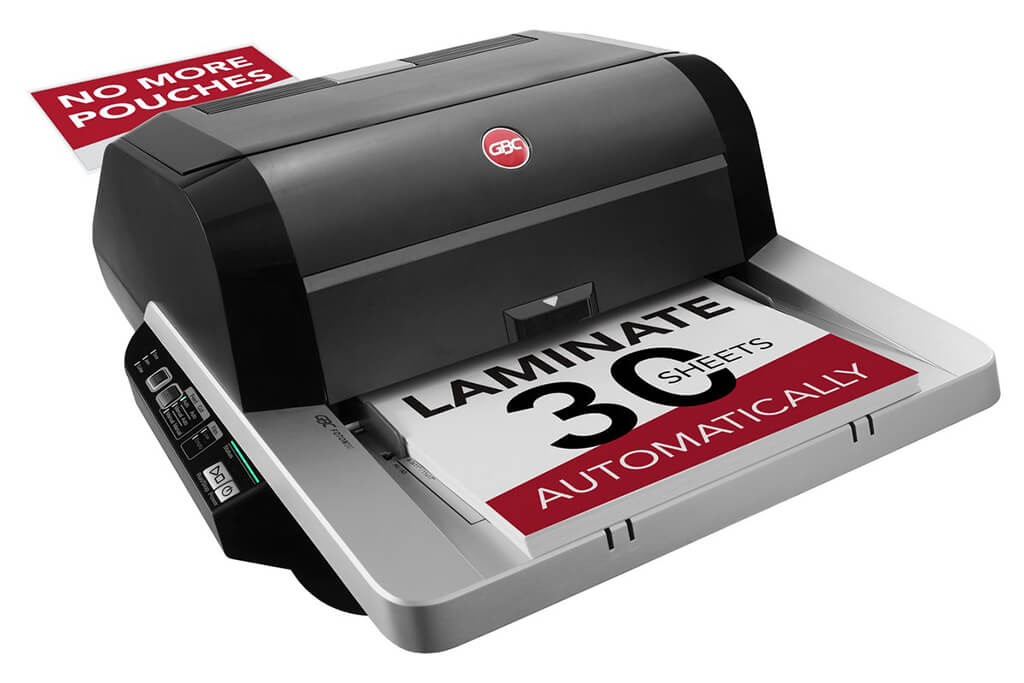
Image Source: ACCO Brands Corporation Official Site
(https://www.gbc-machines.com/products/gbc-foton-30-automatic-laminator)
(https://www.gbc-machines.com/products/gbc-foton-30-automatic-laminator)
Example facilities
Schools, hospitals, municipalities, etc.
Reasons for recommendation
Automates small-scale operations with fewer personnel
- With the push of a button, automatically laminates 30 sheets of A4 paper in 15 minutes. Its size allows it to be placed on a desk, making it easy to install.
- By fully automating the process from feeding to lamination, it enables the handling of jobs with low daily processing volumes in parallel with other operations.
The fact that it does not require dedicated operators or subsequent processes makes it suitable for small-scale sites.
| Maximum processing speed | 7.0 m/min |
|---|---|
| Maximum width | 297 mm (A3 compatible) |
| Warm-up | about 4 minutes |
| Processing type | roll type, double-sided (with borders) |
| Voltage (CE) | AC220 to 240V |
| Main unit dimensions | W 580 mm / D 440 mm / H 250 mm |
[About 1,000+ sheets per month]
Medium-lot production
Medium-lot production
Revo-Flex
(Lami Corporation)
(Lami Corporation)
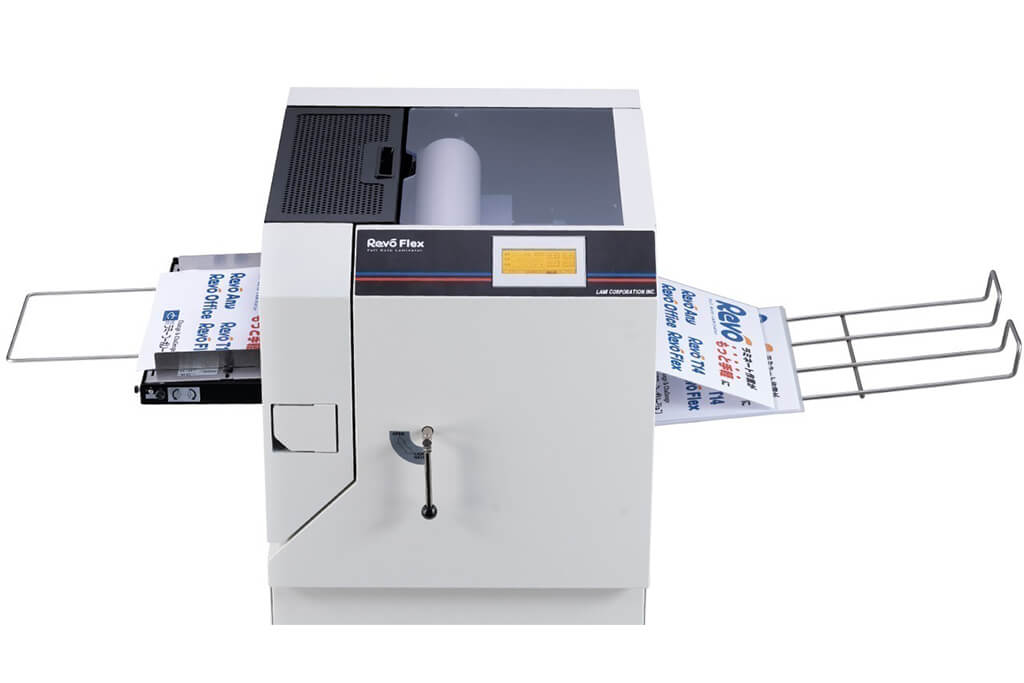
Image source: LAMI Corporation Official Website
(https://www.lami-corporation.co.jp/english/products/detail/51)
(https://www.lami-corporation.co.jp/english/products/detail/51)
Example facilities
Output centers, design offices, franchise headquarters, etc.
Reasons for recommendation
High-mix, fast-turnaround jobs are efficient through process reduction
- Completes trimming simultaneously with lamination, eliminating the need to move to subsequent processes or separate equipment.
Eliminates bottlenecks that tend to occur in on-demand printing and production sites. - High-precision automatic four-side trimming reduces trimming errors resulting from manual work, reducing film loss and the hassle of reprinting.
Even at sites with high-mix, small-lot production, it processes efficiently with consistent quality.
| Maximum processing speed | 2.0 m/min |
|---|---|
| Maximum width | 320 mm (SRA3 standard) |
| Warm-up | about 5 minutes *1 |
| Processing type | roll type, double-sided (border on/off selectable) |
| Voltage (CE) | AC230V |
| Main unit dimensions | W 1,300 mm / D 610 mm / H 1,080 mm *2 |
[10,000+ sheets per month]
High-lot production
High-lot production
Mini 76 TH
(Autobond Laminating)
(Autobond Laminating)
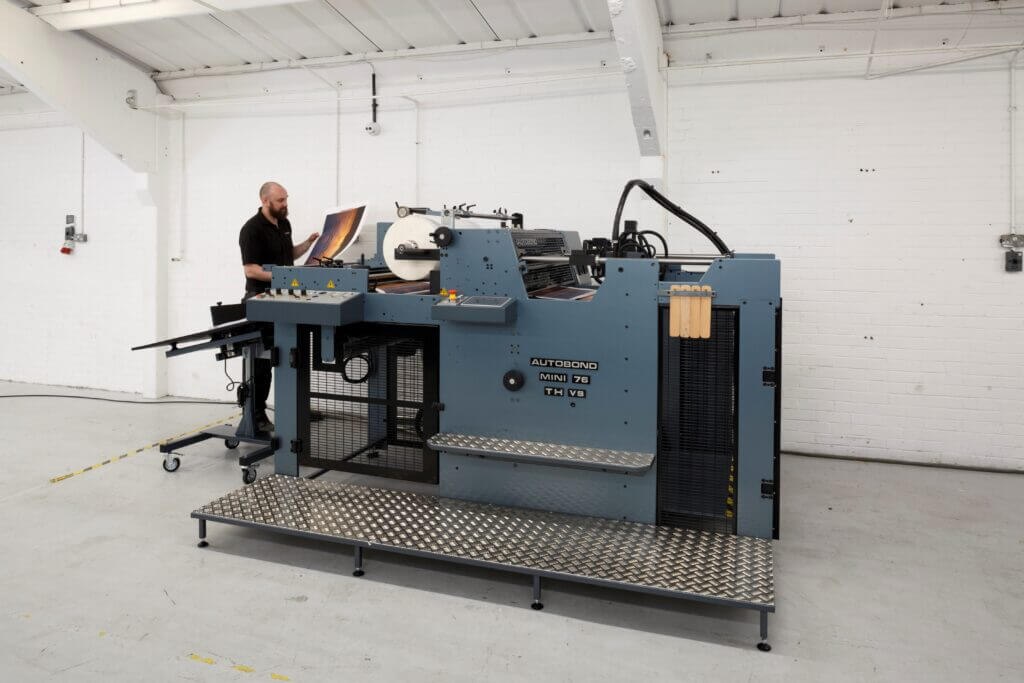
Image source: AUTOBOND Official Website
(https://www.autobondlaminating.com/machinery/thermal-lamination/mini/mini-76-th/)
(https://www.autobondlaminating.com/machinery/thermal-lamination/mini/mini-76-th/)
Example facilities
Printing factories, bookbinding lines, etc.
Reasons for recommendation
High-speed, continuous processing that can be integrated into mass-production lines
- Uses a steel side plate with a thickness of 20 mm described as sturdy like a tank. This rigid structure physically eliminates vibrations even at high-speed operations of 60 m per minute, maintaining stable processing accuracy.
- With a processing capacity of 60 m per minute, it can continuously handle large-format prints stably.
It demonstrates its true value when introduced as a part of a production line rather than as a standalone machine.
| Maximum processing speed | 60.0 m/min |
|---|---|
| Maximum width | 760 mm (B1+ compatible) |
| Warm-up | inquire for details |
| Processing type | roll type, single-sided or double-sided (borderless) |
| Voltage (CE) | inquire for details |
| Main unit dimensions | inquire for details |
*1. At 100°C (212°F) setting
*2. Dimensions when assembled, including the stand, tray, etc.