
Recyclable Laminating Film
Index
Three different properties are commonly described as "recyclable": film that can be separated in a paper re-pulping system, film certified for recovery through industrial composting, and plastic film that can be recycled as plastic once it has been separated.
They are not interchangeable, and a client's sustainability requirement usually specifies which route is required. Choosing the wrong one can result in a job that meets a stated requirement but is not accepted by the relevant recycling or composting system.
Key Takeaways
- Repulpable, compostable and recyclable-as-plastic are three separate properties. Establish which one the job requires before shortlisting film.
- EN 13432 covers packaging designed for recovery through composting and biodegradation under defined conditions. It is not a home composting claim and not a litter claim.
- Oxo-degradable film is restricted in the EU, so it is not a route for work sold into that market.
- Confirm the film runs on your machine — temperature window, thickness range and film system — before you specify a grade to a client.
Three Different Claims Sold as One Word
| Claim | What it means | What happens at end of life | Evidence to ask for |
|---|---|---|---|
| Repulpable | The laminated sheet can go into a standard paper re-pulping system | Fibre is recovered; film residue is screened out during processing | Re-pulping test data and the mill conditions it was tested under |
| Compostable | The film breaks down under controlled composting conditions | Processed at an industrial composting facility, not in household waste | Certification to DIN EN 13432 or equivalent |
| Recyclable as plastic | The film itself is a recyclable polymer | Only recovered if it is mechanically separated from the paper first | Polymer type and whether local streams accept it |
The distinction matters because the three routes need different waste infrastructure. A compostable film in a paper recycling stream is not composted, and a repulpable film in a household compost bin does not break down.
Cellulose-Based Films and What EN 13432 Certifies
Cellulose diacetate films are an established alternative to conventional OPP lamination. Celloglas markets Cellogreen on this basis: a cellulose film made from highly refined wood pulp sourced from SFI-managed forests and offered in gloss, matt and satin finishes. The company describes the appearance as similar to OPP lamination and states that the film is certified to DIN EN 13432 and can be shredded and recycled or composted under specified conditions.
Bio-based films made from renewable feedstocks such as corn starch and sugarcane are the other branch. LAM'ON, for example, markets a bio-based compostable film and states that it breaks down in six weeks under industrial composting.
Read EN 13432 for what it is. The standard covers packaging designed for recovery through composting and biodegradation under defined conditions, including controlled composting conditions. It does not certify that the film degrades in a garden compost heap, in landfill, or in the environment, and marketing copy that blurs those conditions is worth querying.
Why the EU Restricted Oxo-Degradable Film
Oxo-degradable laminating film typically consists of polyolefin film with additives intended to promote fragmentation rather than biodegradation. The resulting fragments are still plastic, which is why the approach lost regulatory support.
The EU Single-Use Plastics Directive, Directive (EU) 2019/904, restricts products made from oxo-degradable plastic. For products within the scope of the directive, this rules out oxo-degradable plastic regardless of how it is described commercially.
Confirm the current position with your own compliance contact before relying on this for a specific product category, since scope and national implementation vary.
Will It Run on Your Machine?
Switching film grade changes the process, not just the material. Three checks decide whether a sustainable grade is practical on the equipment you already have.
Temperature window
Cellulose and bio-based films often have a different processing window from standard OPP. Running them at your usual setting can under-bond the film or distort the sheet, so ask for the recommended temperature and speed and expect to re-profile the job.
Thickness range
Check the grade against the micron range your machine is rated for. A laminator specified for 38 to 150 µm film, for instance, rules out anything outside that band whatever its environmental credentials.
Film system
Some automatic laminators are specified to run the manufacturer's own film. That is how they hold adhesion, trimming accuracy and feed reliability consistent from run to run, and it removes a common source of variation. If you have a particular sustainable grade in mind, ask the manufacturer early whether that option exists within their film range, or whether they can qualify the grade you want — before the specification goes to the client.
Whichever route you take, run a trial on the actual printed stock. Toner and inkjet surfaces behave differently from offset under a new adhesive, and our guide to choosing laminating rolls and films covers the variables to hold constant during the test.
If the Printed Job Is Packaging, PPWR Applies
The EU Packaging and Packaging Waste Regulation, Regulation (EU) 2025/40, applies from 12 August 2026. Its definition of packaging is broad, reaching items such as labels affixed directly to products as well as conventional packs.
The distinction matters for finishers. A laminated folding carton, sleeve or wrap is packaging and falls within scope. A laminated menu, report cover or reference card would generally fall outside the packaging definition when it is not used to contain, protect, handle, deliver or present a product. For packaging, recyclability moves from a customer preference to a regulated design question, which changes who signs off the film choice.
Scope, transition dates and the detail of the design requirements should be confirmed with your legal or compliance contact for the specific product and market. Treat this section as a flag to check, not as a compliance position.
What to Ask a Film Supplier
- Which of the three claims applies — repulpable, compostable, or recyclable as plastic
- Which standard the claim is certified to, and by which body
- Whether composting claims assume industrial conditions
- Re-pulping test data, and the mill conditions used in the test
- Recommended temperature and speed settings for your machine type
- Available thicknesses and widths against your machine's rated range
- Whether the grade has been run with the printing process you use
- Shelf life and storage conditions, which are often tighter than for OPP
FAQs About Recyclable Laminating Film
Q. Can laminated paper go in normal paper recycling?
Conventional plastic laminate has to be separated mechanically before the fibre can be recovered, and some mills will not accept it. Films designed to re-pulp are intended to remove that step, but confirm with the mill or waste contractor that handles your stream.
Q. Is compostable film the same as biodegradable film?
No. Compostable film is certified to break down within a defined time under defined conditions. Biodegradable is a looser term with no implied timeframe, and it is the word most often used without supporting certification.
Q. Does a recyclable film look different from standard lamination?
Cellulose films are marketed as visually similar to OPP and are supplied in gloss, matt and satin finishes. Ask for a sample laminated on your own stock rather than a supplier swatch, since the paper affects the result.
[Advertisement]
[By production scale]
Three Fully Automatic Laminators
[By production scale]
Three Fully Automatic Laminators
When choosing a fully automatic laminator, it is important to base your decision on the volume you process in a day rather than the size of the main unit or equipment scale.
This is an introduction to fully automatic laminators that match the workload and operational style of different production scales.
Advertiser Disclosure:
We receive compensation from some of the companies listed below.This compensation may affect which companies are included and the order in which they appear.
[About 100+ sheets per month]
Small-lot production
Small-lot production
GBC Foton 30
(ACCO Brands Corporation)
(ACCO Brands Corporation)
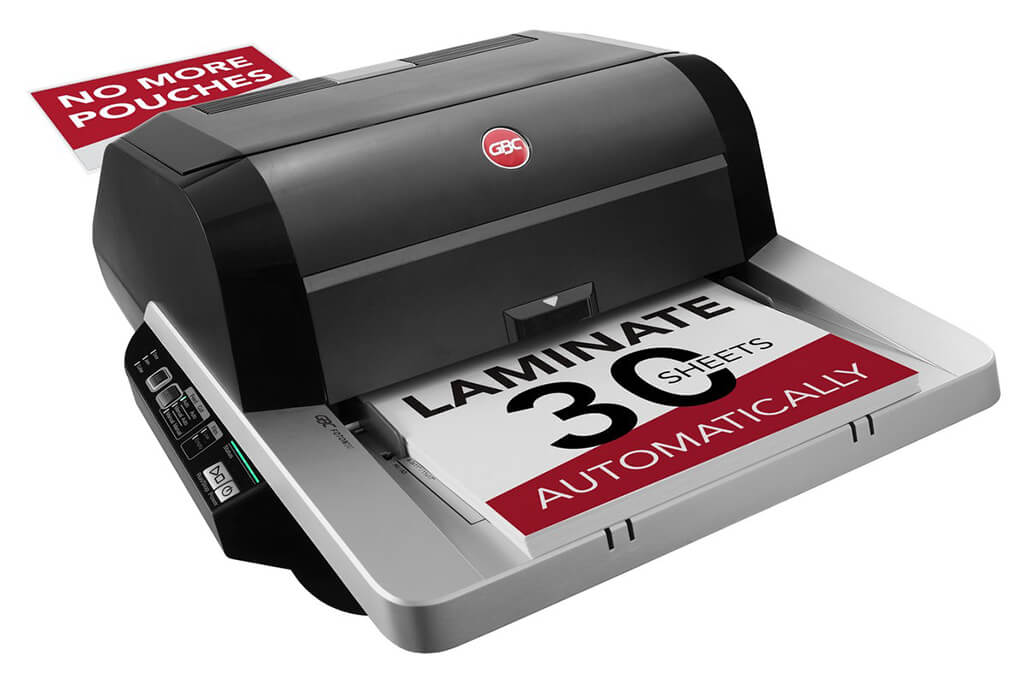
Image Source: ACCO Brands Corporation Official Site
(https://www.gbc-machines.com/products/gbc-foton-30-automatic-laminator)
(https://www.gbc-machines.com/products/gbc-foton-30-automatic-laminator)
Example facilities
Schools, hospitals, municipalities, etc.
Reasons for recommendation
Automates small-scale operations with fewer personnel
- With the push of a button, automatically laminates 30 sheets of A4 paper in 15 minutes. Its size allows it to be placed on a desk, making it easy to install.
- By fully automating the process from feeding to lamination, it enables the handling of jobs with low daily processing volumes in parallel with other operations.
The fact that it does not require dedicated operators or subsequent processes makes it suitable for small-scale sites.
| Maximum processing speed | 7.0 m/min |
|---|---|
| Maximum width | 297 mm (A3 compatible) |
| Warm-up | about 4 minutes |
| Processing type | roll type, double-sided (with borders) |
| Voltage (CE) | AC220 to 240V |
| Main unit dimensions | W 580 mm / D 440 mm / H 250 mm |
[About 1,000+ sheets per month]
Medium-lot production
Medium-lot production
Revo-Flex
(Lami Corporation)
(Lami Corporation)
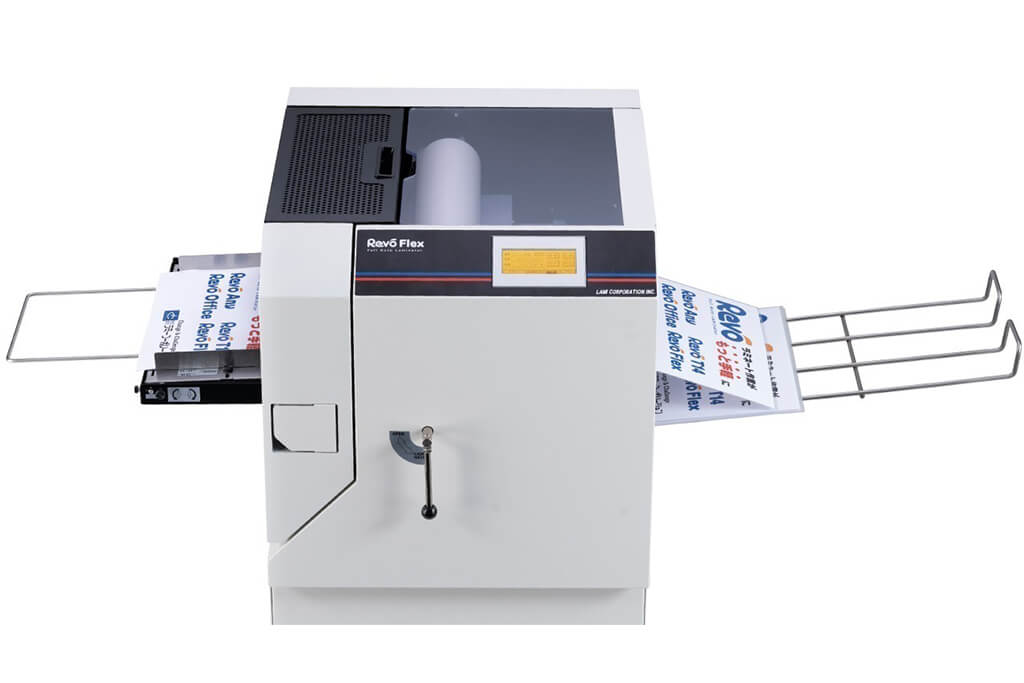
Image source: LAMI Corporation Official Website
(https://www.lami-corporation.co.jp/english/products/detail/51)
(https://www.lami-corporation.co.jp/english/products/detail/51)
Example facilities
Output centers, design offices, franchise headquarters, etc.
Reasons for recommendation
High-mix, fast-turnaround jobs are efficient through process reduction
- Completes trimming simultaneously with lamination, eliminating the need to move to subsequent processes or separate equipment.
Eliminates bottlenecks that tend to occur in on-demand printing and production sites. - High-precision automatic four-side trimming reduces trimming errors resulting from manual work, reducing film loss and the hassle of reprinting.
Even at sites with high-mix, small-lot production, it processes efficiently with consistent quality.
| Maximum processing speed | 2.0 m/min |
|---|---|
| Maximum width | 320 mm (SRA3 standard) |
| Warm-up | about 5 minutes *1 |
| Processing type | roll type, double-sided (border on/off selectable) |
| Voltage (CE) | AC230V |
| Main unit dimensions | W 1,300 mm / D 610 mm / H 1,080 mm *2 |
[10,000+ sheets per month]
High-lot production
High-lot production
Mini 76 TH
(Autobond Laminating)
(Autobond Laminating)
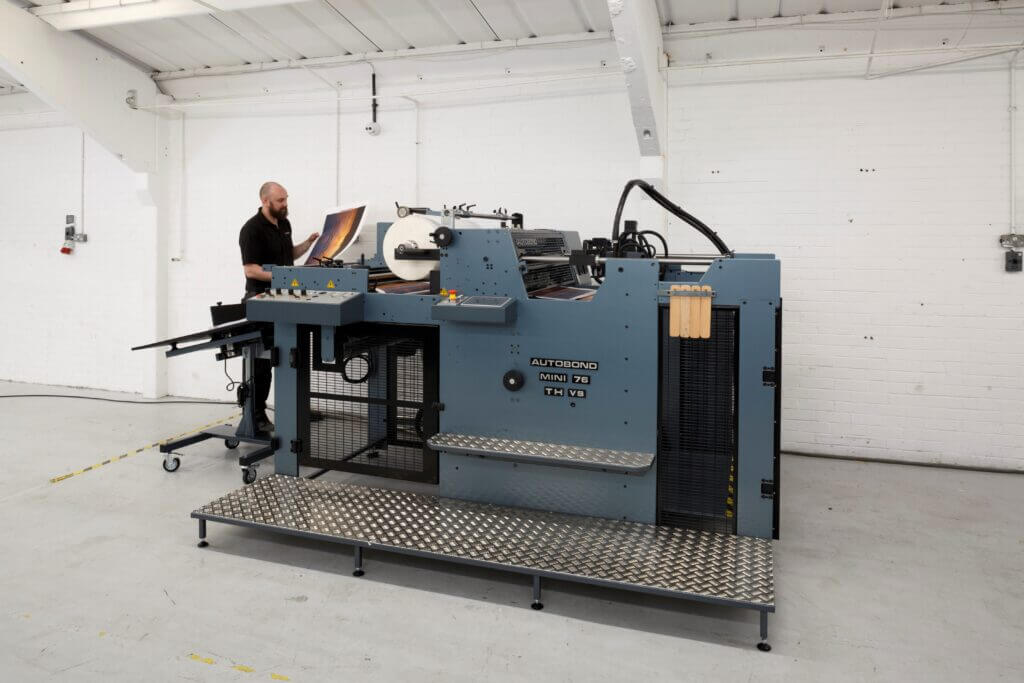
Image source: AUTOBOND Official Website
(https://www.autobondlaminating.com/machinery/thermal-lamination/mini/mini-76-th/)
(https://www.autobondlaminating.com/machinery/thermal-lamination/mini/mini-76-th/)
Example facilities
Printing factories, bookbinding lines, etc.
Reasons for recommendation
High-speed, continuous processing that can be integrated into mass-production lines
- Uses a steel side plate with a thickness of 20 mm described as sturdy like a tank. This rigid structure physically eliminates vibrations even at high-speed operations of 60 m per minute, maintaining stable processing accuracy.
- With a processing capacity of 60 m per minute, it can continuously handle large-format prints stably.
It demonstrates its true value when introduced as a part of a production line rather than as a standalone machine.
| Maximum processing speed | 60.0 m/min |
|---|---|
| Maximum width | 760 mm (B1+ compatible) |
| Warm-up | inquire for details |
| Processing type | roll type, single-sided or double-sided (borderless) |
| Voltage (CE) | inquire for details |
| Main unit dimensions | inquire for details |
*1. At 100°C (212°F) setting
*2. Dimensions when assembled, including the stand, tray, etc.