
Lamination vs UV Coating
Index
UV coating cracks at the spine. A laminated cover folds without splitting because the film acts as a flexible hinge, while cured UV resin is brittle and has no elasticity along the fold.
That difference often determines the choice for covers and folders. What is left to decide is run length, the finish you want to hand the client, and what happens to the sheet at end of life.
Key Takeaways
- If the piece folds — covers, folders, menus — film protects the fold and UV resin does not.
- UV coating adds almost no measurable thickness and is usually cheaper per unit once run lengths get long.
- Film gives gloss, matte, soft touch, textured and metallic finishes. UV coating gives gloss and matte.
- They are not exclusive. Spot UV applied over matte lamination is a standard combination, not a compromise.
What Each Finish Does to the Sheet
Lamination bonds a plastic film to the printed sheet with an adhesive layer. The film adds measurable thickness and seals the printed surface, and laminating both sides encapsulates the sheet for water resistance.
UV coating is a liquid applied to the surface and cured instantly under ultraviolet light. It forms a hard resin layer, adds almost no thickness, and leaves the raw paper edges exposed.
That structural difference drives the practical one. Film encases the sheet, so moisture, grease and dirt stay out. A UV coat is a surface barrier, so a spill that reaches a cut edge is absorbed into the paper as normal.
Folding Decides It for Covers
Cured UV resin splits at the fold because it has no give. On a perfect-bound cover the crack appears along the spine score, and it shows most on dark solids where the white paper core opens up.
Laminated film bends with the paper instead of resisting it. This is why presentation folders, pocket folders, perfect-bound covers and folded menus are normally laminated rather than UV coated.
Film choice still matters within lamination. Polyester (PET) film is more rigid than the polypropylene grades and can be too stiff for folding work, so specify the film with the fold in mind rather than assuming any laminate will do.
Cost Behaves Differently by Run Length
UV coating is generally the cheaper route per unit on long runs. At several thousand units the liquid coat costs less per sheet than film plus adhesive, and it runs at press speed.
The costs that do not appear on a per-sheet quote are also worth considering on the UV side. Coating chemicals need regular replenishment, coating lines are flushed out at the end of each day, and the process brings ventilation, labour and safety requirements with it.
Lamination carries a steeper equipment investment and a higher material cost per sheet because of the adhesive layer. Against that, an automatic laminator can reduce operator time, and modern systems can reach operating temperature in a few minutes rather than requiring a long warm-up period.
Short to mid runs where the finish is part of the product usually land on lamination. Very high runs where the sheet only needs light protection usually land on UV.
Finish Options You Can Actually Order
UV coating offers two visual effects: gloss and matte. Film offers gloss and matte as well, plus soft touch, textured grades such as linen, leather and grit patterns, and metallic or holographic effects.
Laminated sheets also accept a second round of decoration. Gluing, embossing, overprinting and variable-data foiling can be used on a laminated surface, which makes lamination a common base finish for premium packaging and other high-end printed materials.
Spot UV is the case where the two processes combine rather than compete. Applying spot UV over a matte laminate gives a raised gloss highlight against a flat background, and it is an effective way to lift a logo or a single graphic on an otherwise matte cover.
Recycling and End-of-Life
UV coated stock can move through standard paper recycling more simply than some laminated stock, because the cured resin is a thin surface layer rather than a separate film. Conventional laminated stock carries a plastic film that can complicate fibre recovery and recycling.
Film technology has moved on this point. Some cellulose-based laminating films are certified to DIN EN 13432, a standard covering packaging recoverable through composting and biodegradation. However, certification does not by itself mean that a laminated sheet is suitable for conventional paper recycling, so the specific film and disposal route still need to be checked.
Where the printed piece is packaging rather than print, recyclability is now a regulated design question in the EU rather than a client preference. Check the requirement for the market the job is sold into before specifying either finish.
Which Finish Suits Which Job
| Job | Usual choice | Why |
|---|---|---|
| Perfect-bound book and report covers | Lamination | Spine fold; UV resin cracks along the score |
| Presentation and pocket folders | Lamination | Multiple folds plus repeated handling |
| Menus and reference cards | Lamination, both sides | Wiped clean; encapsulation seals the edges |
| Direct mail and postcards | UV coating | High volume, short life, low abrasion demand |
| Magazines and newsletters | UV coating | Run length dominates the cost |
| Luxury packaging and premium catalogues | Matte lamination plus spot UV | Tactile base finish with a gloss highlight |
FAQs About Lamination and UV Coating
Q. Can spot UV be applied over gloss lamination as well as matte?
It can, but the effect is weaker. The contrast that makes spot UV read comes from gloss against a flat background, so matte laminate is the usual base.
Q. Does lamination change the printed colour?
Some films and thicknesses shift the appearance, and matte grades in particular can leave artwork looking slightly muted. Ask for a laminated proof on the actual stock if colour is critical.
Q. Which finish is better for a cover that has to survive a year of handling?
Lamination. A UV coat can rub off with regular use and leaves the cut edges unprotected, which shows first on corners and spine.
[Advertisement]
[By production scale]
Three Fully Automatic Laminators
[By production scale]
Three Fully Automatic Laminators
When choosing a fully automatic laminator, it is important to base your decision on the volume you process in a day rather than the size of the main unit or equipment scale.
This is an introduction to fully automatic laminators that match the workload and operational style of different production scales.
Advertiser Disclosure:
We receive compensation from some of the companies listed below.This compensation may affect which companies are included and the order in which they appear.
[About 100+ sheets per month]
Small-lot production
Small-lot production
GBC Foton 30
(ACCO Brands Corporation)
(ACCO Brands Corporation)
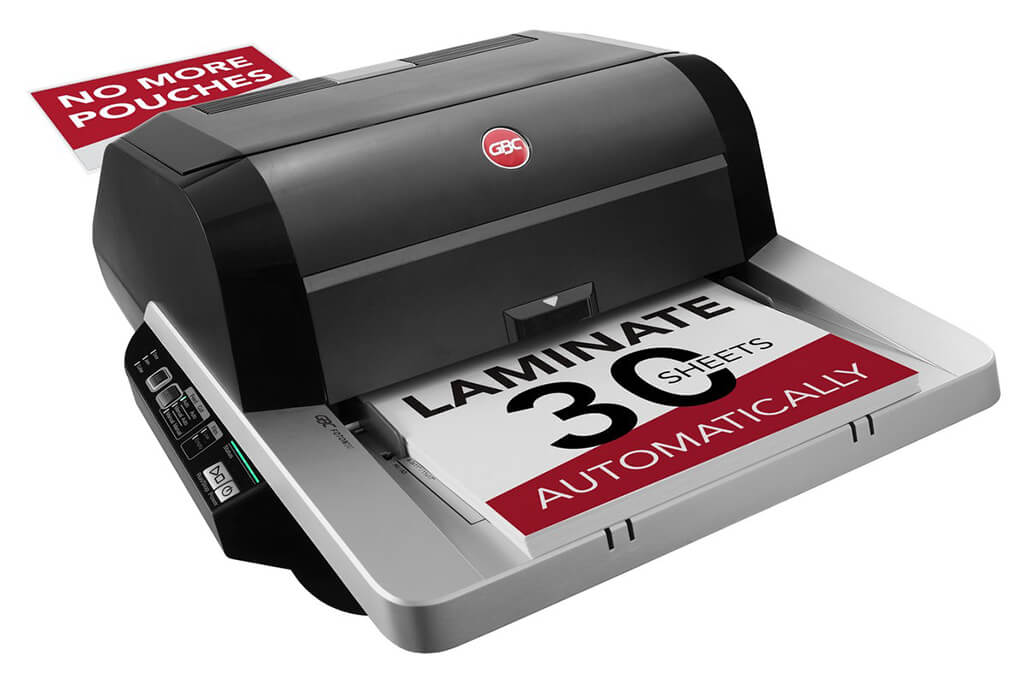
Image Source: ACCO Brands Corporation Official Site
(https://www.gbc-machines.com/products/gbc-foton-30-automatic-laminator)
(https://www.gbc-machines.com/products/gbc-foton-30-automatic-laminator)
Example facilities
Schools, hospitals, municipalities, etc.
Reasons for recommendation
Automates small-scale operations with fewer personnel
- With the push of a button, automatically laminates 30 sheets of A4 paper in 15 minutes. Its size allows it to be placed on a desk, making it easy to install.
- By fully automating the process from feeding to lamination, it enables the handling of jobs with low daily processing volumes in parallel with other operations.
The fact that it does not require dedicated operators or subsequent processes makes it suitable for small-scale sites.
| Maximum processing speed | 7.0 m/min |
|---|---|
| Maximum width | 297 mm (A3 compatible) |
| Warm-up | about 4 minutes |
| Processing type | roll type, double-sided (with borders) |
| Voltage (CE) | AC220 to 240V |
| Main unit dimensions | W 580 mm / D 440 mm / H 250 mm |
[About 1,000+ sheets per month]
Medium-lot production
Medium-lot production
Revo-Flex
(Lami Corporation)
(Lami Corporation)
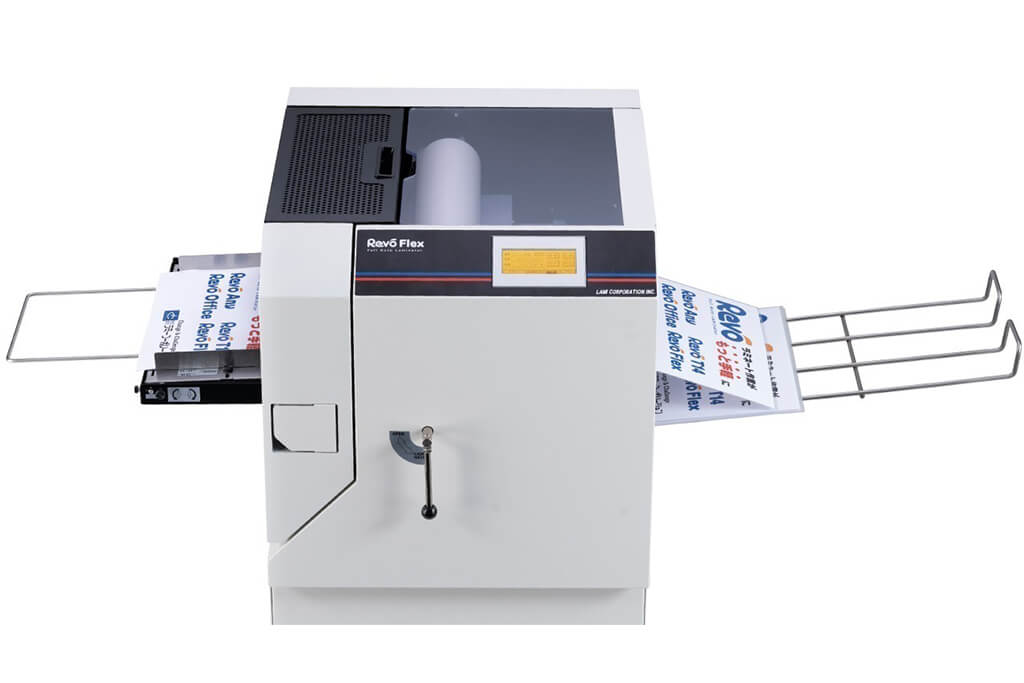
Image source: LAMI Corporation Official Website
(https://www.lami-corporation.co.jp/english/products/detail/51)
(https://www.lami-corporation.co.jp/english/products/detail/51)
Example facilities
Output centers, design offices, franchise headquarters, etc.
Reasons for recommendation
High-mix, fast-turnaround jobs are efficient through process reduction
- Completes trimming simultaneously with lamination, eliminating the need to move to subsequent processes or separate equipment.
Eliminates bottlenecks that tend to occur in on-demand printing and production sites. - High-precision automatic four-side trimming reduces trimming errors resulting from manual work, reducing film loss and the hassle of reprinting.
Even at sites with high-mix, small-lot production, it processes efficiently with consistent quality.
| Maximum processing speed | 2.0 m/min |
|---|---|
| Maximum width | 320 mm (SRA3 standard) |
| Warm-up | about 5 minutes *1 |
| Processing type | roll type, double-sided (border on/off selectable) |
| Voltage (CE) | AC230V |
| Main unit dimensions | W 1,300 mm / D 610 mm / H 1,080 mm *2 |
[10,000+ sheets per month]
High-lot production
High-lot production
Mini 76 TH
(Autobond Laminating)
(Autobond Laminating)
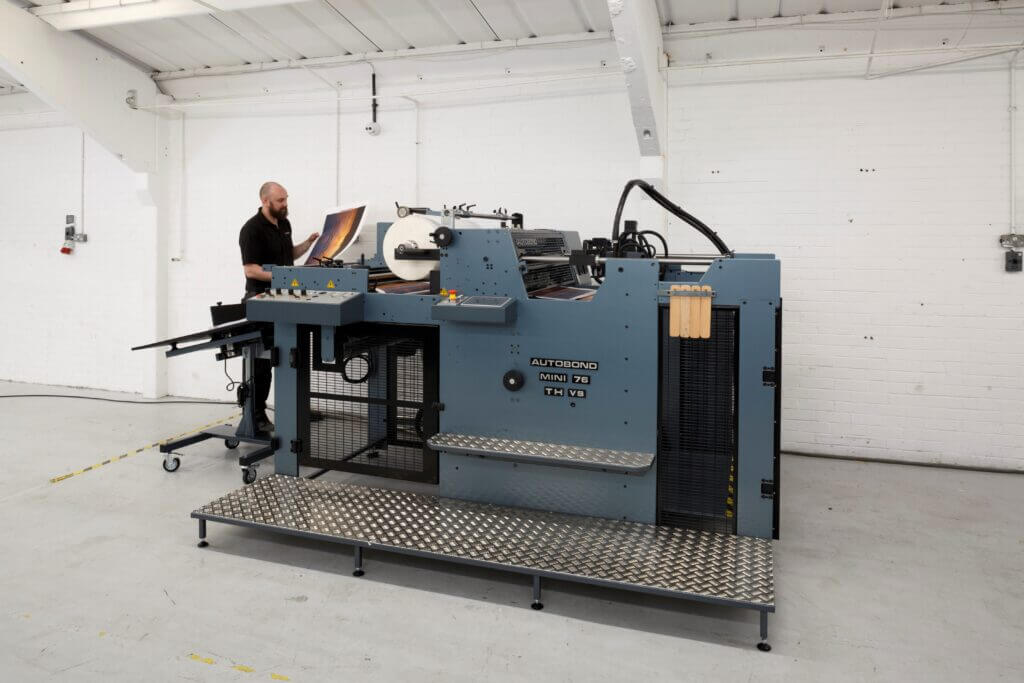
Image source: AUTOBOND Official Website
(https://www.autobondlaminating.com/machinery/thermal-lamination/mini/mini-76-th/)
(https://www.autobondlaminating.com/machinery/thermal-lamination/mini/mini-76-th/)
Example facilities
Printing factories, bookbinding lines, etc.
Reasons for recommendation
High-speed, continuous processing that can be integrated into mass-production lines
- Uses a steel side plate with a thickness of 20 mm described as sturdy like a tank. This rigid structure physically eliminates vibrations even at high-speed operations of 60 m per minute, maintaining stable processing accuracy.
- With a processing capacity of 60 m per minute, it can continuously handle large-format prints stably.
It demonstrates its true value when introduced as a part of a production line rather than as a standalone machine.
| Maximum processing speed | 60.0 m/min |
|---|---|
| Maximum width | 760 mm (B1+ compatible) |
| Warm-up | inquire for details |
| Processing type | roll type, single-sided or double-sided (borderless) |
| Voltage (CE) | inquire for details |
| Main unit dimensions | inquire for details |
*1. At 100°C (212°F) setting
*2. Dimensions when assembled, including the stand, tray, etc.