
Automatic Laminator Hub » Automatic Laminator Comparison Guide » Fujipla ALM-3222 Alternatives:
Comparing Your Options
Comparing Your Options
Fujipla ALM-3222 Alternatives:
Comparing Your Options
If you're replacing an ALM-3222, start with a few jobs you already run. Sealed menus and instruction sheets need different finishing from covers that will be cut or creased later. A machine may feed and laminate sheets automatically but still leave you with extra trimming.
FUJIPLA confirmed that ALM-3222 production had ended in its October 2025 notice. The four alternatives below, LAMI Revo Flex, FUJIPLA HLA-2301, LAMI Revo T14 and KOMFI Amiga 36, handle finishing differently. Your choice will depend on the edges you need, the film you use and how much work remains after lamination.
The FUJIPLA ALM-3222 was distributed in North America by Dry-Lam. Both names refer to the same model, though published specifications vary by region.
Source: FUJIPLA discontinuation notice
Before You Compare Machines
- Decide whether each job needs a sealed film border, a flush cut or further cutting after lamination.
- Check film coverage and finished dimensions. A sheet that fits the feeder may extend beyond the film.
- Use a demonstration to compare completed jobs. Published maximum speeds tell only part of the story.
- Confirm the specification sold in your region, along with film availability and local service.
Which ALM-3222 Functions Do You Need to Keep?
The ALM-3222 laminated, cut, trimmed and stacked sheets in one pass. Dry-Lam's archived US specification lists a 200-sheet feeder, 12.6-inch film coverage (approximately 320 mm) and flush-cut or border-cut finishing. Film thickness ranged from 1.5–10 mil, approximately 38–254 µm, with 10 mil film limited to border cutting. These figures apply to the published US configuration; check them against your own machine.
Your job records will help narrow the search. Note the sheet size, paper weight, film used on each face and required border, plus any cutting or binding afterwards. Include the awkward occasional job as well as the work you run every day.
For each job, describe the finish you need:
- Sealed edges need film extending beyond the paper to form the required border.
- Flush-cut output needs edges cut to the intended paper dimensions.
- Sheets for further finishing need film covering every final piece after cutting, folding or punching.
Check how the machine produces those edges. Automatic sheet separation alone does not tell you whether all four sides of an encapsulated document are finished.
Fujipla ALM-3222 Alternatives at a Glance
Each machine below suits a different type of work.
| Product | Feeding and finishing | Work to assess | What to check |
|---|---|---|---|
| LAMI Revo Flex | Automatic feeding and four-side trimming | Double-sided jobs needing flush cuts or encapsulation borders | Supported film thickness and finished dimensions |
| FUJIPLA HLA-2301 | Automatic feeding and four-side cutting | Jobs you want to keep on a FUJIPLA automatic laminator | Regional paper limits and dedicated HLA film requirements |
| LAMI Revo T14 | Automatic feeding with cross-cutting between sheets | Jobs where you can trim the sides separately | Film coverage and any guillotining needed afterwards |
| KOMFI Amiga 36 | Automatic feeder configurations with film perforation and sheet separation | Print work suited to production lamination and further finishing | How the finished edges compare with four-side trimming or sealed-edge encapsulation |
Sources: LAMI Revo range, AfterPrint Revo Flex, FUJIPLA HLA-2301 brochure, AfterPrint Revo T14 and KOMFI Amiga 36.
How the Four Alternatives Handle Your Jobs
Use these specifications to build a shortlist, then test your own jobs. Maximum speed, feeder capacity and finished dimensions can depend on different operating conditions, so don't assume a machine achieves every listed maximum at once.
LAMI Revo Flex: Automatic Trimming on All Four Sides

Source: LAMI Corporation Official Website
https://www.lami-corporation.co.jp/english/series-lamirevo
https://www.lami-corporation.co.jp/english/series-lamirevo
Revo Flex feeds, laminates and trims sheets on all four sides. LAMI lists both bordered and borderless finishing, making it a candidate for jobs that need either a film border or trimmed edges.
Key specifications
| Item | Published specification |
|---|---|
| Maximum laminating width | 320 mm |
| Maximum laminating speed | 2.0 m/min |
| Film thicknesses | 38, 80, 100, 125 and 150 µm |
| Side trimming | Included |
| Warm-up time | Approximately 5 minutes; depends on conditions |
| Assembled dimensions | 1,300 × 610 × 1,080 mm |
LAMI's September 2024 English catalogue gives these figures. It lists 150 µm film in the specification table but leaves that thickness out of the consumables table. Ask the supplier which film options are available for the machine being quoted.
What happens after feeding?
Automatic feeding → lamination → four-side trimming → delivery.
A menu printed at its finished size may be ready to use when it leaves the machine. Several cards printed on one sheet will still need cutting apart.
Example: bordered and borderless menus
Check the finished dimensions before laying out the artwork. LAMI's Japanese specification gives these basic A3 results:
| Setting | Published finished size |
|---|---|
| With border | 303 × 426 mm |
| Without border | 294 × 417 mm |
The borderless setting trims the sheet smaller than A3. Leave room for that cut when positioning text and images, and check the finished-size settings on the version you'll receive.
The Japanese page also lists a 200-sheet copy-paper feeder and a stock range of 64–240 gsm. Confirm those limits with your supplier, along with the film thickness approved for your jobs, because configurations can vary by market.
FUJIPLA HLA-2301: Four-Side Cutting with Dedicated HLA Film

Source: HLA-2301 (Dry-Lam) Official Website
(https://drylam.com/hla-2301)
(https://drylam.com/hla-2301)
The HLA-2301 offers automatic feeding and four-side cutting for buyers looking at another FUJIPLA machine. It uses dedicated HLA film, so check consumables carefully if you have ALM film left in stock.
Key specifications
| Item | Published specification |
|---|---|
| Minimum / maximum sheet size | 182 × 148 mm / 330 × 500 mm; long mode has separate conditions |
| Maximum paper width with film margins | 297 mm |
| Paper weight / thickness | 64–209 gsm / 0.07–0.25 mm |
| Maximum total laminating thickness | 0.5 mm, including film |
| Feeder capacity | Approximately 200 sheets of 64 gsm copy paper |
| Laminating speed | 0.5–2.1 m/min; single-cut and long mode fixed at 1 m/min |
| Supported film | Dedicated HLA film: 38, 75, 100 and 125 µm |
These figures come from FUJIPLA's English product page. If a supplier gives different limits, ask which specification applies to the quoted machine.
Cutting modes
Automatic feeding → lamination → four-side cutting → delivery.
FUJIPLA describes two-stage cutting as favouring consistent dimensions. Single-stage cutting reduces film waste and processing time, but has restrictions on front and rear margin settings. Choose the mode with the finished job in mind.
Example: A3 instruction sheets with a sealed border
For bordered work, the maximum paper width is 297 mm, even though the feeder accepts wider sheets. Give the supplier your feed orientation and required border so they can confirm the cutting mode and finished dimensions.
Include your heaviest paper-and-film combination in the trial and ask for the compatible consumable codes. The English and Japanese pages list different lateral-slitter adjustment ranges; have the supplier confirm the range for your machine.
LAMI Revo T14: Cross-Cutting with Separate Side Trimming
Source: Lami Corporation Official Website
(https://www.lami-corporation.co.jp/english/products/detail/46)
(https://www.lami-corporation.co.jp/english/products/detail/46)
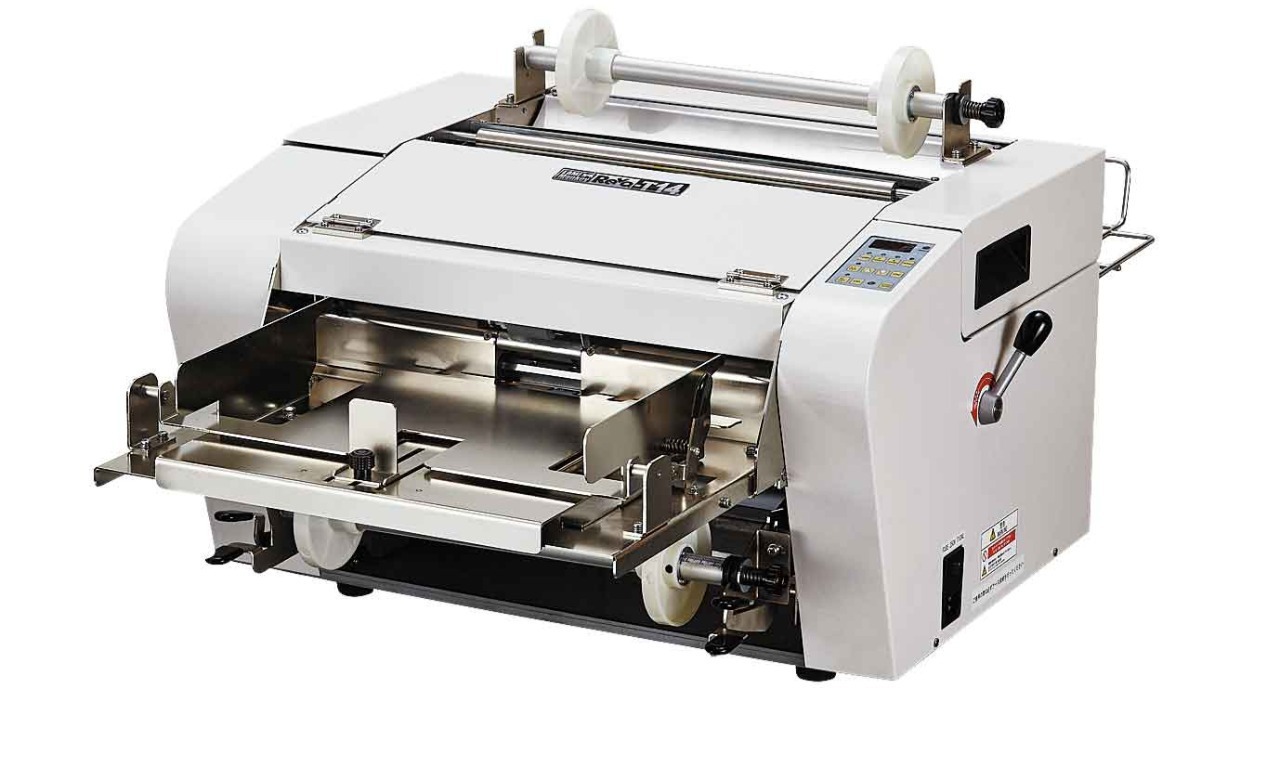
Revo T14 automatically feeds sheets and cuts between them. It may suit jobs where you already use a guillotine for the remaining cuts. Unlike Flex, it has no side-trimming function, according to LAMI's catalogue.
Key specifications
| Item | Published specification |
|---|---|
| Maximum laminating width | 305 mm |
| Maximum laminating speed | 1.6 m/min |
| Film thicknesses | 50, 80, 100 and 125 µm |
| Side trimming | Not included |
| Warm-up time | Approximately 5 minutes; depends on conditions |
| Dimensions | 530 × 900 × 420 mm, excluding the up/down lever |
| Mobile stand | Optional |
Source: LAMI Revo catalogue.
LAMI's English range page lists a feeder width of 330 mm. Film coverage is narrower, with the catalogue giving a maximum laminating width of 305 mm.
Allowing for the remaining cuts
Automatic feeding → lamination → cross-cutting between sheets → delivery → separate trimming where required.
AfterPrint describes a rear cross-cutting blade that produces sheets ready for guillotining. Include that guillotine work when comparing time and labour with your ALM-3222.
Example: several cards on one printed sheet
Keep every finished card within the film coverage and check where the guillotine cuts will fall. The parent sheet may fit the feeder while some of its printed area falls outside the laminate.
Confirm feeder capacity and the approved stock range as well. LAMI's Japanese page lists 60–160 gsm; ask whether that range applies to the version being supplied.
KOMFI Amiga 36: Lamination Before Further Finishing

Source: KOMFI Official Website
(https://www.komfi.cz/en/amiga-36-en/)
(https://www.komfi.cz/en/amiga-36-en/)
KOMFI lists brochures, business cards and soft covers among the Amiga 36's applications. For these jobs, assess how the laminated sheets move through the cutting, creasing or other finishing equipment you use afterwards.
Key specifications by feeder configuration
| Item | Feeding head | Bottom suction feeder |
|---|---|---|
| Maximum laminating speed | 20 m/min | 15 m/min |
| Minimum sheet size | 200 × 200 mm | 200 × 200 mm |
| Maximum sheet size | 360 × 700 mm, without extensions | 360 × 700 mm |
| Paper weight | 115–350 gsm | 115–350 gsm |
| Film thickness | 24–50 µm | 24–50 µm |
| Maximum pile height | 40 cm | 6 cm, depending on sheet length |
| Required air pressure | At least 6 bar | At least 6 bar |
These figures come from KOMFI's English configuration tables. The manufacturer also lists a feeder output of 8,000 sheets per hour, but that figure measures feeding, not completed lamination.
Sheet separation and finishing
Automatic feeding → lamination and decurling → film perforation and sheet separation → delivery → subsequent finishing.
The optional film slitter adjusts the roll width. It does not provide four-side document trimming.
Example: covers laminated before cutting and creasing
Run the laminated covers through your cutting and creasing steps during the trial. Sheet size needs checking too: a standard A5 sheet falls below the published minimum feed size when fed individually, so smaller products may need to be printed on a larger parent sheet.
Ask the supplier to confirm the feeder configuration, any processing needed for the second face and installation requirements. If your jobs need sealed borders, request samples showing that finish; automatic sheet separation alone does not confirm the capability.
What to Include in the Supplier's Quote
The quote should identify the exact machine configuration and who will install and maintain it. Ask the supplier to put local film supply, spare-parts availability and service arrangements in writing.
- Machine and installation: regional specification, electrical supply, any compressed-air requirement, operating space, delivery, installation and training.
- Consumables: approved film codes, widths and finishes, minimum orders, local stock and replenishment lead times.
- Support: service provider, response arrangements, travel charges, maintenance requirements and parts lead times.
- Cost: machine, options, film, servicing and any additional finishing equipment, with tax treatment stated clearly.
Base every quotation on the same sample jobs. If a machine leaves an extra finishing step, add the equipment and labour costs before comparing totals.
Run Your Existing Jobs Before Choosing
Send each supplier the same samples, using your own paper and printed output. Include an everyday job and a more demanding one, such as heavier stock, dense ink coverage or a particular border size.
- State what an acceptable job looks like: finished dimensions, film, border, appearance and any cutting, folding or punching afterwards.
- Run a representative batch. Record setup and loading time, interruptions, rejected sheets and how often the operator needs to intervene.
- Inspect sheets across the batch for film coverage, adhesion, flatness and consistent edges.
- Complete the remaining finishing steps and check the pieces again.
- Compare total elapsed time and hands-on labour per acceptable finished item.
A trial should show both whether the machine can produce your jobs and how much work it takes to finish them. Compare those results alongside the written service offer, including every extra step a replacement requires.
FAQs About Replacing the ALM-3222
Can I still obtain ALM-3222 parts?
FUJIPLA's October 2025 notice says ALM3222 parts supplies are available until 2030, subject to stock levels. Some parts may run out before then. Give your service provider the machine details and required part numbers to check whether keeping it running is practical.
Can I use my remaining ALM film in a replacement?
Check with the replacement supplier before counting that stock towards your purchase. The HLA-2301, for example, specifies dedicated HLA film. Provide your exact film product codes and ask for confirmation of compatibility. A roll that physically fits is not necessarily approved for use.
[Advertisement]
[By production scale]
Three Fully Automatic Laminators
[By production scale]
Three Fully Automatic Laminators
When choosing a fully automatic laminator, it is important to base your decision on the volume you process in a day rather than the size of the main unit or equipment scale.
This is an introduction to fully automatic laminators that match the workload and operational style of different production scales.
Advertiser Disclosure:
We receive compensation from some of the companies listed below.This compensation may affect which companies are included and the order in which they appear.
[About 100+ sheets per month]
Small-lot production
Small-lot production
GBC Foton 30
(ACCO Brands Corporation)
(ACCO Brands Corporation)
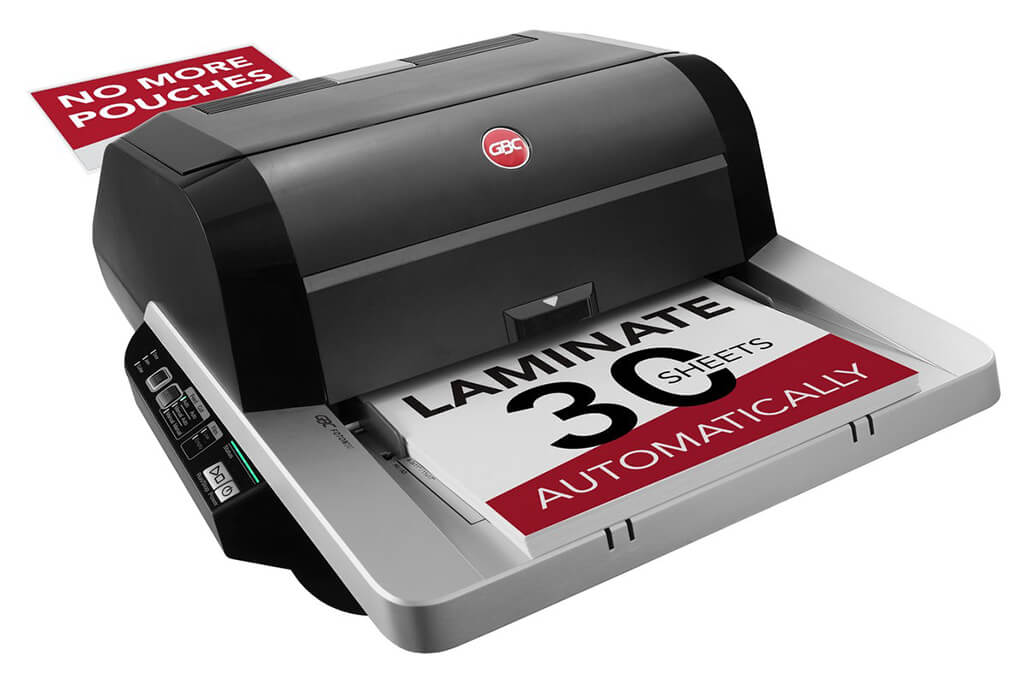
Image Source: ACCO Brands Corporation Official Site
(https://www.gbc-machines.com/products/gbc-foton-30-automatic-laminator)
(https://www.gbc-machines.com/products/gbc-foton-30-automatic-laminator)
Example facilities
Schools, hospitals, municipalities, etc.
Reasons for recommendation
Automates small-scale operations with fewer personnel
- With the push of a button, automatically laminates 30 sheets of A4 paper in 15 minutes. Its size allows it to be placed on a desk, making it easy to install.
- By fully automating the process from feeding to lamination, it enables the handling of jobs with low daily processing volumes in parallel with other operations.
The fact that it does not require dedicated operators or subsequent processes makes it suitable for small-scale sites.
| Maximum processing speed | 7.0 m/min |
|---|---|
| Maximum width | 297 mm (A3 compatible) |
| Warm-up | about 4 minutes |
| Processing type | roll type, double-sided (with borders) |
| Voltage (CE) | AC220 to 240V |
| Main unit dimensions | W 580 mm / D 440 mm / H 250 mm |
[About 1,000+ sheets per month]
Medium-lot production
Medium-lot production
Revo-Flex
(Lami Corporation)
(Lami Corporation)
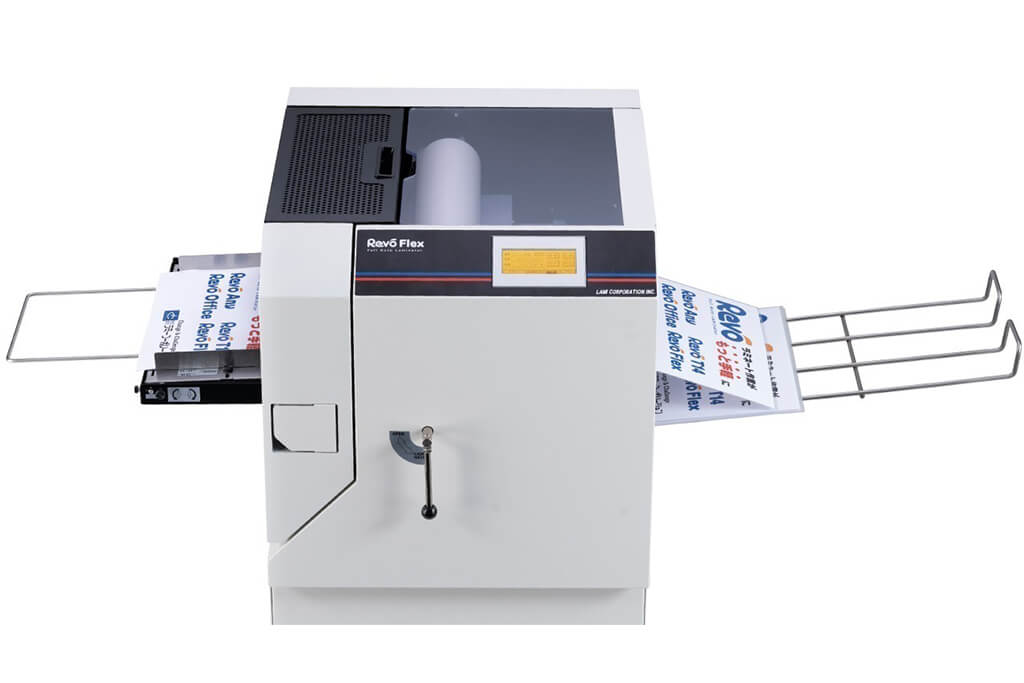
Image source: LAMI Corporation Official Website
(https://www.lami-corporation.co.jp/english/products/detail/51)
(https://www.lami-corporation.co.jp/english/products/detail/51)
Example facilities
Output centers, design offices, franchise headquarters, etc.
Reasons for recommendation
High-mix, fast-turnaround jobs are efficient through process reduction
- Completes trimming simultaneously with lamination, eliminating the need to move to subsequent processes or separate equipment.
Eliminates bottlenecks that tend to occur in on-demand printing and production sites. - High-precision automatic four-side trimming reduces trimming errors resulting from manual work, reducing film loss and the hassle of reprinting.
Even at sites with high-mix, small-lot production, it processes efficiently with consistent quality.
| Maximum processing speed | 2.0 m/min |
|---|---|
| Maximum width | 320 mm (SRA3 standard) |
| Warm-up | about 5 minutes *1 |
| Processing type | roll type, double-sided (border on/off selectable) |
| Voltage (CE) | AC230V |
| Main unit dimensions | W 1,300 mm / D 610 mm / H 1,080 mm *2 |
[10,000+ sheets per month]
High-lot production
High-lot production
Mini 76 TH
(Autobond Laminating)
(Autobond Laminating)
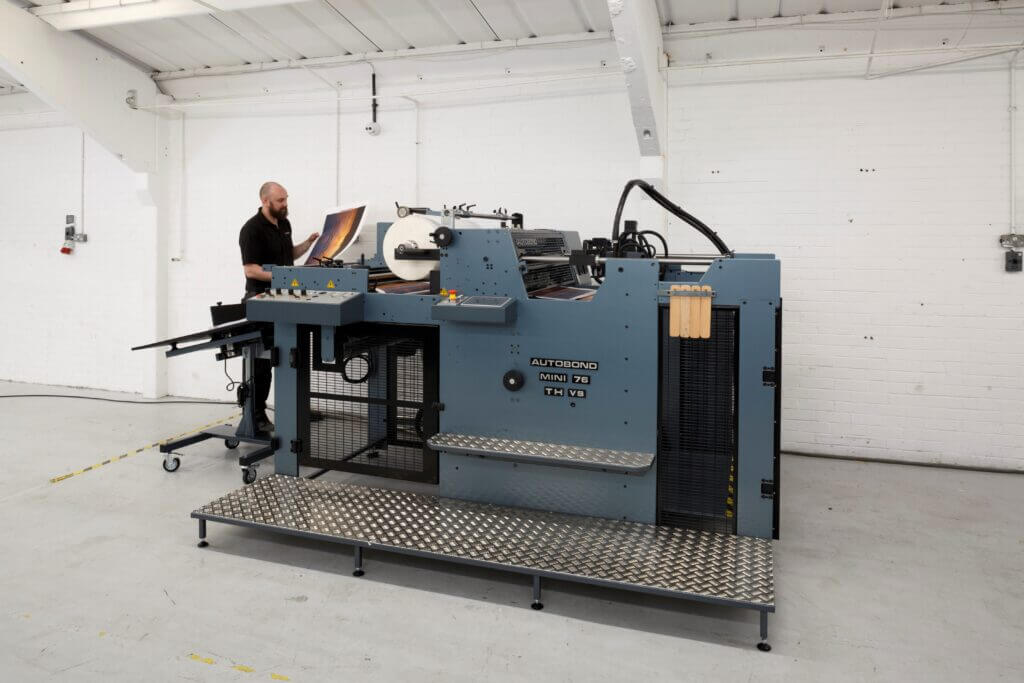
Image source: AUTOBOND Official Website
(https://www.autobondlaminating.com/machinery/thermal-lamination/mini/mini-76-th/)
(https://www.autobondlaminating.com/machinery/thermal-lamination/mini/mini-76-th/)
Example facilities
Printing factories, bookbinding lines, etc.
Reasons for recommendation
High-speed, continuous processing that can be integrated into mass-production lines
- Uses a steel side plate with a thickness of 20 mm described as sturdy like a tank. This rigid structure physically eliminates vibrations even at high-speed operations of 60 m per minute, maintaining stable processing accuracy.
- With a processing capacity of 60 m per minute, it can continuously handle large-format prints stably.
It demonstrates its true value when introduced as a part of a production line rather than as a standalone machine.
| Maximum processing speed | 60.0 m/min |
|---|---|
| Maximum width | 760 mm (B1+ compatible) |
| Warm-up | inquire for details |
| Processing type | roll type, single-sided or double-sided (borderless) |
| Voltage (CE) | inquire for details |
| Main unit dimensions | inquire for details |
*1. At 100°C (212°F) setting
*2. Dimensions when assembled, including the stand, tray, etc.