
Automatic Laminator Hub » Basic Knowledge About Laminators » In House Lamination vs Outsourcing: Determining the Tipping Point by Volume and Lead Time
In House Lamination vs Outsourcing: Determining the Tipping Point by Volume and Lead Time
Index
Many businesses find themselves continuously relying on external contractors for lamination, only to realize their processing volume has grown to a point where bringing lamination in-house becomes a serious consideration.
Rather than simply declaring which method is cheaper, this article provides objective criteria to help you determine which jobs you should handle internally and which you should outsource based on your specific operational needs.
Key Takeaways
- In-house processing and outsourcing are not strictly superior or inferior to one another; the right choice depends on the nature of your workload.
- Outsourcing typically favors specialty materials, large formats, and one-off high-volume projects.
- In-house processing excels for routine daily tasks, medium-sized batches, and projects with tight deadlines.
- While bringing operations in-house eliminates transportation costs and transit delays, it requires dedicated floor space and ongoing maintenance.
- Base your decision not merely on unit cost comparisons, but on two core metrics: processing volume and lead time requirements.
The Fundamental Shift: What Changes When You Bring Lamination In-House?
By shifting to in-house processing, you can often eliminate the processing fees and transportation costs associated with external contractors. Additionally, you can drastically reduce the waiting time for order processing and final delivery.
Outsourcing inherently involves a multi-step cycle: requesting the job, waiting for the facility to process it, and waiting for transit. Depending on the project, these delays can significantly impact your workflow.
In contrast, bringing lamination in-house allows you to laminate printed materials immediately using your own equipment, effectively bypassing third-party queues and delivery windows.
However, this transition is a trade-off. While you save on shipping costs and transit times, you must account for new responsibilities, such as securing floor space for the automated laminator, training operators, and performing routine maintenance.
Comparing In-House Lamination and Outsourcing
No single solution wins on every front. The advantages shift depending on your operational priorities. Below is a breakdown of how both approaches compare across key criteria.
| Criteria | Outsourcing | In-House Processing |
|---|---|---|
| Cost per Sheet | Fluctuates based on contract terms and order quantities. | Depends on equipment, consumables, labor time, and overall processing volume. |
| Lead Time | Demands additional time for order placement, processing, and shipping. | Enables immediate processing without transit delays, provided equipment is available. |
| Quality Control | Relies entirely on the external contractor's equipment and quality standards. | Allows you to set and monitor specific processing conditions tailored to your machine. |
| Peak Season Resilience | Vulnerable to the contractor's backlog and extended turnaround times. | Managed directly by adjusting your own equipment and personnel schedules. |
| Initial Investment | Zero | Requires capital to purchase equipment and secure installation space. |
| Handling Special Specifications | Limited to the service provider's available equipment and expertise. | Limited by the specifications and capabilities of your chosen automated laminator. |
When Outsourcing Takes the Lead
Outsourcing becomes the strategic choice when you require processing for specialty materials or handling sizes and specifications beyond your in-house capabilities. Additionally, if you encounter one-off, exceptionally high-volume projects, leveraging an external contractor prevents overwhelming your internal staff and equipment.
When In-House Processing Is the Better Choice
If your operations generate a consistent, predictable volume of lamination every month, bringing processing in-house can provide a strong return on investment. It is also the ideal solution for recurring short-turnaround projects, allowing you to bypass external wait times. Furthermore, if your workflow frequently requires immediate lamination following last-minute print revisions, an in-house setup offers unmatched agility.
Understanding the Cost Structure Differences
The expenses you eliminate by dropping outsourcing do not map one-to-one with the new costs generated by in-house processing.
When contracting out, your invoice includes both the core processing fee and round-trip shipping costs. Moreover, the multi-day waiting period for delivery represents a hidden opportunity cost, delaying your ability to deploy promotional or operational materials.
Bringing operations in-house eliminates these specific financial and temporal drains. However, you must account for the initial capital expenditure to purchase a dedicated machine. Ongoing expenses will shift toward maintenance and consumables like lamination film. Furthermore, securing floor space and allocating time for operators to master the machine are new investments your business must absorb.
Finding the Tipping Point
When evaluating in house lamination vs outsourcing, assess your operations across two primary axes: monthly processing volume and lead time requirements. If your workload involves a mix of tasks that don't neatly fit one model, a hybrid approach is often the most effective solution.
Evaluating by Volume
Look at whether your monthly processing volume is stable rather than highly seasonal. If your facility generates a consistent baseline of lamination work every month, investing in your own equipment becomes highly justifiable from an efficiency and ROI perspective.
Evaluating by Lead Time
Determine if your operations require same-day or next-day turnarounds. Outsourcing inherently involves a physical transit lag. The stronger your need to immediately deploy printed materials from the production floor, the more essential an in-house setup becomes.
The Hybrid Approach
You can maximize overall efficiency by stratifying your workload. Process standard-sized promotional materials quickly in-house, while reserving external contractors strictly for event-specific specialty materials, oversized prints, or sudden volume spikes.
The First Feature to Evaluate When Bringing Lamination In-House
When building an internal processing framework, the first major bottleneck you will encounter is the trimming process—cutting away the excess film borders after lamination.
Manual trimming scales poorly; as your processing volume increases, so does your labor time. Therefore, it is critical to evaluate whether the machine offers automated trimming capabilities.
Select the class of equipment based on your required volume. Because footprint and electrical requirements vary significantly across models, carefully verify your available installation space and power supply before finalizing a purchase.
Learn more about automated trimming features hereCompare fully automatic laminators vs. manual machines here
Read about practical applications for printing companies and copy centers here
FAQ
Q. At what processing volume should we consider bringing lamination in-house?
There is no single universal threshold. Base your decision primarily on volume stability and the strictness of your lead time requirements.
Q. Does outsourcing guarantee more consistent quality?
Outsourced quality depends entirely on the contractor's equipment and standards. You can achieve equally stable quality in-house through proper process control and reliable equipment.
Q. Will bringing operations in-house guarantee cost reductions?
Not necessarily. You must evaluate the Total Cost of Ownership (TCO), factoring in equipment depreciation, ongoing maintenance, and consumables before declaring it a cost-saving measure.
Q. Can we outsource only our specialty finishes?
Absolutely. A hybrid approach is highly effective: process standard, routine jobs in-house while delegating specialty materials and oversized formats to external contractors.
Q. What are the most commonly overlooked costs when transitioning to in-house processing?
Beyond the machine's initial purchase price, businesses frequently overlook the overhead associated with dedicating floor space and the labor time required for operator training.
Conclusion
When weighing the core dilemma of in house lamination vs outsourcing, asking "which is cheaper?" rarely leads to the most strategic decision.
The critical first step is categorizing tasks by their operational nature—keeping routine, fast-turnaround jobs close at hand, while delegating highly specialized or massive ad-hoc projects to external partners.
[Advertisement]
[By production scale]
Three Fully Automatic Laminators
[By production scale]
Three Fully Automatic Laminators
When choosing a fully automatic laminator, it is important to base your decision on the volume you process in a day rather than the size of the main unit or equipment scale.
This is an introduction to fully automatic laminators that match the workload and operational style of different production scales.
Advertiser Disclosure:
We receive compensation from some of the companies listed below.This compensation may affect which companies are included and the order in which they appear.
[About 100+ sheets per month]
Small-lot production
Small-lot production
GBC Foton 30
(ACCO Brands Corporation)
(ACCO Brands Corporation)
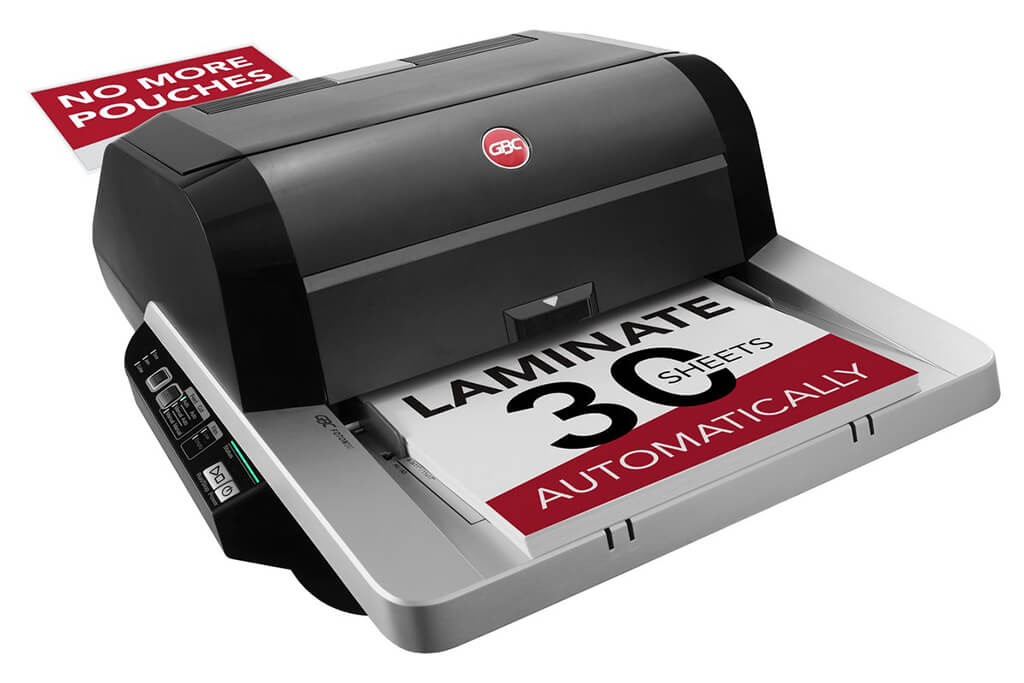
Image Source: ACCO Brands Corporation Official Site
(https://www.gbc-machines.com/products/gbc-foton-30-automatic-laminator)
(https://www.gbc-machines.com/products/gbc-foton-30-automatic-laminator)
Example facilities
Schools, hospitals, municipalities, etc.
Reasons for recommendation
Automates small-scale operations with fewer personnel
- With the push of a button, automatically laminates 30 sheets of A4 paper in 15 minutes. Its size allows it to be placed on a desk, making it easy to install.
- By fully automating the process from feeding to lamination, it enables the handling of jobs with low daily processing volumes in parallel with other operations.
The fact that it does not require dedicated operators or subsequent processes makes it suitable for small-scale sites.
| Maximum processing speed | 7.0 m/min |
|---|---|
| Maximum width | 297 mm (A3 compatible) |
| Warm-up | about 4 minutes |
| Processing type | roll type, double-sided (with borders) |
| Voltage (CE) | AC220 to 240V |
| Main unit dimensions | W 580 mm / D 440 mm / H 250 mm |
[About 1,000+ sheets per month]
Medium-lot production
Medium-lot production
Revo-Flex
(Lami Corporation)
(Lami Corporation)
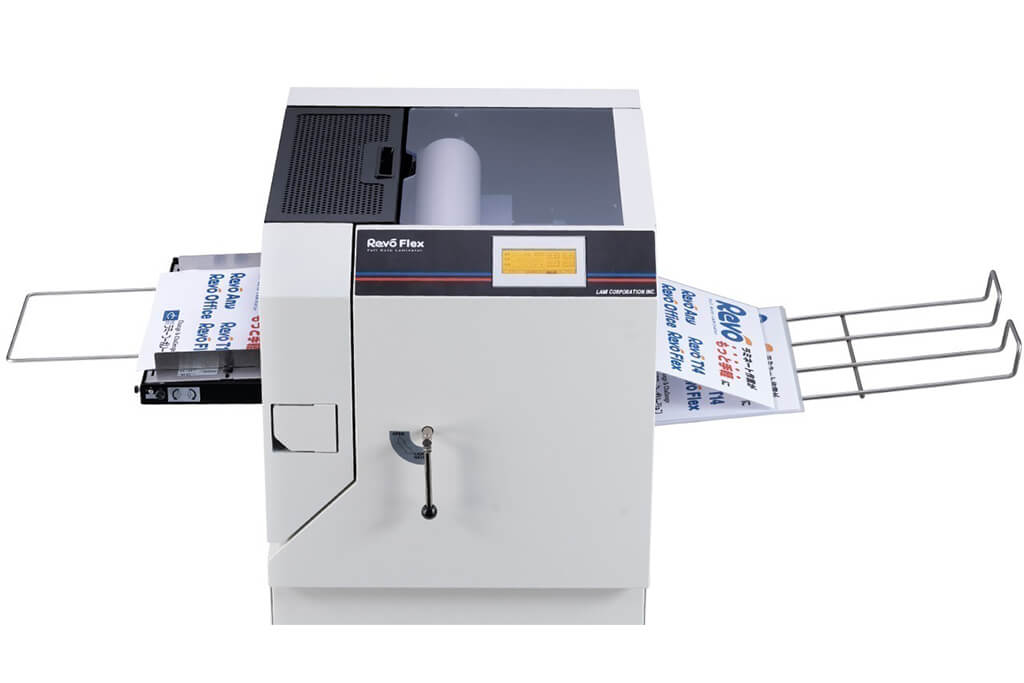
Image source: LAMI Corporation Official Website
(https://www.lami-corporation.co.jp/english/products/detail/51)
(https://www.lami-corporation.co.jp/english/products/detail/51)
Example facilities
Output centers, design offices, franchise headquarters, etc.
Reasons for recommendation
High-mix, fast-turnaround jobs are efficient through process reduction
- Completes trimming simultaneously with lamination, eliminating the need to move to subsequent processes or separate equipment.
Eliminates bottlenecks that tend to occur in on-demand printing and production sites. - High-precision automatic four-side trimming reduces trimming errors resulting from manual work, reducing film loss and the hassle of reprinting.
Even at sites with high-mix, small-lot production, it processes efficiently with consistent quality.
| Maximum processing speed | 2.0 m/min |
|---|---|
| Maximum width | 320 mm (SRA3 standard) |
| Warm-up | about 5 minutes *1 |
| Processing type | roll type, double-sided (border on/off selectable) |
| Voltage (CE) | AC230V |
| Main unit dimensions | W 1,300 mm / D 610 mm / H 1,080 mm *2 |
[10,000+ sheets per month]
High-lot production
High-lot production
Mini 76 TH
(Autobond Laminating)
(Autobond Laminating)
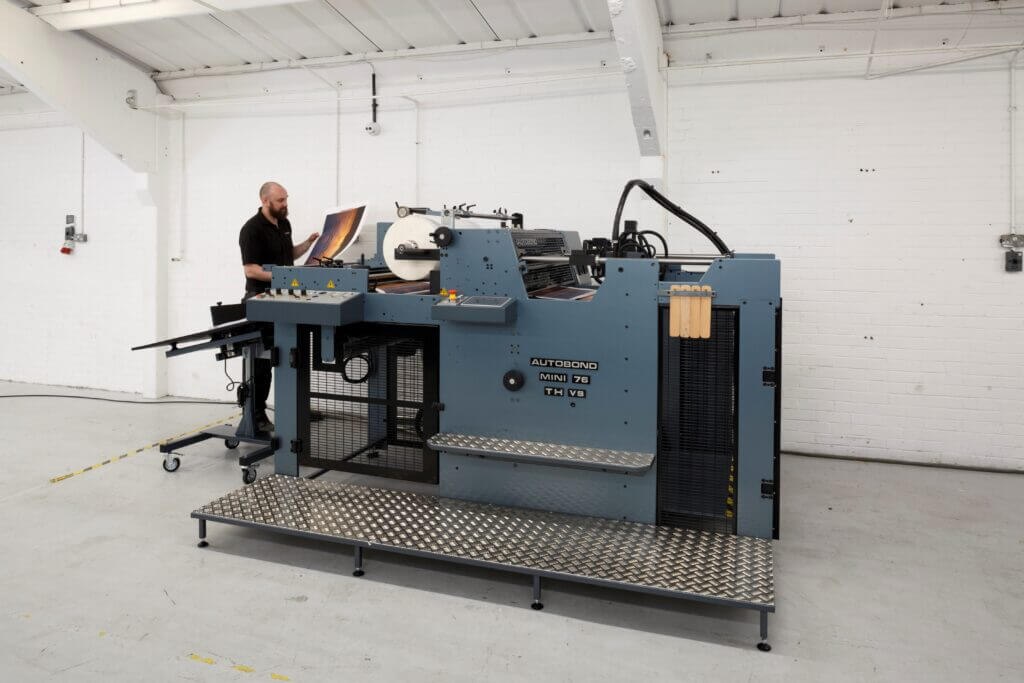
Image source: AUTOBOND Official Website
(https://www.autobondlaminating.com/machinery/thermal-lamination/mini/mini-76-th/)
(https://www.autobondlaminating.com/machinery/thermal-lamination/mini/mini-76-th/)
Example facilities
Printing factories, bookbinding lines, etc.
Reasons for recommendation
High-speed, continuous processing that can be integrated into mass-production lines
- Uses a steel side plate with a thickness of 20 mm described as sturdy like a tank. This rigid structure physically eliminates vibrations even at high-speed operations of 60 m per minute, maintaining stable processing accuracy.
- With a processing capacity of 60 m per minute, it can continuously handle large-format prints stably.
It demonstrates its true value when introduced as a part of a production line rather than as a standalone machine.
| Maximum processing speed | 60.0 m/min |
|---|---|
| Maximum width | 760 mm (B1+ compatible) |
| Warm-up | inquire for details |
| Processing type | roll type, single-sided or double-sided (borderless) |
| Voltage (CE) | inquire for details |
| Main unit dimensions | inquire for details |
*1. At 100°C (212°F) setting
*2. Dimensions when assembled, including the stand, tray, etc.