
A6 Laminator
Index
This article explains A6 laminators from a business-use perspective, focusing on small-format documents that require durability, professional presentation, and consistent finishing quality.
Typical Applications and Where A6 Laminators Are Used
- Retail stores and service counters
Price cards, product labels, membership cards, reservation cards, and compact in-store notices - Offices and corporate facilities
Visitor passes, desk labels, equipment tags, instruction cards, and frequently handled internal materials - Schools and educational institutions
Flashcards, small teaching aids, name cards, and reusable classroom materials - Healthcare facilities, clinics, and care homes
Information cards, room labels, temporary notices, and frequently handled reference materials - Print shops and on-demand printing services
Short-run cards, tags, coupons, and small-format printed materials requiring a clean, durable finish
Why A6 Is Often the Preferred Size
A6 is often chosen because it is compact, easy to handle, and large enough to display essential information clearly.
It works well for materials that need to be read quickly, carried easily, attached to products, or displayed in limited spaces. A4 and A5 formats can be unnecessarily large for these applications, while smaller formats may not provide sufficient space for clear text and graphics.
Another advantage is that A6 materials are easy to store, distribute, and replace. For workplaces that regularly produce labels, cards, or small notices, A6 offers a practical format for day-to-day operations.
A6 vs. Oversized A6: Size Comparison
A6 has a finished size of 105 × 148 mm. For printed materials that will be laminated and trimmed afterward, slightly oversized sheets may be used to provide trimming margins.
In print shops and on-demand printing environments, sheets are often printed larger than the final A6 size before being trimmed after lamination. This helps accommodate print registration tolerances, edge finishing, and post-lamination cutting. When selecting a laminator for professional A6 workflows, it is important to verify the actual maximum feed width and supported sheet dimensions rather than relying solely on A6 compatibility.
| Item | A6 | Oversized A6 / Pre-trim Stock |
|---|---|---|
| Size | 105 × 148 mm | Varies by workflow |
| Primary use | Finished size | Pre-processing size |
| Margins | None | Trimming margins included |
Pre-purchase Checks
- Maximum supported sheet or pouch size
- Compatibility with oversized sheets used for trimming
- Supported paper and film thicknesses
- Laminating speed and continuous throughput
- Feed stability when handling small sheets
- Warm-up time
- Ease of operation, including automatic settings and preset functions
- Installation space and portability
For A6 workflows, small-sheet handling has a direct impact on both productivity and finishing quality. If sheets frequently shift during feeding or require constant manual adjustment, the laminator can quickly become a bottleneck despite the small format.
Rather than comparing only maximum sheet size, it is important to select a model that matches the actual production volume, operator skill level, and finishing workflow.
How to Think About Increasing Processing Volume
When choosing a laminator, processing volume is just as important as sheet size.
A6 materials are often produced in batches. Cards, labels, passes, tags, and small notices may be processed repeatedly throughout the day. As production volume increases, time spent on manual feeding, alignment checks, and repeated setup becomes more significant. For business applications, this is where automation features become particularly valuable.
On this site, we have carefully selected fully automatic laminator models according to production volume and operating environment. Use this information as a reference when evaluating your options.
How to Choose Film for an A6 Laminator
- Film or pouch thickness, such as lightweight (50–80 μm), standard (100–125 μm), or heavyweight (150 μm and above)
- Surface finish, such as gloss or matt
- Pouch size or roll width suitable for A6 sheets and any required trimming margins
- Roll length for roll-fed machines, particularly in high-volume applications
- Core diameter for roll-fed models
- Film compatibility with the machine's temperature and pressure settings
Choose the film thickness and finish according to the intended application. Cards and tags that are handled frequently may benefit from thicker film, while temporary notices often require only basic protection.
For roll-fed or automated models, pouch size, film width, and core diameter depend on the machine specifications, so verifying compatibility is essential. If the workflow includes trimming after lamination, ensure that sufficient film margin remains around the printed area.
With automated models, repeated small-format jobs rely less on operator skill, helping maintain stable and consistent output quality. In addition to the basic specifications, be sure to evaluate the machine's automation features.
FAQs About A6 Laminators
Q. What types of materials are best suited to an A6 laminator?
A. A6 laminators are well suited to small-format materials such as information cards, price tags, name cards, desk labels, instruction cards, and compact notices.
They are particularly useful when materials need to be handled frequently, displayed for extended periods, or protected from dirt and moisture.
Q. Is an A6 laminator sufficient for business use?
A. It depends on the range of materials you need to process.
If your workplace primarily produces small cards and labels, an A6 laminator may be sufficient. However, if you also process A5, A4, or oversized pre-trim sheets, a larger model may be more practical. Before purchasing, confirm the largest sheet size you expect to use regularly.
Q. What determines how easy it is to process small sheets?
A. Feed stability, guide accuracy, and the loading mechanism are especially important.
Small sheets are more likely to shift during feeding, so a machine with stable alignment features can help reduce misfeeds and uneven finishing. Automatic settings and clear guides can also make results less dependent on operator experience.
Q. How can I reduce running costs?
A. For very low-volume applications, pouch laminating is often the simplest and most practical option. In workplaces handling repeated batches or continuous production, roll laminating can help reduce the cost per item, particularly when multiple A6 pieces are processed from larger rolls.
Q. What type of workplace is a fully automatic laminator best suited to?
A. It is best suited to workplaces that process large quantities of small-format materials and want to reduce manual work.
Compared with manual-feed machines, a fully automatic laminator can reduce repetitive setup and feeding tasks. The greater the number of cards, labels, or small notices being processed, the greater the benefit. It is particularly suitable for workplaces that want to maintain consistent quality while reducing processing time.
[Advertisement]
[By production scale]
Three Fully Automatic Laminators
[By production scale]
Three Fully Automatic Laminators
When choosing a fully automatic laminator, it is important to base your decision on the volume you process in a day rather than the size of the main unit or equipment scale.
This is an introduction to fully automatic laminators that match the workload and operational style of different production scales.
Advertiser Disclosure:
We receive compensation from some of the companies listed below.This compensation may affect which companies are included and the order in which they appear.
[About 100+ sheets per month]
Small-lot production
Small-lot production
GBC Foton 30
(ACCO Brands Corporation)
(ACCO Brands Corporation)
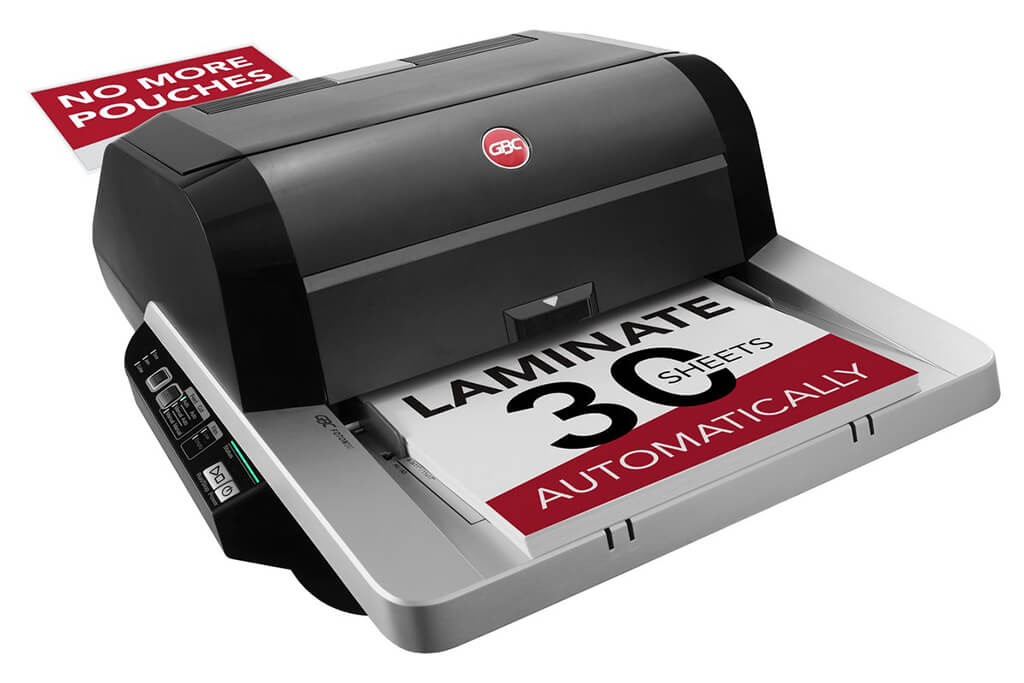
Image Source: ACCO Brands Corporation Official Site
(https://www.gbc-machines.com/products/gbc-foton-30-automatic-laminator)
(https://www.gbc-machines.com/products/gbc-foton-30-automatic-laminator)
Example facilities
Schools, hospitals, municipalities, etc.
Reasons for recommendation
Automates small-scale operations with fewer personnel
- With the push of a button, automatically laminates 30 sheets of A4 paper in 15 minutes. Its size allows it to be placed on a desk, making it easy to install.
- By fully automating the process from feeding to lamination, it enables the handling of jobs with low daily processing volumes in parallel with other operations.
The fact that it does not require dedicated operators or subsequent processes makes it suitable for small-scale sites.
| Maximum processing speed | 7.0 m/min |
|---|---|
| Maximum width | 297 mm (A3 compatible) |
| Warm-up | about 4 minutes |
| Processing type | roll type, double-sided (with borders) |
| Voltage (CE) | AC220 to 240V |
| Main unit dimensions | W 580 mm / D 440 mm / H 250 mm |
[About 1,000+ sheets per month]
Medium-lot production
Medium-lot production
Revo-Flex
(Lami Corporation)
(Lami Corporation)
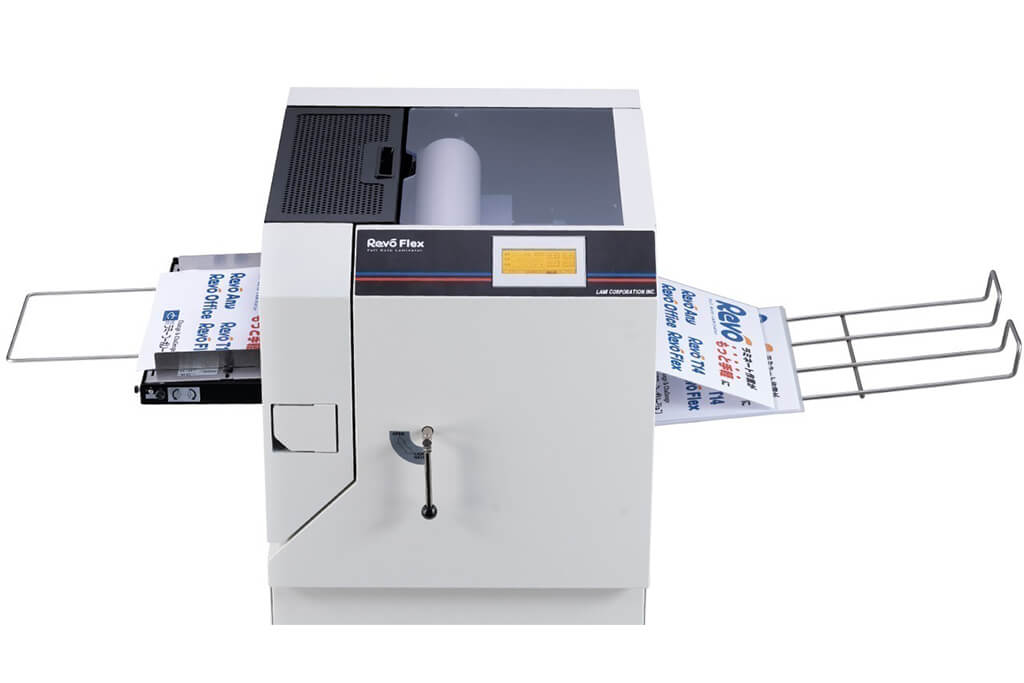
Image source: LAMI Corporation Official Website
(https://www.lami-corporation.co.jp/english/products/detail/51)
(https://www.lami-corporation.co.jp/english/products/detail/51)
Example facilities
Output centers, design offices, franchise headquarters, etc.
Reasons for recommendation
High-mix, fast-turnaround jobs are efficient through process reduction
- Completes trimming simultaneously with lamination, eliminating the need to move to subsequent processes or separate equipment.
Eliminates bottlenecks that tend to occur in on-demand printing and production sites. - High-precision automatic four-side trimming reduces trimming errors resulting from manual work, reducing film loss and the hassle of reprinting.
Even at sites with high-mix, small-lot production, it processes efficiently with consistent quality.
| Maximum processing speed | 2.0 m/min |
|---|---|
| Maximum width | 320 mm (SRA3 standard) |
| Warm-up | about 5 minutes *1 |
| Processing type | roll type, double-sided (border on/off selectable) |
| Voltage (CE) | AC230V |
| Main unit dimensions | W 1,300 mm / D 610 mm / H 1,080 mm *2 |
[10,000+ sheets per month]
High-lot production
High-lot production
Mini 76 TH
(Autobond Laminating)
(Autobond Laminating)
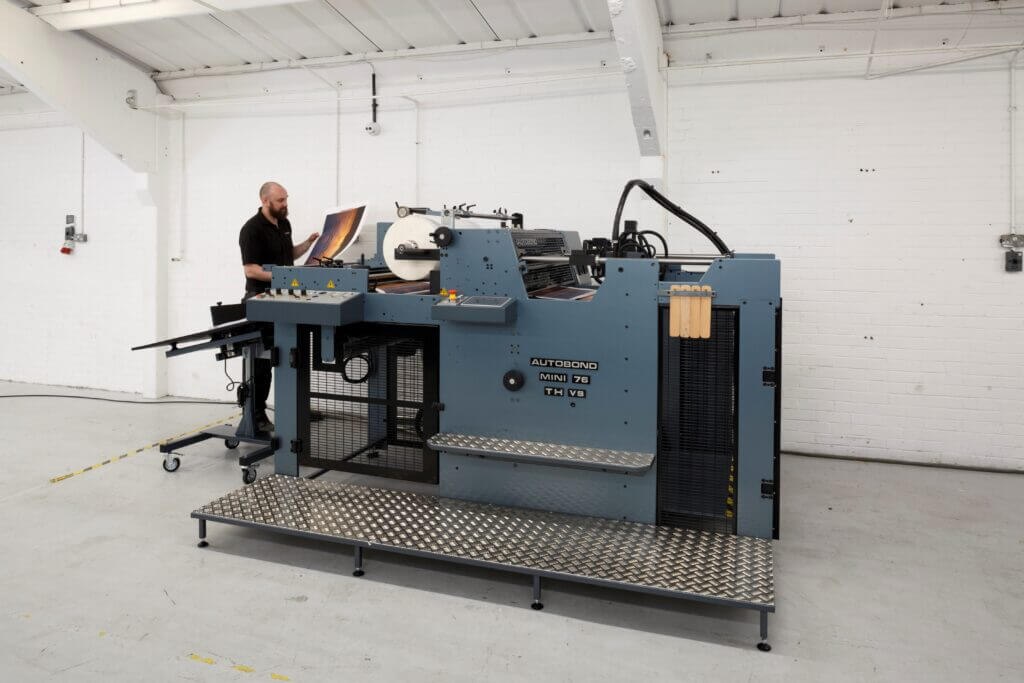
Image source: AUTOBOND Official Website
(https://www.autobondlaminating.com/machinery/thermal-lamination/mini/mini-76-th/)
(https://www.autobondlaminating.com/machinery/thermal-lamination/mini/mini-76-th/)
Example facilities
Printing factories, bookbinding lines, etc.
Reasons for recommendation
High-speed, continuous processing that can be integrated into mass-production lines
- Uses a steel side plate with a thickness of 20 mm described as sturdy like a tank. This rigid structure physically eliminates vibrations even at high-speed operations of 60 m per minute, maintaining stable processing accuracy.
- With a processing capacity of 60 m per minute, it can continuously handle large-format prints stably.
It demonstrates its true value when introduced as a part of a production line rather than as a standalone machine.
| Maximum processing speed | 60.0 m/min |
|---|---|
| Maximum width | 760 mm (B1+ compatible) |
| Warm-up | inquire for details |
| Processing type | roll type, single-sided or double-sided (borderless) |
| Voltage (CE) | inquire for details |
| Main unit dimensions | inquire for details |
*1. At 100°C (212°F) setting
*2. Dimensions when assembled, including the stand, tray, etc.