
Automatic Laminator Hub » Basic Knowledge About Laminators » What Should You Check Before Buying a Used Laminator?
What Should You Check Before Buying a Used Laminator?
A used laminator can cost less initially; wear, warranty, and repairs affect its long-term value too.
Key Takeaways
- Compare the asking price with likely maintenance and replacement costs.
- Request a test run and inspect the rollers, not just the exterior.
- Check warranty transfer, repair access, and return terms before payment.
- A new machine reduces uncertainty about its previous use and condition.
Benefits of Buying a Used Laminator
A used machine may lower the initial purchase cost. It can make sense when the seller documents its condition, allows a test run, and offers clear support or return terms.
Risks to Check Before Buying
Roller residue or damage can affect results
Adhesive residue, scratches, or uneven wear can interfere with feeding and finishing. Ask to see the rollers and laminate a sample before committing.
Warranty and parts coverage may be limited
Coverage depends on the manufacturer, model, seller, and purchase history. Confirm whether any warranty transfers and whether service parts remain available.
Previous use can be hard to assess
Without service records or usage history, remaining service life is uncertain. A low purchase price can be offset by repairs or an earlier replacement.
Used or New: Which Should You Choose?
Compare purchase price plus expected repairs and replacement against the cost of a new model. A new machine has a known starting condition and stated warranty terms; a tested, well-maintained used model may still suit a limited budget.
A Checklist for Used Laminators
Confirm size and roller specifications
Check supported document size, roller count, pouch thickness, and required power.
Inspect and test the rollers
Look for residue or visible damage, then run a sample pouch to check feeding and finish.
Read the seller’s terms
Confirm return eligibility, initial-defect support, repair options, and any remaining warranty in writing.
Conclusion
Choose based on condition and total ownership cost, not the initial price alone. If you are selecting equipment for regular production, explore our recommendations by production scale using the button below.
[Advertisement]
[By production scale]
Three Fully Automatic Laminators
[By production scale]
Three Fully Automatic Laminators
When choosing a fully automatic laminator, it is important to base your decision on the volume you process in a day rather than the size of the main unit or equipment scale.
This is an introduction to fully automatic laminators that match the workload and operational style of different production scales.
Advertiser Disclosure:
We receive compensation from some of the companies listed below.This compensation may affect which companies are included and the order in which they appear.
[About 100+ sheets per month]
Small-lot production
Small-lot production
GBC Foton 30
(ACCO Brands Corporation)
(ACCO Brands Corporation)
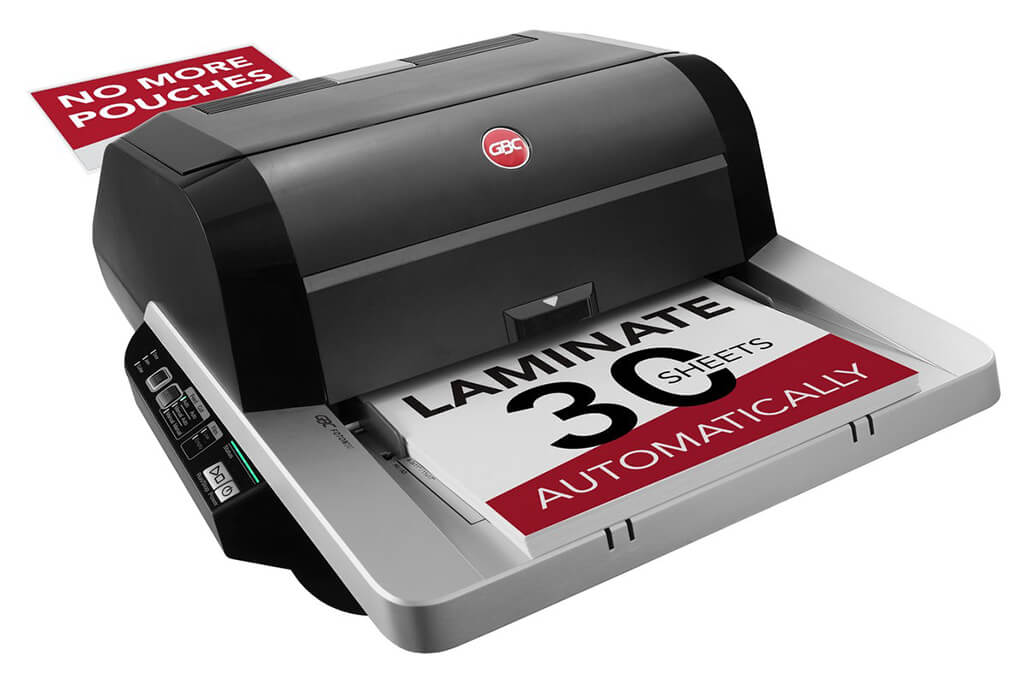
Image Source: ACCO Brands Corporation Official Site
(https://www.gbc-machines.com/products/gbc-foton-30-automatic-laminator)
(https://www.gbc-machines.com/products/gbc-foton-30-automatic-laminator)
Example facilities
Schools, hospitals, municipalities, etc.
Reasons for recommendation
Automates small-scale operations with fewer personnel
- With the push of a button, automatically laminates 30 sheets of A4 paper in 15 minutes. Its size allows it to be placed on a desk, making it easy to install.
- By fully automating the process from feeding to lamination, it enables the handling of jobs with low daily processing volumes in parallel with other operations.
The fact that it does not require dedicated operators or subsequent processes makes it suitable for small-scale sites.
| Maximum processing speed | 7.0 m/min |
|---|---|
| Maximum width | 297 mm (A3 compatible) |
| Warm-up | about 4 minutes |
| Processing type | roll type, double-sided (with borders) |
| Voltage (CE) | AC220 to 240V |
| Main unit dimensions | W 580 mm / D 440 mm / H 250 mm |
[About 1,000+ sheets per month]
Medium-lot production
Medium-lot production
Revo-Flex
(Lami Corporation)
(Lami Corporation)
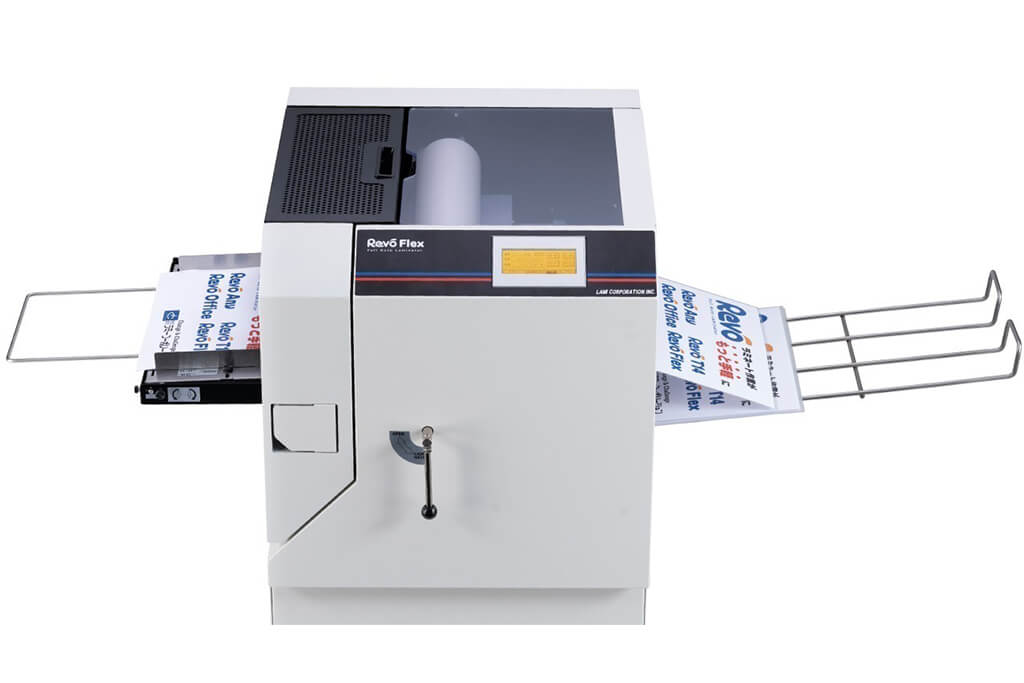
Image source: LAMI Corporation Official Website
(https://www.lami-corporation.co.jp/english/products/detail/51)
(https://www.lami-corporation.co.jp/english/products/detail/51)
Example facilities
Output centers, design offices, franchise headquarters, etc.
Reasons for recommendation
High-mix, fast-turnaround jobs are efficient through process reduction
- Completes trimming simultaneously with lamination, eliminating the need to move to subsequent processes or separate equipment.
Eliminates bottlenecks that tend to occur in on-demand printing and production sites. - High-precision automatic four-side trimming reduces trimming errors resulting from manual work, reducing film loss and the hassle of reprinting.
Even at sites with high-mix, small-lot production, it processes efficiently with consistent quality.
| Maximum processing speed | 2.0 m/min |
|---|---|
| Maximum width | 320 mm (SRA3 standard) |
| Warm-up | about 5 minutes *1 |
| Processing type | roll type, double-sided (border on/off selectable) |
| Voltage (CE) | AC230V |
| Main unit dimensions | W 1,300 mm / D 610 mm / H 1,080 mm *2 |
[10,000+ sheets per month]
High-lot production
High-lot production
Mini 76 TH
(Autobond Laminating)
(Autobond Laminating)
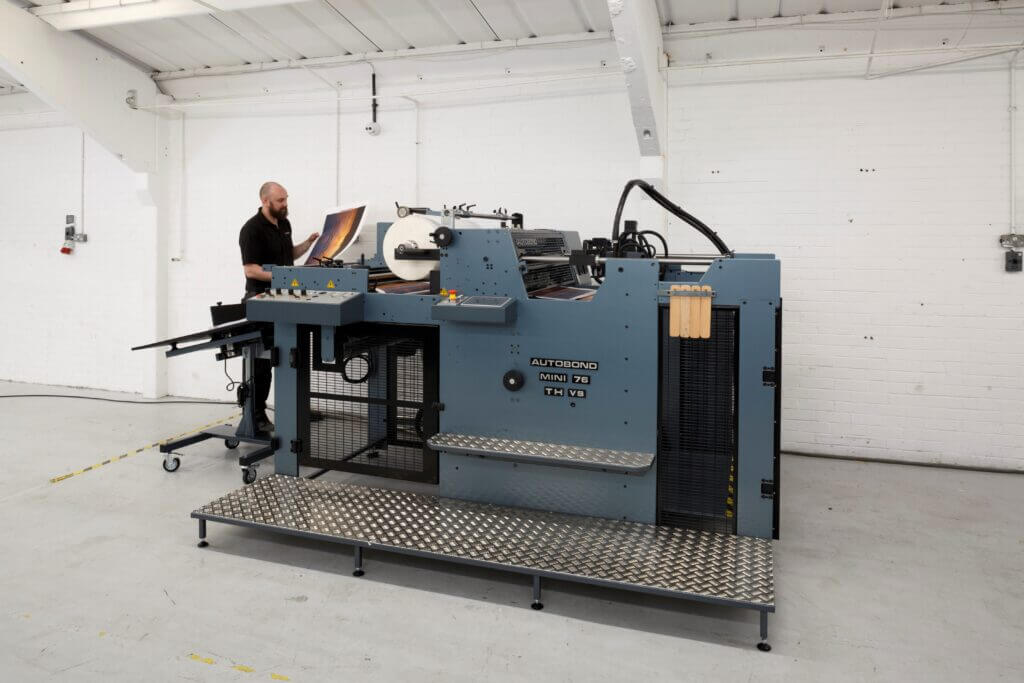
Image source: AUTOBOND Official Website
(https://www.autobondlaminating.com/machinery/thermal-lamination/mini/mini-76-th/)
(https://www.autobondlaminating.com/machinery/thermal-lamination/mini/mini-76-th/)
Example facilities
Printing factories, bookbinding lines, etc.
Reasons for recommendation
High-speed, continuous processing that can be integrated into mass-production lines
- Uses a steel side plate with a thickness of 20 mm described as sturdy like a tank. This rigid structure physically eliminates vibrations even at high-speed operations of 60 m per minute, maintaining stable processing accuracy.
- With a processing capacity of 60 m per minute, it can continuously handle large-format prints stably.
It demonstrates its true value when introduced as a part of a production line rather than as a standalone machine.
| Maximum processing speed | 60.0 m/min |
|---|---|
| Maximum width | 760 mm (B1+ compatible) |
| Warm-up | inquire for details |
| Processing type | roll type, single-sided or double-sided (borderless) |
| Voltage (CE) | inquire for details |
| Main unit dimensions | inquire for details |
*1. At 100°C (212°F) setting
*2. Dimensions when assembled, including the stand, tray, etc.