
Automatic Laminator Hub » Basic Knowledge About Laminators » What Is the Difference Between 2-Roller and 4-Roller Laminators?
What Is the Difference Between 2-Roller and 4-Roller Laminators?
Index
Key Takeaways
- Two rollers can cover occasional laminating with standard pouches.
- Four rollers add roller contact, though results still depend on the machine and materials.
- Check size, pouch thickness, and speed against your actual workload.
- Compare model specifications before deciding; roller count alone does not determine price or footprint.
Main Differences Between 2-Roller and 4-Roller Laminators
Roller design: two rollers versus added roller contact
A 2-roller pouch laminator uses two heated rollers to feed and seal the pouch. Many 4-roller models add two rollers to the system, but the arrangement varies by model. Check the manufacturer’s specifications to see which rollers are heated.
Finish: consider the whole laminating setup
Additional roller contact can support steadier feeding, but roller count alone does not guarantee a flat, bubble-free result. Temperature, speed, pouch thickness, and paper all affect the finish. Choose a model with settings suited to the materials you use.
Price and size: compare the specifications
A 4-roller model has more rollers, but its price and dimensions depend on the complete design. Compare listed prices, weight, and footprint directly. Do not assume that every 4-roller laminator costs more or takes up more space than every 2-roller model.
Features of 2-Roller Laminators
Advantages of 2-roller laminators
Two-roller models use a simple roller setup and are available in compact designs. They can meet everyday needs when you laminate standard documents or photos occasionally.
Disadvantages of 2-roller laminators
Some models offer fewer settings or a narrower range of compatible pouch thicknesses. Check the specifications before using thicker pouches or laminating large batches.
Best uses for 2-roller laminators
Choose a 2-roller model for home, classroom, or small-office jobs that involve modest volumes and common document sizes.
Features of 4-Roller Laminators
Advantages of 4-roller laminators
The added rollers give the pouch more roller contact during processing. Depending on the model, this can support steadier feeding and consistent results across repeated jobs.
Disadvantages of 4-roller laminators
Four rollers do not guarantee a better finish in every situation. Models vary in warm-up time, speed, compatible pouch thickness, weight, and price, so compare those details too.
Best uses for 4-roller laminators
Consider a 4-roller model when you laminate regularly and want to compare options with additional roller contact. Confirm its specifications match your materials and daily volume.
Three Points to Check When Choosing a Laminator
Confirm the supported size
Choose a machine that accepts your largest document. A4 and A3 models have different maximum entry widths.
Check compatible pouch thickness
Match the laminator’s supported thickness to your pouches. Thicker pouches require a model designed to handle them.
Compare warm-up time and laminating speed
Warm-up time affects when work can begin; processing speed affects how long a batch takes. Check both figures against how often and how much you laminate.
Conclusion
Choose a laminator based on your workload, document sizes, and pouch requirements.
If you are also considering automation for recurring or larger jobs, explore our recommendations by production scale using the button below.
[Advertisement]
[By production scale]
Three Fully Automatic Laminators
[By production scale]
Three Fully Automatic Laminators
When choosing a fully automatic laminator, it is important to base your decision on the volume you process in a day rather than the size of the main unit or equipment scale.
This is an introduction to fully automatic laminators that match the workload and operational style of different production scales.
Advertiser Disclosure:
We receive compensation from some of the companies listed below.This compensation may affect which companies are included and the order in which they appear.
[About 100+ sheets per month]
Small-lot production
Small-lot production
GBC Foton 30
(ACCO Brands Corporation)
(ACCO Brands Corporation)
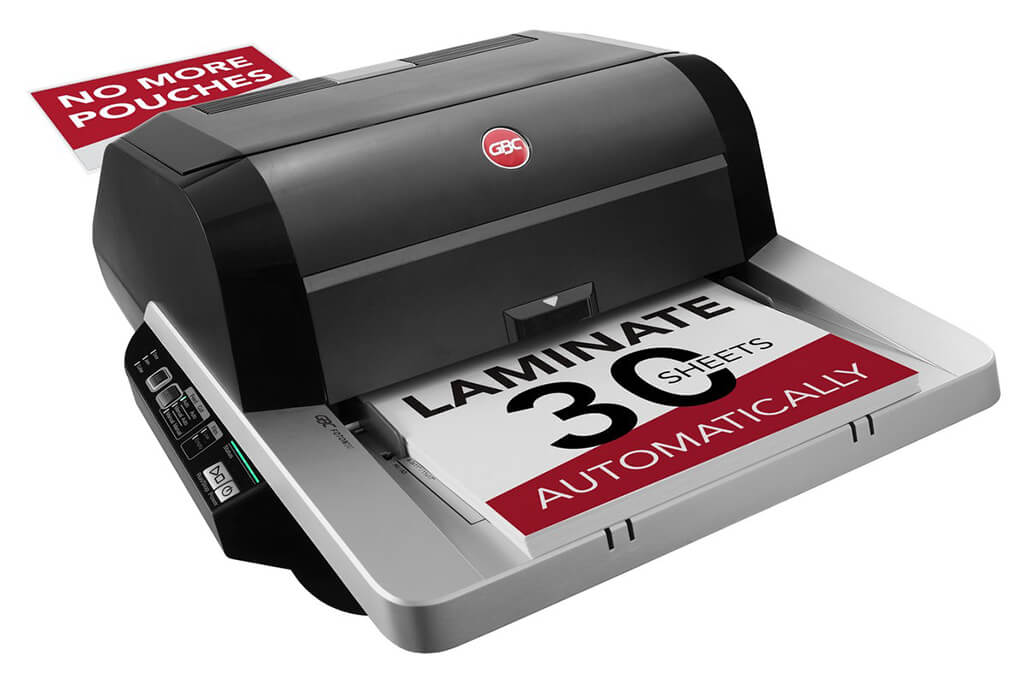
Image Source: ACCO Brands Corporation Official Site
(https://www.gbc-machines.com/products/gbc-foton-30-automatic-laminator)
(https://www.gbc-machines.com/products/gbc-foton-30-automatic-laminator)
Example facilities
Schools, hospitals, municipalities, etc.
Reasons for recommendation
Automates small-scale operations with fewer personnel
- With the push of a button, automatically laminates 30 sheets of A4 paper in 15 minutes. Its size allows it to be placed on a desk, making it easy to install.
- By fully automating the process from feeding to lamination, it enables the handling of jobs with low daily processing volumes in parallel with other operations.
The fact that it does not require dedicated operators or subsequent processes makes it suitable for small-scale sites.
| Maximum processing speed | 7.0 m/min |
|---|---|
| Maximum width | 297 mm (A3 compatible) |
| Warm-up | about 4 minutes |
| Processing type | roll type, double-sided (with borders) |
| Voltage (CE) | AC220 to 240V |
| Main unit dimensions | W 580 mm / D 440 mm / H 250 mm |
[About 1,000+ sheets per month]
Medium-lot production
Medium-lot production
Revo-Flex
(Lami Corporation)
(Lami Corporation)
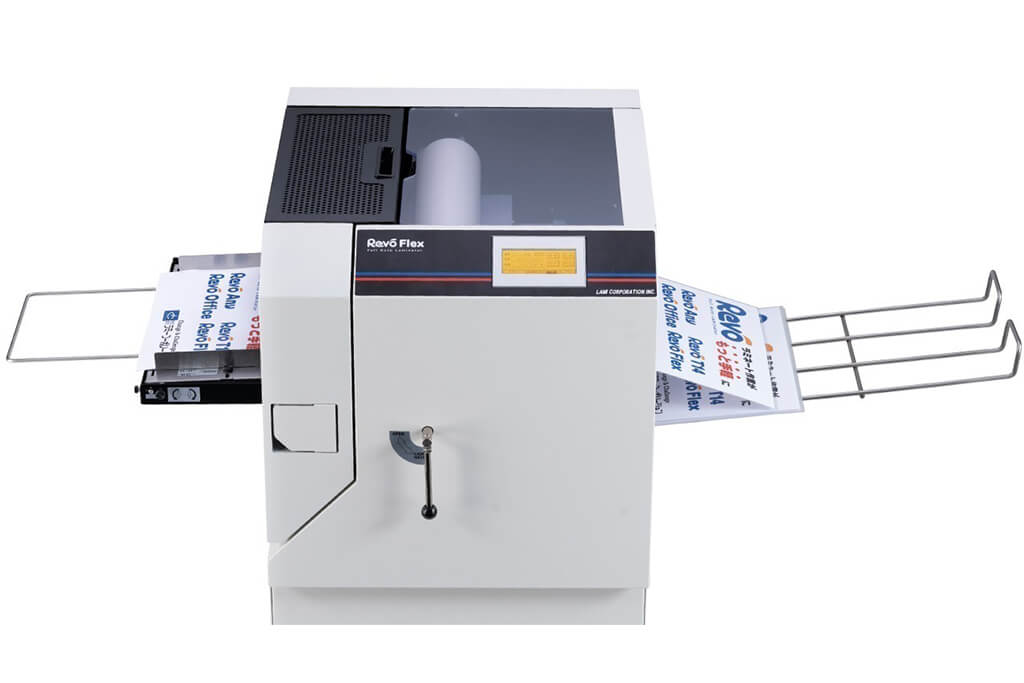
Image source: LAMI Corporation Official Website
(https://www.lami-corporation.co.jp/english/products/detail/51)
(https://www.lami-corporation.co.jp/english/products/detail/51)
Example facilities
Output centers, design offices, franchise headquarters, etc.
Reasons for recommendation
High-mix, fast-turnaround jobs are efficient through process reduction
- Completes trimming simultaneously with lamination, eliminating the need to move to subsequent processes or separate equipment.
Eliminates bottlenecks that tend to occur in on-demand printing and production sites. - High-precision automatic four-side trimming reduces trimming errors resulting from manual work, reducing film loss and the hassle of reprinting.
Even at sites with high-mix, small-lot production, it processes efficiently with consistent quality.
| Maximum processing speed | 2.0 m/min |
|---|---|
| Maximum width | 320 mm (SRA3 standard) |
| Warm-up | about 5 minutes *1 |
| Processing type | roll type, double-sided (border on/off selectable) |
| Voltage (CE) | AC230V |
| Main unit dimensions | W 1,300 mm / D 610 mm / H 1,080 mm *2 |
[10,000+ sheets per month]
High-lot production
High-lot production
Mini 76 TH
(Autobond Laminating)
(Autobond Laminating)
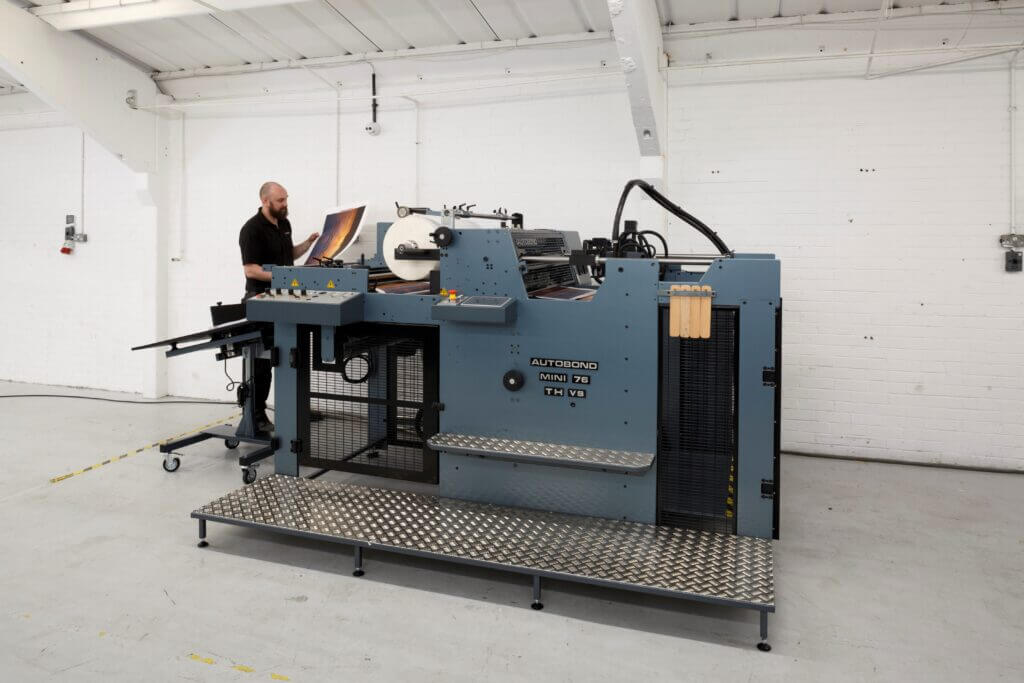
Image source: AUTOBOND Official Website
(https://www.autobondlaminating.com/machinery/thermal-lamination/mini/mini-76-th/)
(https://www.autobondlaminating.com/machinery/thermal-lamination/mini/mini-76-th/)
Example facilities
Printing factories, bookbinding lines, etc.
Reasons for recommendation
High-speed, continuous processing that can be integrated into mass-production lines
- Uses a steel side plate with a thickness of 20 mm described as sturdy like a tank. This rigid structure physically eliminates vibrations even at high-speed operations of 60 m per minute, maintaining stable processing accuracy.
- With a processing capacity of 60 m per minute, it can continuously handle large-format prints stably.
It demonstrates its true value when introduced as a part of a production line rather than as a standalone machine.
| Maximum processing speed | 60.0 m/min |
|---|---|
| Maximum width | 760 mm (B1+ compatible) |
| Warm-up | inquire for details |
| Processing type | roll type, single-sided or double-sided (borderless) |
| Voltage (CE) | inquire for details |
| Main unit dimensions | inquire for details |
*1. At 100°C (212°F) setting
*2. Dimensions when assembled, including the stand, tray, etc.