
Automatic Laminator Hub » Basic Knowledge About Laminators » Automatic Laminator Price: Evaluating Classes and Per-Sheet Cost Breakdowns
Automatic Laminator Price: Evaluating Classes and Per-Sheet Cost Breakdowns
Index
When researching an automatic laminator price, you might see results ranging from a few hundred to tens of thousands of dollars, making it difficult to identify the right fit for your facility. To grasp the true financial commitment, you must evaluate costs through two critical lenses: categorizing by machine tier, and separating the initial equipment cost from the per-sheet processing cost.
This article breaks down pricing by equipment class and details the hidden factors that determine your exact per-sheet cost.
Key Takeaways
- You cannot accurately compare costs without separating the initial equipment purchase from ongoing per-sheet expenses.
- No single average price exists; capital requirements shift dramatically depending on the machine's operational class.
- Per-sheet costs consist of four core elements: film, power, waste, and labor.
- If a machine requires manual trimming, labor will dominate your per-sheet cost structure.
- When analyzing in house lamination vs outsourcing, you must factor in shipping costs and transit days alongside the raw processing fee.
The Two-Tiered Cost Structure: Equipment Cost vs. Per-Sheet Cost
Laminator expenses operate on a two-tier structure: the one-time upfront payment and the continuous cost incurred for every sheet processed.
The initial equipment cost includes the base price on the quote, plus bundled film, on-site installation fees, and initial maintenance contracts.
However, corporate approval rarely hinges on the initial price alone; management scrutinizes the projected return on investment (ROI). Therefore, you must clearly separate the capital expenditure from the daily operational per-sheet cost. Even if a fully automatic laminator requires a high initial investment, driving down the per-sheet cost establishes a reliable path to long-term cost recovery.
Pricing Tiers by Machine Class
You must evaluate the automatic laminator price based on three distinct operational classes. Cross-class price comparisons are meaningless.
| Class | Intended Application | Max Size (Approx.) | Price Range | Source & Date |
|---|---|---|---|---|
| Desktop Automated Laminators | Office & School Signage | A3 Class | ¥175,780 - ¥747,780 (Tax Included) | MonotaRO (Verified Aug 24, 2026) |
| Mid-Volume Integrated Trimming Laminators | Print Shops & In-house Processing | A3 and up | Not specified | Not specified |
| Wide-Format & Industrial Laminators | Commercial Print Factories & Binderies | B2 and larger | Not specified | Not specified |
Price disparities between classes stem from factors such as roller count, continuous-duty durability, automated trimming capabilities, and electrical requirements.
*1 Reference: MonotaRO Official Website (https://www.monotaro.com/s/q-オートフィードラミネーター/) (Verified August 2026)
*2 Reference: MonotaRO Official Website (https://www.monotaro.com/s/b-14445/) (Verified August 2026)
Desktop models offer an accessible entry price, but they often leave manual trimming tasks to the operator, driving up labor costs during high-volume runs. Mid-volume integrated trimming laminators demand a higher initial investment, but they automate the entire finishing process, drastically cutting labor hours.
Wide-format and industrial machines require massive capital expenditure but maximize throughput and efficiency for commercial mass production.
Breakdown of Per-Sheet Costs
Calculate your exact per-sheet cost by adding four distinct operational expenses: film, power, waste, and labor.
Film Costs
Film forms the baseline of your running costs. Prices fluctuate based on thickness (microns), roll width, and length. Offices typically standardize on 100-micron film*3. While utilizing 150-micron or 250-micron film expands your capabilities for outdoor signage, it proportionally increases the unit cost of the film.
*3 Reference: Inashin Official Website (https://www.inashin.co.jp/blog/lami-film-thickness2302/)
Power Consumption
Because laminators rely on heat for adhesion, electricity consumption directly impacts operating costs. Machines draw different power levels during the warm-up phase versus continuous operation. You must factor the electricity consumed during active processing hours into your per-sheet calculations.
Waste (Spoilage and Discarded Film)
Operators frequently overlook the cost of waste. This includes reprints caused by incorrect settings, discarded film between sheets, and edge scraps from trimming. Even a fully automatic laminator generates a certain percentage of waste, so you must build a spoilage allowance into your cost projections.
Labor Costs
The labor required to operate the machine is a critical cost driver. Rather than guessing, calculate this by multiplying your facility's hourly wage by the actual operator time required. Be aware that if your setup relies on manual feeding, trimming, or constant monitoring, labor will quickly dominate your per-sheet cost.
The Relationship Between Film Thickness and Finish
How to Choose Lamination Films and Rolls
Comparing Internal Costs Against Outsourcing
When analyzing in house lamination vs outsourcing, your cost matrix must include two-way shipping fees and delivery lead times—not just the raw processing rate.
External contractors benefit from economies of scale, often lowering their per-unit processing fee as volumes increase. However, outsourcing forces you to absorb shipping fees, packaging labor, and transit delays. For smaller batches, outsourcing often becomes a financial liability once you account for freight and lost time.
For example, public pricing in the US market (as of August 2026) shows walk-in outsourcing rates ranging from approximately $1.89 to $2.49 per sheet, depending on film thickness. You must benchmark these figures against your internal per-sheet cost.
*4 Reference: The Pricer Official Website (https://www.thepricer.org/the-cost-of-laminating/)
*5 Reference: Climb the Ladder Official Website (https://climbtheladder.com/how-much-does-it-cost-to-get-something-laminated/)
Conversely, many facilities significantly lower their per-sheet costs by bringing lamination in-house. Case studies show that transitioning poster lamination to internal processing cuts external expenses while simultaneously accelerating turnaround times.
*6 Reference: Fujitex (https://journal.fjtex.co.jp/n/n11a7bdbd02d4)
Cost Checklist for Fully Automatic Laminators
Before finalizing a quote, account for these five critical items beyond the base equipment price.
Use this checklist to uncover hidden expenses when evaluating an automated laminator:
- Film availability and compatibility (Does it require proprietary manufacturer film, or can it run generic rolls?)
- Consumable pricing (Costs for routine replacement parts and rollers)
- Maintenance terms (Availability and cost of manufacturer service contracts)
- Trimming capabilities (Does the machine feature auto-cutting, or does it leave manual trimming to your staff?)
- Electrical infrastructure (Will your facility require a 200V/220V power drop installation?)
Proactively verifying these items prevents budget overruns after deployment.
- For a deeper dive into processing setups: In House Lamination vs Outsourcing
- Learn about automated trimming features: Automated Trimming Functions
- Essential specs for requesting quotes: Quote Request Checklist
FAQ
Q. How wide is the automatic laminator price range?
A. It depends entirely on the application. Desktop models for offices start around the $1,000 range, while industrial wide-format machines for commercial printers cost tens of thousands of dollars.
Q. How do we calculate the true per-sheet cost?
A. Add four factors: film material cost, electricity consumption, waste/spoilage costs, and labor (calculated as hourly wage multiplied by operator time).
Q. Does thicker film increase processing costs?
A. Yes. As you upgrade from a standard 100-micron film to 150- or 250-micron thicknesses, the unit price of the film material naturally increases.
Q. Will bringing lamination in-house guarantee cost savings?
A. Not necessarily, due to the required initial capital investment. You must forecast the payback period based on your monthly volume and hourly labor rates.
Q. What cost factors are most commonly overlooked on quotes?
A. Buyers frequently miss freight and rigging fees, dedicated electrical installation costs, recurring maintenance contract fees, and the hidden labor costs associated with manual margin trimming.
Conclusion
To accurately evaluate an automatic laminator price, start by categorizing machines into distinct classes; eliminate models that do not fit your production tier. Next, clearly separate the initial equipment cost from the ongoing per-sheet cost to project the total cost of ownership.
By analyzing these two critical axes, you can confidently select an automated laminator that aligns with your facility's production volume and budget constraints, ultimately settling the debate of in house lamination vs outsourcing.
[By production scale]
Three Fully Automatic Laminators
Three Fully Automatic Laminators
When choosing a fully automatic laminator, it is important to base your decision on the volume you process in a day rather than the size of the main unit or equipment scale.
This is an introduction to fully automatic laminators that match the workload and operational style of different production scales.
[About 100+ sheets per month]
Small-lot production
Small-lot production
GBC Foton 30
(ACCO Brands Corporation)
(ACCO Brands Corporation)
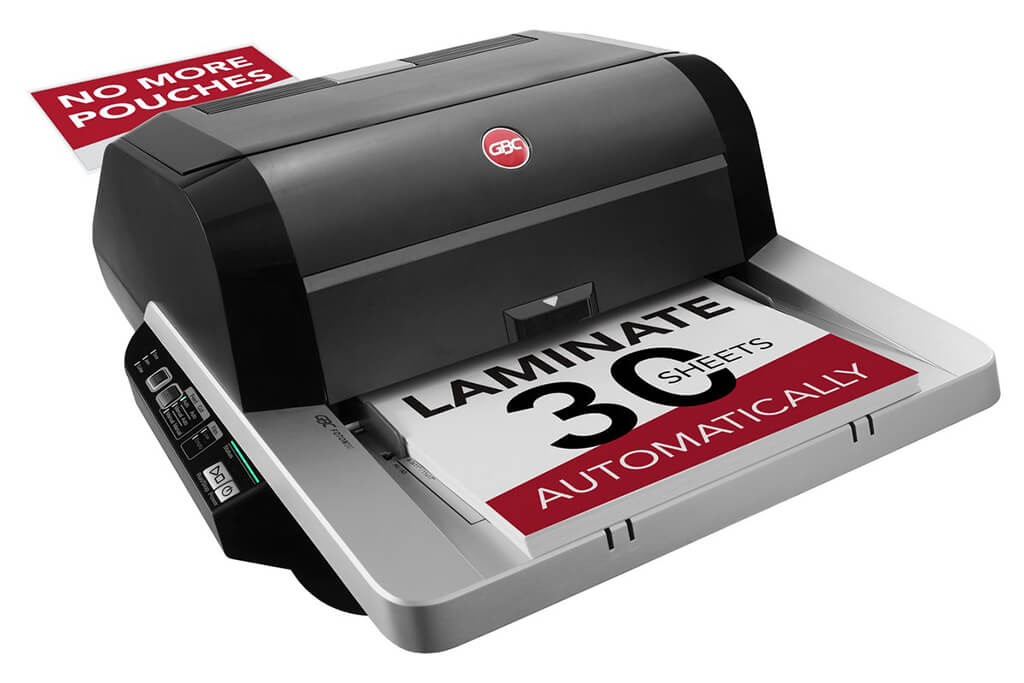
Image Source: ACCO Brands Corporation Official Site
(https://www.gbc-machines.com/products/gbc-foton-30-automatic-laminator)
(https://www.gbc-machines.com/products/gbc-foton-30-automatic-laminator)
Example facilities
Schools, hospitals, municipalities, etc.
Reasons for recommendation
Automates small-scale operations with fewer personnel
- With the push of a button, automatically laminates 30 sheets of A4 paper in 15 minutes. Its size allows it to be placed on a desk, making it easy to install.
- By fully automating the process from feeding to lamination, it enables the handling of jobs with low daily processing volumes in parallel with other operations.
The fact that it does not require dedicated operators or subsequent processes makes it suitable for small-scale sites.
| Maximum processing speed | 7.0 m/min |
|---|---|
| Maximum width | 297 mm (A3 compatible) |
| Warm-up | about 4 minutes |
| Processing type | roll type, double-sided (with borders) |
| Voltage (CE) | AC220 to 240V |
| Main unit dimensions | W 580 mm / D 440 mm / H 250 mm |
[About 1,000+ sheets per month]
Medium-lot production
Medium-lot production
Revo-Flex
(Lami Corporation)
(Lami Corporation)
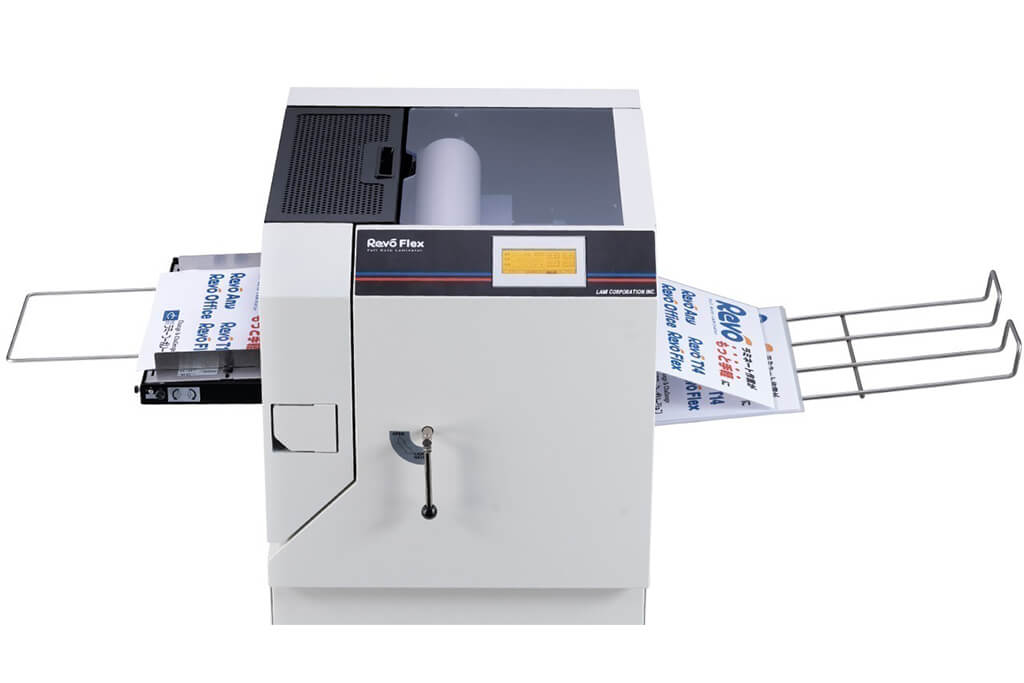
Image source: LAMI Corporation Official Website
(https://www.lami-corporation.co.jp/english/products/detail/51)
(https://www.lami-corporation.co.jp/english/products/detail/51)
Example facilities
Output centers, design offices, franchise headquarters, etc.
Reasons for recommendation
High-mix, fast-turnaround jobs are efficient through process reduction
- Completes trimming simultaneously with lamination, eliminating the need to move to subsequent processes or separate equipment.
Eliminates bottlenecks that tend to occur in on-demand printing and production sites. - High-precision automatic four-side trimming reduces trimming errors resulting from manual work, reducing film loss and the hassle of reprinting.
Even at sites with high-mix, small-lot production, it processes efficiently with consistent quality.
| Maximum processing speed | 2.0 m/min |
|---|---|
| Maximum width | 320 mm (SRA3 standard) |
| Warm-up | about 5 minutes *1 |
| Processing type | roll type, double-sided (border on/off selectable) |
| Voltage (CE) | AC230V |
| Main unit dimensions | W 1,300 mm / D 610 mm / H 1,080 mm *2 |
[10,000+ sheets per month]
High-lot production
High-lot production
Mini 76 TH
(Autobond Laminating)
(Autobond Laminating)
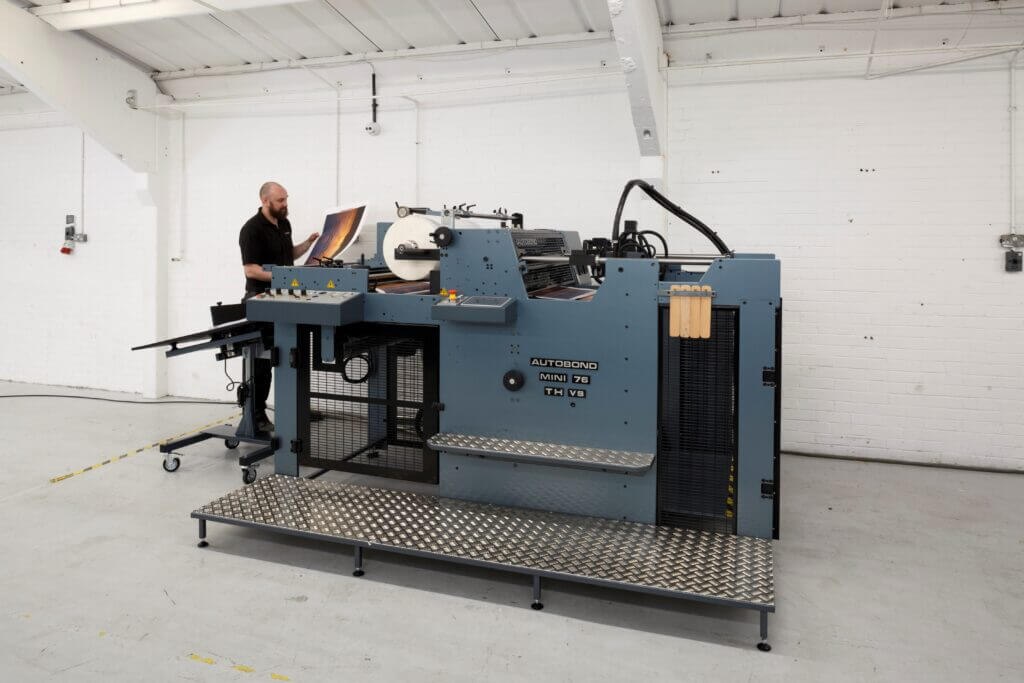
Image source: AUTOBOND Official Website
(https://www.autobondlaminating.com/machinery/thermal-lamination/mini/mini-76-th/)
(https://www.autobondlaminating.com/machinery/thermal-lamination/mini/mini-76-th/)
Example facilities
Printing factories, bookbinding lines, etc.
Reasons for recommendation
High-speed, continuous processing that can be integrated into mass-production lines
- Uses a steel side plate with a thickness of 20 mm described as sturdy like a tank. This rigid structure physically eliminates vibrations even at high-speed operations of 60 m per minute, maintaining stable processing accuracy.
- With a processing capacity of 60 m per minute, it can continuously handle large-format prints stably.
It demonstrates its true value when introduced as a part of a production line rather than as a standalone machine.
| Maximum processing speed | 60.0 m/min |
|---|---|
| Maximum width | 760 mm (B1+ compatible) |
| Warm-up | inquire for details |
| Processing type | roll type, single-sided or double-sided (borderless) |
| Voltage (CE) | inquire for details |
| Main unit dimensions | inquire for details |
*1. At 100°C (212°F) setting
*2. Dimensions when assembled, including the stand, tray, etc.