
Automatic Laminator Hub » Choosing a Laminator [by Type]
Choosing a Laminator [by Type]
Index
This article is written for corporate buyers considering the introduction of a professional laminator. It brings together the key points for choosing the right machine for professional use—so you don’t end up with the wrong fit—covering laminating method, document size and throughput.
Main Types of Laminators
An overview of the different types of laminators, focusing on differences in lamination process, heating method and the bonding surface.
Pouch Laminators
Pouch laminators work by placing your document inside a pouch and feeding it through the machine one sheet at a time. They’re straightforward to use and ideal when you need consistent, reliable results in small batches—perfect for standard-size documents, notices for display, and cards.
Hot Pouch Laminator
Hot pouch laminators use heat and roller pressure to activate the adhesive layer inside the film and bond it under pressure. They typically deliver an even, consistent finish and make it easy to achieve strong water resistance and durability. On the other hand, they’re not suitable for heat-sensitive materials. This is the most common type used in offices and schools.
Cold Pouch Laminator
Cold pouch laminators use pressure-sensitive (adhesive) film that bonds with pressure alone, so no heat is required. This makes them well suited to photographs, heat-sensitive materials, and thermal paper.
They’re a practical option when you want to avoid heat-related issues, but it’s worth noting that adhesive films can be more affected by the working environment—such as dust, humidity, or oils from hands—as well as by how accurately the material is aligned when laminating.
Roll Feed Laminators
Roll feed laminators use film supplied on a roll, which enables continuous laminating. They’re suited to workplaces that need to process posters, signs, menus, and display materials together, as well as production environments where long-format output and a mix of non-standard sizes are common. They’re also a good fit for factories and print-related operations where lead times are short and the workload peaks.
Hot Roll Laminator
Hot roll laminators use heat to activate the adhesive layer and bond under pressure, making it easier to achieve close adhesion and a clear finish, while also ensuring high durability. They’re suited to high-volume processing and long periods of continuous operation.
Cold Roll Laminator
A cold roll laminator applies adhesive film using pressure alone—no heat—making it ideal for heat-sensitive media such as inkjet prints, photographs and thermal paper. With no warm-up required, setup is quick and efficient. However, the finished look can vary depending on the application, particularly in terms of stiffness and edge handling, so careful operation is important.
Single Roll Laminator
Available in both hot and cold formats, a single roll laminator is designed for one-sided lamination only. It’s well suited to sign applications, mounting onto panels, and protecting the surface of printed output—ideal when you want to protect just one side or when the work will be laminated and then handled in a subsequent process.
Double Roll Laminator
A double roll laminator laminates both sides simultaneously, making it ideal for applications where documents and printed materials need protection on both sides to enhance durability. Available in both hot and cold formats, it’s commonly used in professional environments for continuous processing.
Choosing a Laminator by Size
The model you need will vary greatly depending on the sizes you plan to handle. Size affects more than just the finished output—it also influences installation requirements and processing efficiency—so choose a machine that matches the needs of your workplace.
A4 Laminator
Ideal for environments where documents and notices are the main focus. Well suited to offices and schools, as well as day-to-day signage such as HR and general affairs notices, factory safety notices, facility guidance, and signage in healthcare and care settings, where materials need to be produced and displayed quickly as part of daily operations.
A3 Laminator
A good fit for workplaces that increasingly handle printed materials for business use and presentations, such as print shops and other professional settings. For in-store POPs, menus, and notice posters, A3 is a practical choice when A4 doesn’t provide enough space but you don’t need an oversized format—offering an easy balance between visibility and handling.
A2 and Larger (Large Format)
This size is aimed at print shops and production environments handling posters, signage, exhibition materials, guidance boards, and other large-format outputs. It’s important to consider more than just where and how the machine will be installed—whether it’s floor-standing or on a dedicated stand or table. You should also check the delivery route, the space available for operation, and whether you have a suitable table for laying out materials.
Choosing a Laminator Based on Processing Frequency and Workload
As your workload increases, the burden of manual feeding and setup tasks quickly adds up, putting pressure on overall working time.
For small volumes processed only a few times a month, a pouch laminator or compact machine is usually sufficient. But in workplaces handling medium to high volumes, choosing a model that can automate feeding and setup is key to improving productivity.
Considering a Fully Automatic Laminator
By choosing a fully automatic laminator that lets you load a stack of sheets and automates the process from feeding through to lamination, you can reduce working time and achieve more consistent results.
This site also introduces fully automatic laminators by production scale, so it can serve as a useful reference.
[By production scale]
Three Fully Automatic Laminators
Three Fully Automatic Laminators
When choosing a fully automatic laminator, it is important to base your decision on the volume you process in a day rather than the size of the main unit or equipment scale.
This is an introduction to fully automatic laminators that match the workload and operational style of different production scales.
[About 100+ sheets per month]
Small-lot production
Small-lot production
GBC Foton 30
(ACCO Brands Corporation)
(ACCO Brands Corporation)
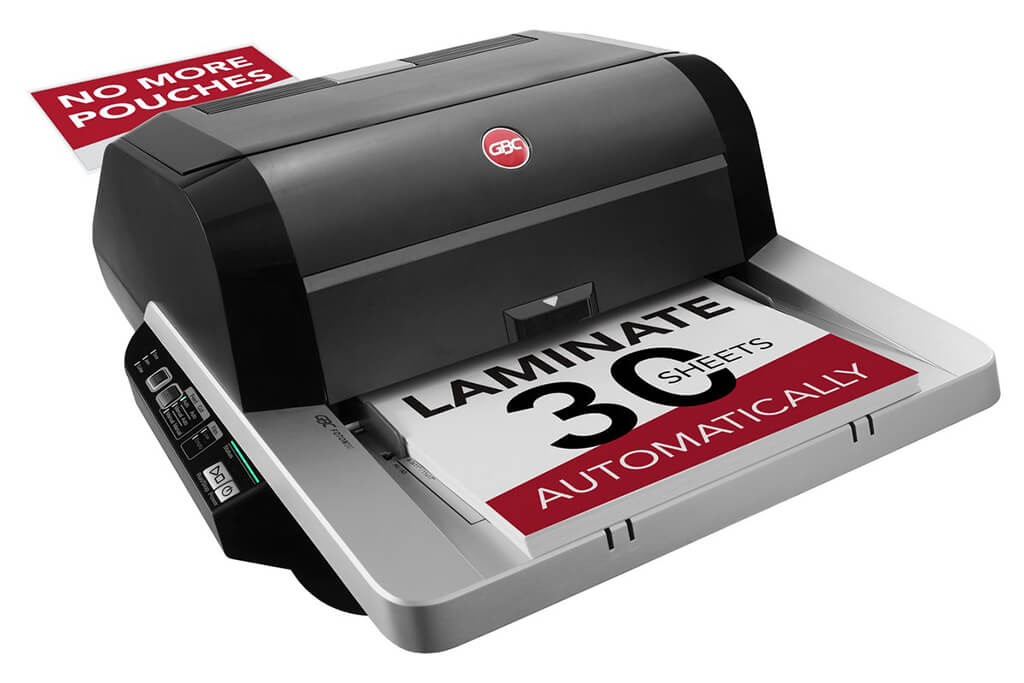
Image Source: ACCO Brands Corporation Official Site
(https://www.gbc-machines.com/products/gbc-foton-30-automatic-laminator)
(https://www.gbc-machines.com/products/gbc-foton-30-automatic-laminator)
Example facilities
Schools, hospitals, municipalities, etc.
Reasons for recommendation
Automates small-scale operations with fewer personnel
- With the push of a button, automatically laminates 30 sheets of A4 paper in 15 minutes. Its size allows it to be placed on a desk, making it easy to install.
- By fully automating the process from feeding to lamination, it enables the handling of jobs with low daily processing volumes in parallel with other operations.
The fact that it does not require dedicated operators or subsequent processes makes it suitable for small-scale sites.
| Maximum processing speed | 7.0 m/min |
|---|---|
| Maximum width | 297 mm (A3 compatible) |
| Warm-up | about 4 minutes |
| Processing type | roll type, double-sided (with borders) |
| Voltage (CE) | AC220 to 240V |
| Main unit dimensions | W 580 mm / D 440 mm / H 250 mm |
[About 1,000+ sheets per month]
Medium-lot production
Medium-lot production
Revo-Flex
(Lami Corporation)
(Lami Corporation)
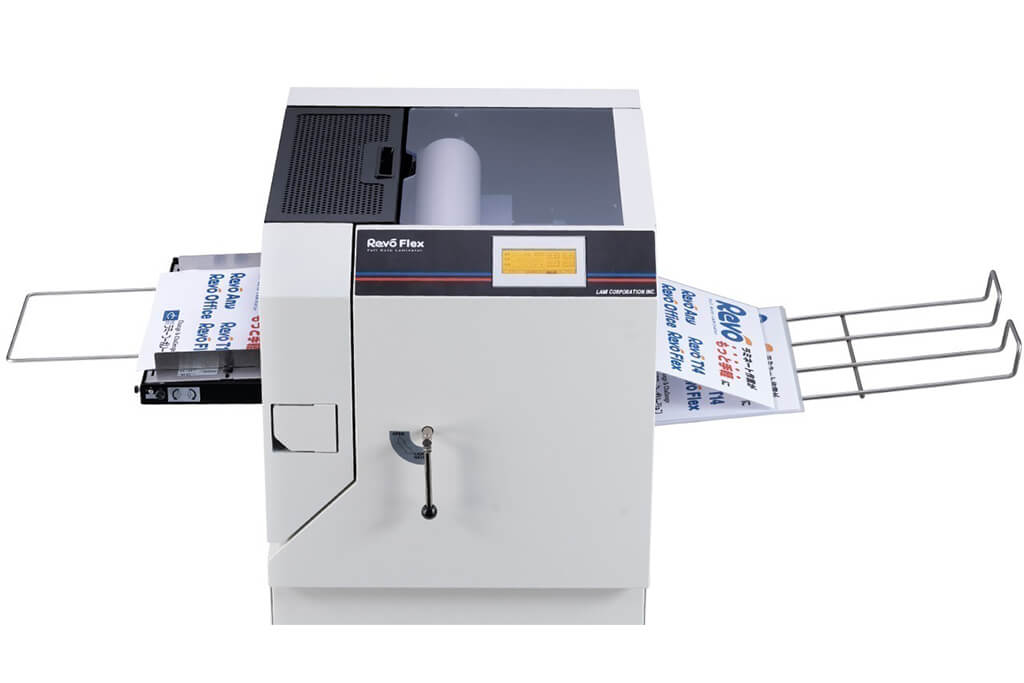
Image source: LAMI Corporation Official Website
(https://www.lami-corporation.co.jp/english/products/detail/51)
(https://www.lami-corporation.co.jp/english/products/detail/51)
Example facilities
Output centers, design offices, franchise headquarters, etc.
Reasons for recommendation
High-mix, fast-turnaround jobs are efficient through process reduction
- Completes trimming simultaneously with lamination, eliminating the need to move to subsequent processes or separate equipment.
Eliminates bottlenecks that tend to occur in on-demand printing and production sites. - High-precision automatic four-side trimming reduces trimming errors resulting from manual work, reducing film loss and the hassle of reprinting.
Even at sites with high-mix, small-lot production, it processes efficiently with consistent quality.
| Maximum processing speed | 2.0 m/min |
|---|---|
| Maximum width | 320 mm (SRA3 standard) |
| Warm-up | about 5 minutes *1 |
| Processing type | roll type, double-sided (border on/off selectable) |
| Voltage (CE) | AC230V |
| Main unit dimensions | W 1,300 mm / D 610 mm / H 1,080 mm *2 |
[10,000+ sheets per month]
High-lot production
High-lot production
Mini 76 TH
(Autobond Laminating)
(Autobond Laminating)
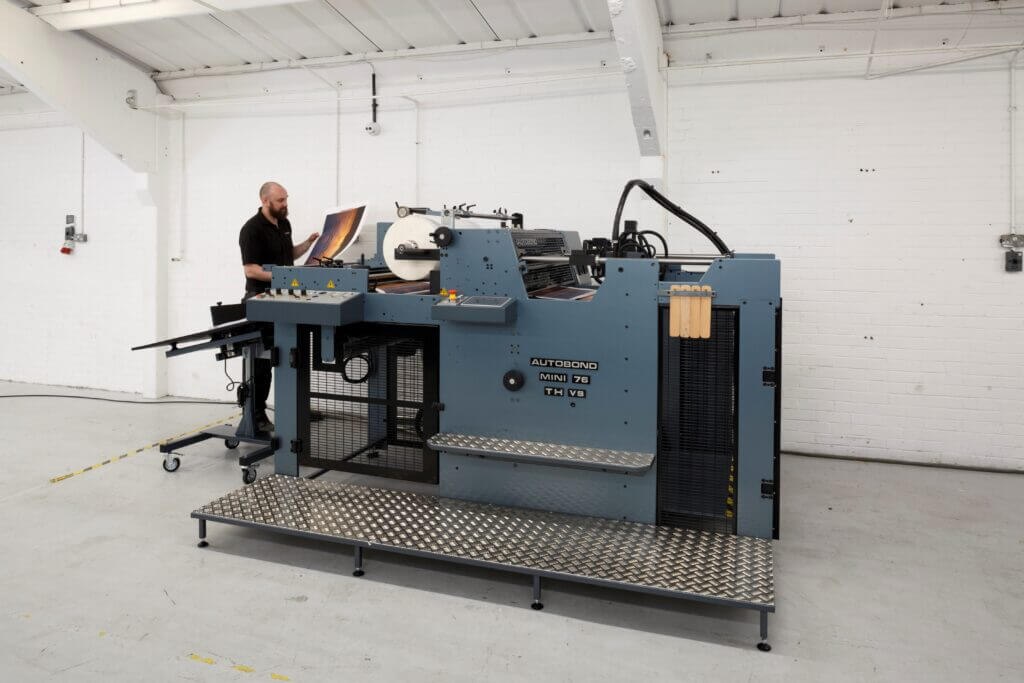
Image source: AUTOBOND Official Website
(https://www.autobondlaminating.com/machinery/thermal-lamination/mini/mini-76-th/)
(https://www.autobondlaminating.com/machinery/thermal-lamination/mini/mini-76-th/)
Example facilities
Printing factories, bookbinding lines, etc.
Reasons for recommendation
High-speed, continuous processing that can be integrated into mass-production lines
- Uses a steel side plate with a thickness of 20 mm described as sturdy like a tank. This rigid structure physically eliminates vibrations even at high-speed operations of 60 m per minute, maintaining stable processing accuracy.
- With a processing capacity of 60 m per minute, it can continuously handle large-format prints stably.
It demonstrates its true value when introduced as a part of a production line rather than as a standalone machine.
| Maximum processing speed | 60.0 m/min |
|---|---|
| Maximum width | 760 mm (B1+ compatible) |
| Warm-up | inquire for details |
| Processing type | roll type, single-sided or double-sided (borderless) |
| Voltage (CE) | inquire for details |
| Main unit dimensions | inquire for details |
*1. At 100°C (212°F) setting
*2. Dimensions when assembled, including the stand, tray, etc.