
A1 Laminator
Index
This article explains A1 laminators from a business-use perspective, focusing on large-format output, consistent finishing quality, and efficient processing for workplaces that handle posters, drawings, display materials, and signage.
Typical Applications and Where A1 Laminators Are Used
- Print shops and large-format finishing companies
Posters, presentation panels, display boards, maps, POP materials and promotional graphics - Signage and display production companies
In-store signs, exhibition graphics, indoor notices and laminated visual materials - Architecture, engineering and construction companies
Protecting drawings, plans, site maps and reference documents used repeatedly in project environments - Schools, universities and educational institutions
Laminating teaching materials, wall displays, event posters and large-format learning aids - Government offices and public-sector facilities
Protecting public notices, evacuation maps, facility guides and long-term display documents - Corporate in-house production teams
Finishing training materials, presentation boards, office signage and internal communication displays
Why A1 is chosen for large-format work
A1 is often chosen when A3 or A2 does not provide sufficient space for visual information. It allows posters, drawings, and display materials to be presented at a scale that is easy to read from a distance.
For workplaces that handle technical drawings, notices or presentation boards, A1 provides a practical balance between impact and manageability. It is large enough for detailed information, but still easier to handle than A0 and other very large formats.
Because A1 sheets are physically large, the laminator itself must be selected with more care than a small-format desktop machine. Feed stability, roll width, installation space and operator handling all become important factors.
A1 vs SRA1: Size Comparison
SRA1 is a paper size designed to produce a finished A1 sheet. It includes extra margins for trimming.
In professional printing and finishing, oversized sheets may be used before trimming to the final A1 size. This helps compensate for print registration variations, lamination alignment, and post-lamination trimming. When choosing a professional A1 laminator, it is important to confirm whether the machine can handle the sheet size used in your actual workflow, not only the final A1 size.
| Item | A1 | SRA1 |
|---|---|---|
| Size | 594×841 mm | 640×900 mm |
| Primary use | Finished size | Pre-processing size |
| Margins | None | Trimming margins included |
Pre-purchase Checks
- Maximum laminating width and supported sheet size
- Compatibility with A1 only, or with SRA1 and other oversized sheets
- Supported paper thickness and material type
- Laminating speed and continuous throughput
- Warm-up time and temperature consistency
- Film width, film thickness and roll outer diameter compatibility
- Ease of film replacement and roll loading
- Installation requirements, including machine footprint and working space
- Operator skill level and availability of automatic settings
For A1 workflows, size alone is not enough to judge suitability. A machine may support A1 in theory, but if the feed width, film compatibility or processing speed does not match the workplace, it can slow down the entire finishing process.
Before purchase, check how the machine performs under real operating conditions: the number of sheets processed per day, the materials being laminated, the available installation space and the experience level of the operator. The goal is to select a model that will not become a bottleneck when large-format work increases.
Planning for Higher Processing Volumes
When choosing an A1 laminator, processing frequency is just as important as maximum size.
Large-format sheets take more time and space to handle than smaller sheets. As volume increases, repeated manual feeding, alignment and film replacement can create significant time loss. For business use, this is where automation and stable sheet handling become especially important.
On this site, we have carefully selected fully automatic laminator models by production scale across different facilities. Use this as a reference when considering your introduction.
How to Choose Film for a Roll-Type A1 Laminator
- Film thickness: light-duty (25–50 μm) / medium-duty (75–100 μm) / heavy-duty (125–250 μm)
- Surface finish: gloss or matte
- Roll width: wide enough to cover A1 or SRA1 sheets with appropriate margins
- Roll length: short rolls for occasional use / long rolls for continuous production
- Core diameter: check the machine specifications before purchase
- Roll outer diameter: confirm the maximum roll size supported by the laminator
Choose the film thickness and finish according to the application. Gloss film gives posters and display materials a clear, vivid appearance, while matt film helps reduce glare and can be easier to read under strong lighting.
For A1 work, roll width is especially important. The film must be wide enough for the sheet size and any trimming margin required by the workflow. Checking film compatibility in advance is essential, particularly when using SRA1 or other oversized materials.
With automated or professional models, heavy rolls and wider films are easier to manage, reducing set-up errors and helping output remain stable. Alongside size and speed, make sure to review the film-loading mechanism and automation features.
FAQs About A1 Laminators
Q. What kind of workplace needs an A1 laminator?
A. An A1 laminator is well suited to workplaces that regularly handle large-format materials such as posters, drawings, maps, display boards and signage.
It is especially useful for print shops, signage companies, schools, public facilities and technical departments that need to protect large documents while keeping them easy to read and handle.
Q. What should I check first when comparing A1 laminators?
A. Start by checking the maximum laminating width and the actual sheet sizes used in your production workflow.
If your workplace prints on oversized paper before trimming, A1 support alone may not be enough. Confirm whether the machine can handle SRA1 or the specific pre-trim size you use. After that, compare speed, film compatibility, installation space and ease of operation.
Q. Is a roll laminator better than a pouch laminator for A1 size?
A. For large-format applications and regular business use, roll laminating is generally more practical.
Pouch laminating may be suitable for occasional small-format jobs, but A1 materials require wider film handling and more stable feeding. In workplaces with high output volume, roll laminating can improve efficiency and reduce the cost per sheet.
Q. What kind of workplace is a fully automatic A1 laminator best suited to?
A. It is best suited to environments where large-format materials are processed frequently and operator workload needs to be reduced.
Compared with manual-feed machines, a fully automatic laminator can reduce repeated set-up work and help maintain stable quality across multiple sheets. The benefits become more significant as processing volumes increase. It is a strong fit for workplaces that want to shorten processing time while keeping large-format output consistent.
[Advertisement]
[By production scale]
Three Fully Automatic Laminators
[By production scale]
Three Fully Automatic Laminators
When choosing a fully automatic laminator, it is important to base your decision on the volume you process in a day rather than the size of the main unit or equipment scale.
This is an introduction to fully automatic laminators that match the workload and operational style of different production scales.
Advertiser Disclosure:
We receive compensation from some of the companies listed below.This compensation may affect which companies are included and the order in which they appear.
[About 100+ sheets per month]
Small-lot production
Small-lot production
GBC Foton 30
(ACCO Brands Corporation)
(ACCO Brands Corporation)
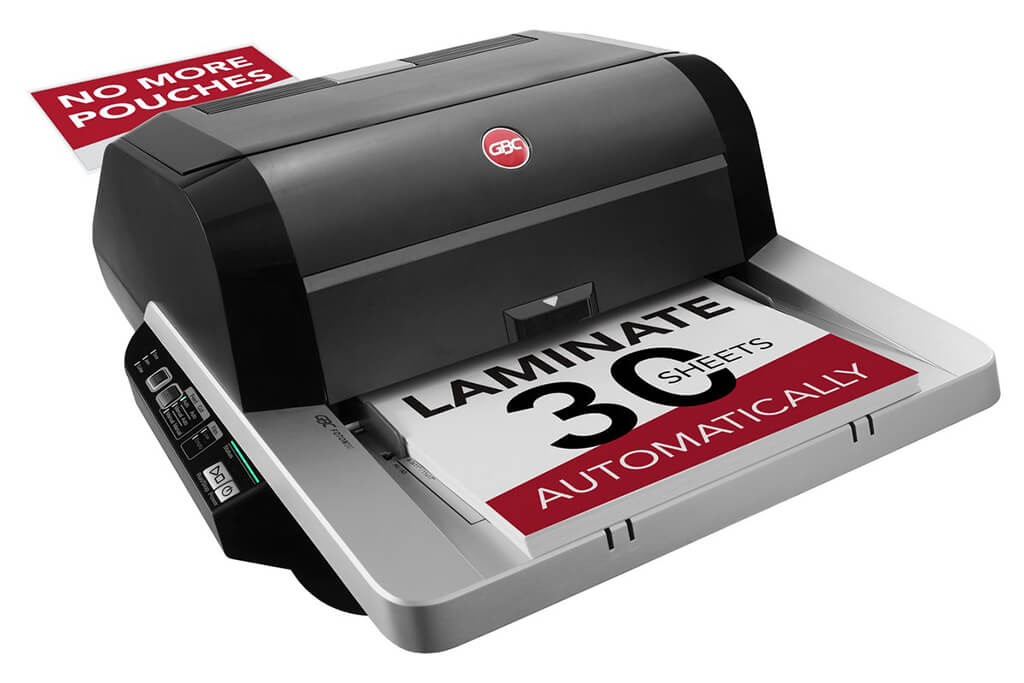
Image Source: ACCO Brands Corporation Official Site
(https://www.gbc-machines.com/products/gbc-foton-30-automatic-laminator)
(https://www.gbc-machines.com/products/gbc-foton-30-automatic-laminator)
Example facilities
Schools, hospitals, municipalities, etc.
Reasons for recommendation
Automates small-scale operations with fewer personnel
- With the push of a button, automatically laminates 30 sheets of A4 paper in 15 minutes. Its size allows it to be placed on a desk, making it easy to install.
- By fully automating the process from feeding to lamination, it enables the handling of jobs with low daily processing volumes in parallel with other operations.
The fact that it does not require dedicated operators or subsequent processes makes it suitable for small-scale sites.
| Maximum processing speed | 7.0 m/min |
|---|---|
| Maximum width | 297 mm (A3 compatible) |
| Warm-up | about 4 minutes |
| Processing type | roll type, double-sided (with borders) |
| Voltage (CE) | AC220 to 240V |
| Main unit dimensions | W 580 mm / D 440 mm / H 250 mm |
[About 1,000+ sheets per month]
Medium-lot production
Medium-lot production
Revo-Flex
(Lami Corporation)
(Lami Corporation)
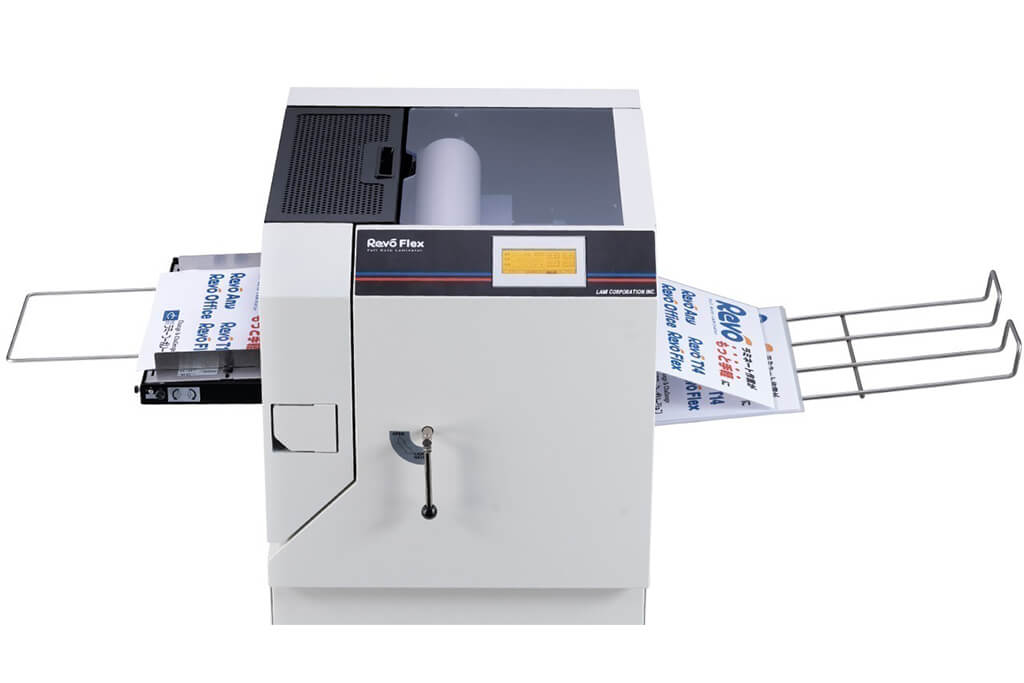
Image source: LAMI Corporation Official Website
(https://www.lami-corporation.co.jp/english/products/detail/51)
(https://www.lami-corporation.co.jp/english/products/detail/51)
Example facilities
Output centers, design offices, franchise headquarters, etc.
Reasons for recommendation
High-mix, fast-turnaround jobs are efficient through process reduction
- Completes trimming simultaneously with lamination, eliminating the need to move to subsequent processes or separate equipment.
Eliminates bottlenecks that tend to occur in on-demand printing and production sites. - High-precision automatic four-side trimming reduces trimming errors resulting from manual work, reducing film loss and the hassle of reprinting.
Even at sites with high-mix, small-lot production, it processes efficiently with consistent quality.
| Maximum processing speed | 2.0 m/min |
|---|---|
| Maximum width | 320 mm (SRA3 standard) |
| Warm-up | about 5 minutes *1 |
| Processing type | roll type, double-sided (border on/off selectable) |
| Voltage (CE) | AC230V |
| Main unit dimensions | W 1,300 mm / D 610 mm / H 1,080 mm *2 |
[10,000+ sheets per month]
High-lot production
High-lot production
Mini 76 TH
(Autobond Laminating)
(Autobond Laminating)
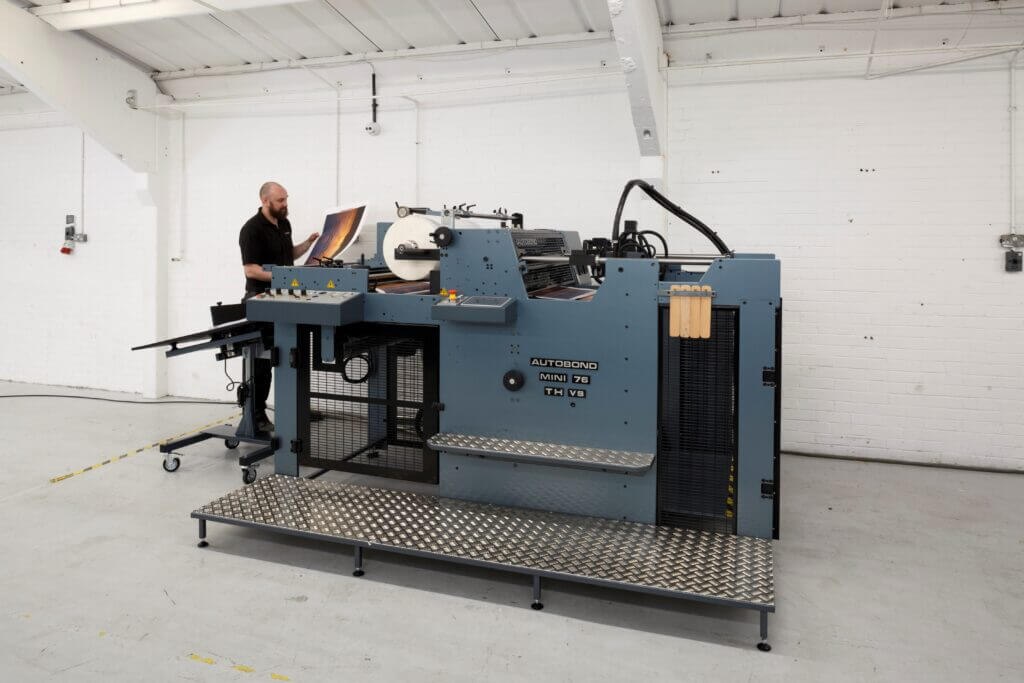
Image source: AUTOBOND Official Website
(https://www.autobondlaminating.com/machinery/thermal-lamination/mini/mini-76-th/)
(https://www.autobondlaminating.com/machinery/thermal-lamination/mini/mini-76-th/)
Example facilities
Printing factories, bookbinding lines, etc.
Reasons for recommendation
High-speed, continuous processing that can be integrated into mass-production lines
- Uses a steel side plate with a thickness of 20 mm described as sturdy like a tank. This rigid structure physically eliminates vibrations even at high-speed operations of 60 m per minute, maintaining stable processing accuracy.
- With a processing capacity of 60 m per minute, it can continuously handle large-format prints stably.
It demonstrates its true value when introduced as a part of a production line rather than as a standalone machine.
| Maximum processing speed | 60.0 m/min |
|---|---|
| Maximum width | 760 mm (B1+ compatible) |
| Warm-up | inquire for details |
| Processing type | roll type, single-sided or double-sided (borderless) |
| Voltage (CE) | inquire for details |
| Main unit dimensions | inquire for details |
*1. At 100°C (212°F) setting
*2. Dimensions when assembled, including the stand, tray, etc.